
Using Soap Bubbles and High-Speed Cameras: Flow Research on Quadcopters

DLR
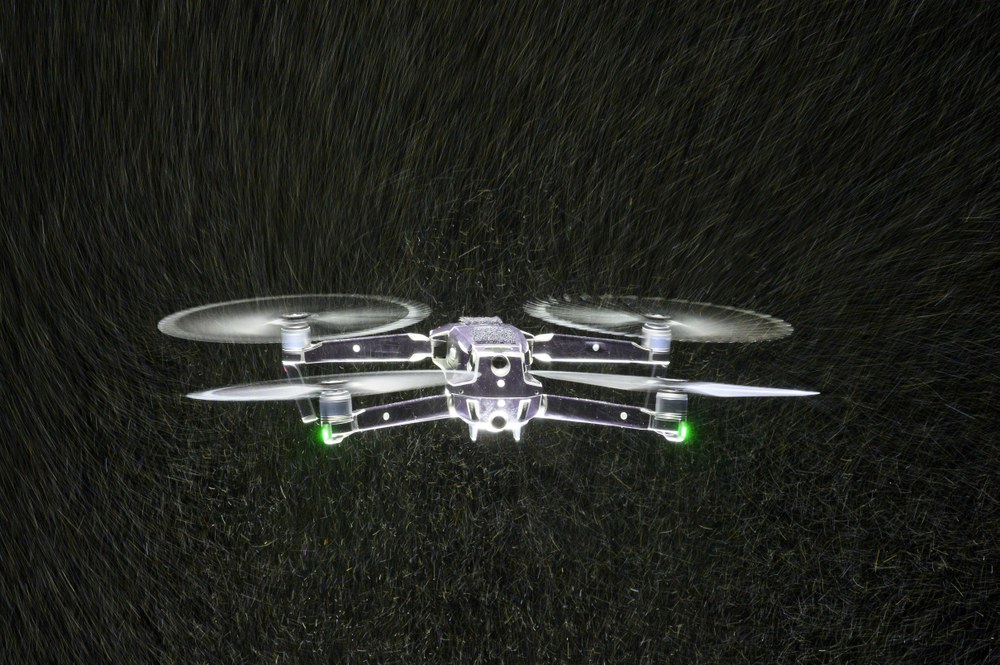
Modern quadcopters are playing an increasingly important role in many fields today – from aerial filming and rescue missions to future air taxi concepts. To make these aircraft more efficient, quieter and safer, it is essential to gain a better understanding of how air behaves around the rotors during different flight manoeuvres. This is precisely what researchers from the Institute of Aerodynamics and Flow Technology investigated within the DLR project Urban Rescue using a truly unique measurement technique.
Research Objectives
The researchers sought to gain a deeper understanding of how air moves around a quadcopter during flight. The study focused on the following key questions:
- How do airflow patterns change during different flight manoeuvres, such as hovering, take-off and forward flight?
- What influence does the surrounding environment – particularly proximity to the ground – have on flight behaviour and the resulting vortex structures?
- How can these findings be used to improve the performance and safety of future drones and other vertical take-off and landing aircraft?
The following flight conditions were investigated:
- Hovering
- Forward flight
- Take-off and landing manoeuvres
- Flights with and without ground effect
The term “ground effect” describes the influence of the ground on the airflow beneath the quadcopter.
DLR
An Unusual Experimental Setup
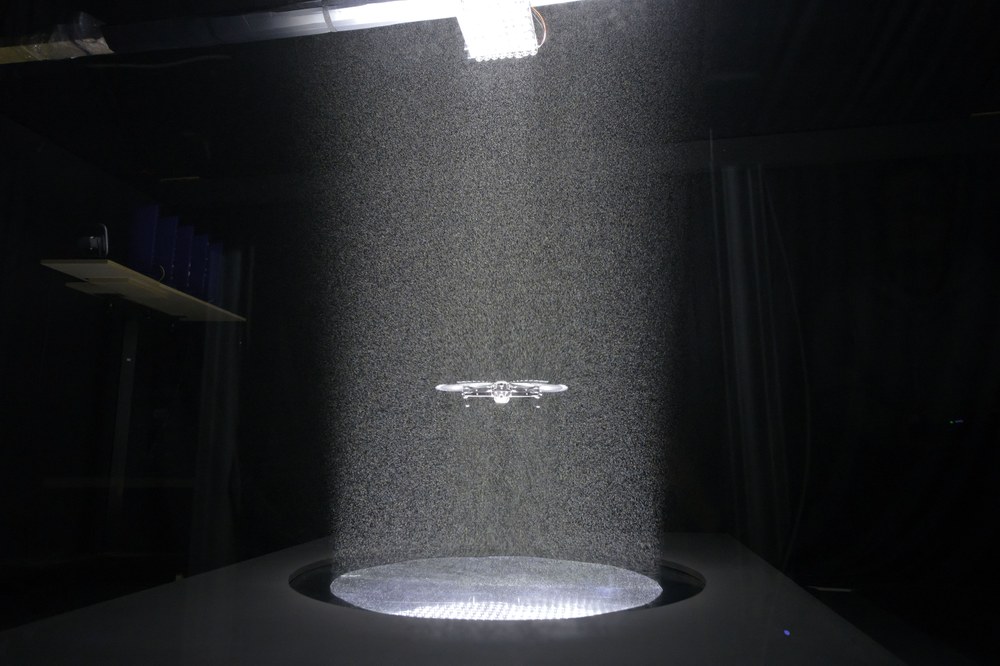
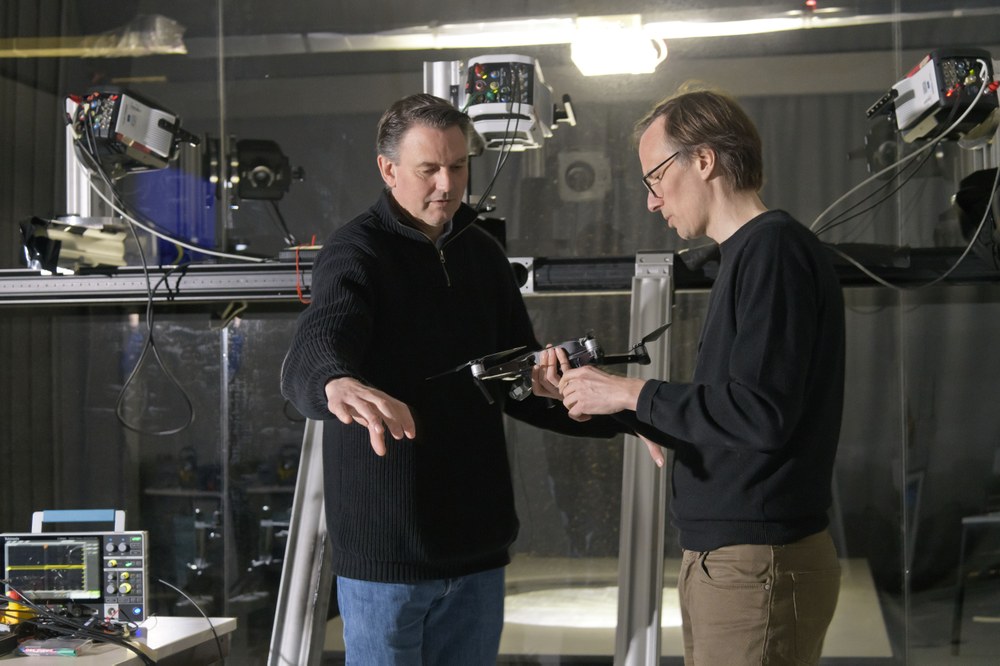
The study was carried out using a remotely controlled quadcopter weighing 915 g and measuring approximately 0.5 m in span. To make the airflow visible, a large test facility was filled with several hundred thousand helium-filled soap bubbles. These tiny tracer particles had a diameter of approximately 350 micrometres and are so light that they follow the airflow almost perfectly.
Five high-speed cameras recorded the motion of the particles at a frame rate of 3 kilohertz, while around 1,600 high-power LEDs illuminated the measurement volume.
A key feature of the experiment was DLR’s patented Shake-The-Box (STB) method. This technique makes it possible to track the motion of individual tracer particles over time and combine the resulting trajectories into a detailed three-dimensional representation of the airflow. As a result, several hundred thousand particles could be analysed simultaneously – significantly more than with conventional methods.
For the first time, this enabled researchers to visualise the three-dimensional airflow around a freely flying drone with exceptionally high spatial and temporal resolution.
Challenges in Flow Measurement
One of the main challenges was that the quadcopter itself moved within the measurement volume. Rotors, shadows and reflections normally make such measurements considerably more difficult.

Ground effect in forward flight
Your consent to the storage of data ('cookies') is required for the playback of this video on Quickchannel.com. You can view and change your current data storage settings at any time under privacy.
DLR
However, specialised camera technology and advanced image-processing techniques made it possible to minimise these disturbances and reliably track the tracer particles.
What the Measurements Revealed
The measurements clearly demonstrate just how complex the airflow around a quadcopter really is.
Strong Rotor Interactions
Each of the four rotors generates its own vortex system. These vortex structures meet beneath the drone and interact with one another. Particularly during hovering flight, this results in highly dynamic and turbulent flow structures.
Ground Influence
When the drone operates close to the ground, the airflow is forced downward, impacts the surface and then spreads outwards. This generates additional vortices and recirculating flow structures. Under certain conditions, a so-called “fountaining effect” can even occur, where air is pushed back upwards beneath the centre of the vehicle.
Relevance for Future Aircraft
These findings are not only scientifically significant but also highly relevant for practical applications.
The results contribute to:
- Improving drone stability and efficiency
- Reducing energy consumption
- Better understanding sources of noise
- Enhancing flight-control systems
- Minimising safety risks during take-off and landing
Based on the measured particle trajectories, the researchers used DLR’s data-assimilation technique FlowFit3.0 to reconstruct the three-dimensional airflow around the drone with even greater accuracy. This made it possible to analyse the complex, highly unsteady airflow and the resulting vortex structures in detail.
Of particular interest is the interaction between rotor wakes and the ground. This interaction plays a major role in determining how air moves beneath and around the aircraft.
The detailed analysis of these vortex dynamics helps improve our understanding of phenomena such as brown-out – situations in which airborne particles stirred up by the aircraft severely reduce visibility. It also provides valuable insight into how particles are transported and distributed near the ground.
Furthermore, a better understanding of flow dynamics contributes to identifying potential aeroacoustic noise sources and fluctuating aerodynamic loads during flight manoeuvres, helping to optimise future drone systems.
DLR
Looking Ahead
The measurement methodology is expected to be applied to larger aircraft in the future, including air taxis and modern VTOL aircraft capable of vertical take-off and landing.
The next phase of research will involve further experimental investigations using the same measurement approach. As part of the follow-up project ROME (Rotor Multidisciplinary Methods and Experiments), particular attention will be given to airflow behaviour around rotorcraft operating close to the ground.
The extensive three-dimensional, time-resolved flow dataset will continue to be analysed in collaboration with project partners in order to derive and better understand key aerodynamic parameters.
The analysis methods themselves are also being further developed. Highly unsteady flow processes will be investigated using modern data-driven approaches, including methods such as SPOD and PINNs, which mathematically decompose and analyse complex flow patterns. The aim is to gain a deeper understanding of unsteady and recurring flow phenomena and to support future scientific publications.
The measurements provide a unique insight into the otherwise invisible world of airflow around quadcopters. Using state-of-the-art measurement techniques, researchers have been able to visualise highly complex vortex structures that are crucial for the stability, safety, efficiency and acoustic performance of future aircraft.
Further Links: