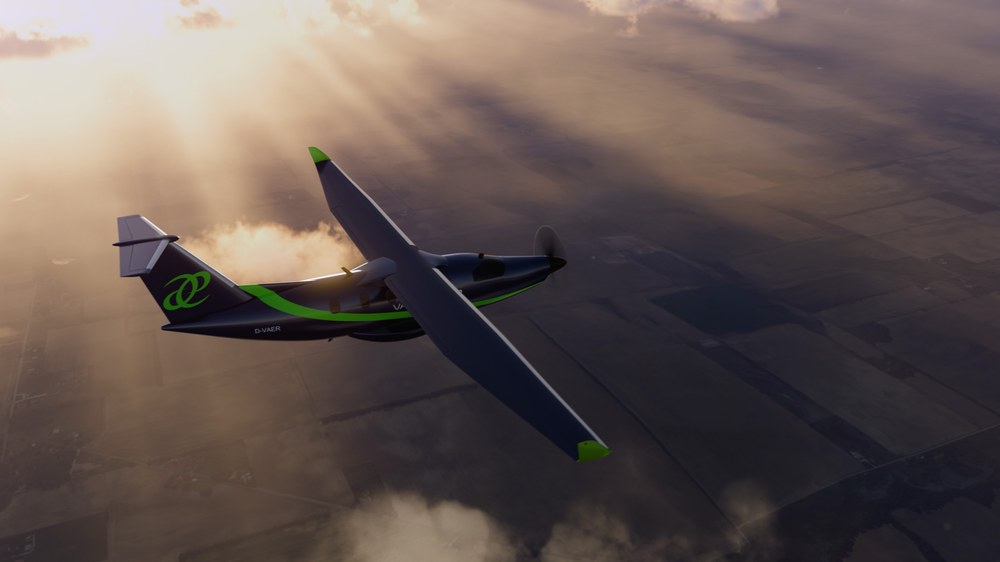
The decarbonisation of aviation requires new propulsion concepts for short- and medium-haul aircraft. Battery-electric propulsion systems offer significant potential. However, the considerably lower energy density of batteries compared with conventional energy carriers makes highly efficient aerodynamic aircraft design essential.
For this reason, in the BREEZE project, we are developing, characterising and evaluating aerodynamic key technologies for future battery-electric regional aircraft together with our consortium partner VAERIDION. The focus is on reducing aerodynamic drag both at high-lift conditions and in cruise flight for a battery-electric regional aircraft with wing-integrated batteries. The project aims to establish a robust experimental database for high-aspect-ratio wings with relatively thick aerofoils and maximum possible laminar-flow extent. To achieve this, we combine numerical investigations with two wind tunnel test campaigns over a period of 30 months.
Our work focuses in particular on:
Laminar flow and surface contamination: Investigation of the effects on the laminar boundary layer of surface contamination, such as manufacturing imperfections, insect debris and icing, as well as derivation of operational guidelines for anti-icing and de-icing strategies.
High-lift components: Aerodynamic optimisation and experimental characterisation of high-lift systems and flap-track fairings.
Experimental and numerical validation: Experimental validation of numerical tools and provision of reliable predictions for aircraft performance and range as basis for future aircraft certification.
At the DLR Institute of Aerodynamics and Flow Technology, we investigate the stability and transition of laminar boundary layers on comparatively thick aerofoils via numerical stability analyses and experimental transition investigations across the relevant parameter range for aerodynamically smooth surfaces. To quantify the extent of laminar flow in the presence of leading-edge contamination, we identify relevant surface disturbances such as manufacturing imperfections, insect contamination and icing, and analyse their influence on boundary-layer stability and transition using both numerical and experimental methods. We quantify the resulting drag increase relying on the experimentally determined shifts in the transition front and complementary numerical methods.
To investigate the boundary-layer evolution, we qualify the Temperature-Sensitive Paint (TSP) measurement technique for low-speed applications. In addition, we develop a high-lift system for unswept wings of battery-electric regional aircraft from an aerodynamic and kinematic perspective, and design flap-track fairings that reduce the overall drag of a generic, industrially relevant cruise-flight configuration in steady level flight.
BREEZE contributes to accelerating the market introduction of climate-friendly regional aircraft and strengthening Europe's technological leadership in zero-emission aviation.