Improved Simulation Methods for Installed Aircraft–Engine Aerodynamics
ENVISION
Engine Inlet
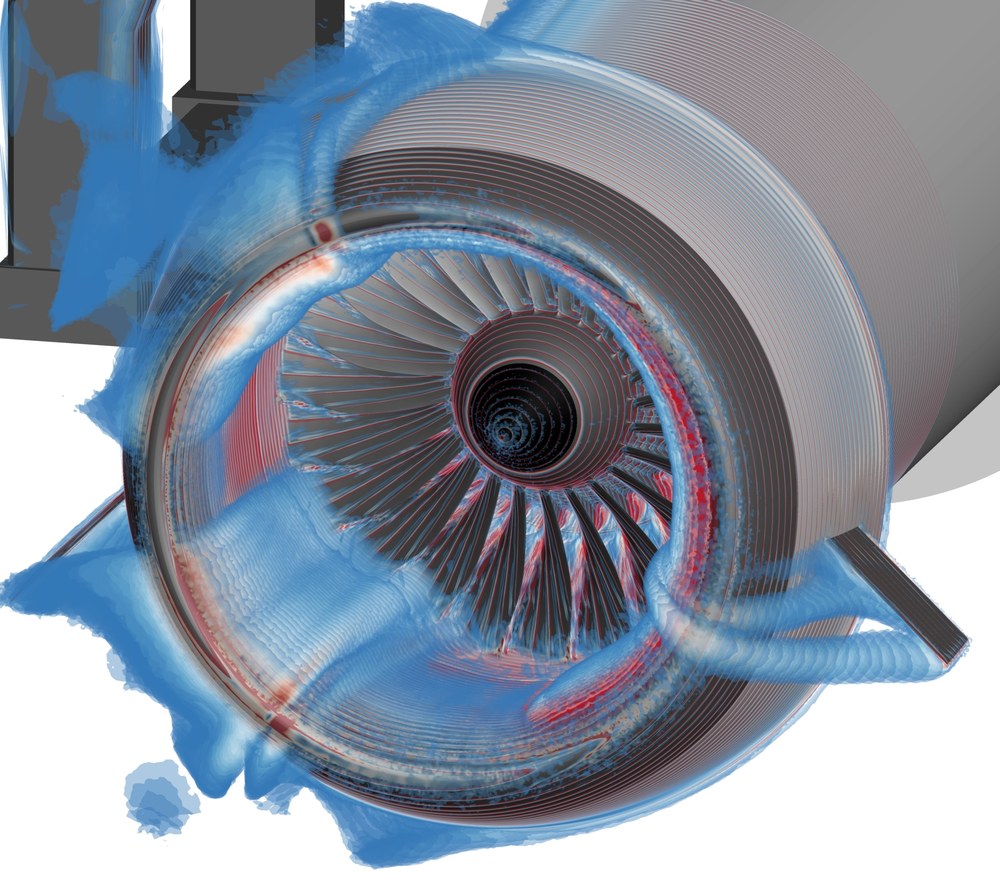
Numerical simulation of an engine inlet in order to precisely determine the effects of crosswinds on the aerodynamics of the fan stage (setup from the predecessor project PRESTIGE)
Credit:
Rolls-Royce Deutschland
Europe’s climate targets in aviation can only be achieved through substantial aerodynamic improvements of the overall system, comprising both the aircraft airframe and the propulsion system. At the edges of the flight envelope, these components interact closely. To reliably predict these effects already in the early design phases, novel simulation methods are required. These methods must capture the aerodynamics of the aircraft and the propulsion system in an integrated way, while being based on highly accurate turbulence-resolving approaches. Such methods, however, involve very high computational effort and require the use of modern high-performance computers with GPU-based accelerators (Graphics Processing Units), which are particularly efficient for parallel numerical simulations.
The LuFo collaborative project ENVISION, funded by the German Federal Ministry for Economic Affairs and Energy (BMWE), develops the methodological foundations for these simulation capabilities on modern GPU-based computing systems. The aim is to significantly increase the efficiency of installed aircraft engines in the future by gaining a better understanding of unsteady turbulent flow processes and their interactions within the overall system.
Our researchers are improving turbulence-resolving simulation methods, developing precise coupling strategies between specialised codes for external aerodynamics and engine flow, and enabling the efficient use of GPU accelerators in unsteady simulations. Together with the industrial partner and consortium lead, Rolls-Royce Deutschland, we demonstrate and validate the developed methods on application-oriented test cases. These include, for example, high-resolution simulations of an engine intake in crosswind to analyse disturbed fan inflow, as well as unsteady coupled simulations of the aerodynamic interactions between the aircraft and the installed engine.
Project
ENVISION - Skalenauflösende und gekoppelte Simulationsverfahren auf Höchstleistungsrechnern für die instationäre Aerodynamik des installierten Triebwerks
Term
1/2026 - 6/2029
Partners
Rolly-Royce Deutschland (Leader)
Technische Universität Dresden
DLR Institute of Aerodynamics and Flow Technology
DLR Institute of Software Methods for Product-Virtualization
Funding
Federal Ministry of Economic Affaris and Energy (BMWE), Aviation Research Programme (LuFo), ref. no. 20T2403B