Future enabLing technologies for hYdrogen-powered electrified aero engine for Clean aviatiOn
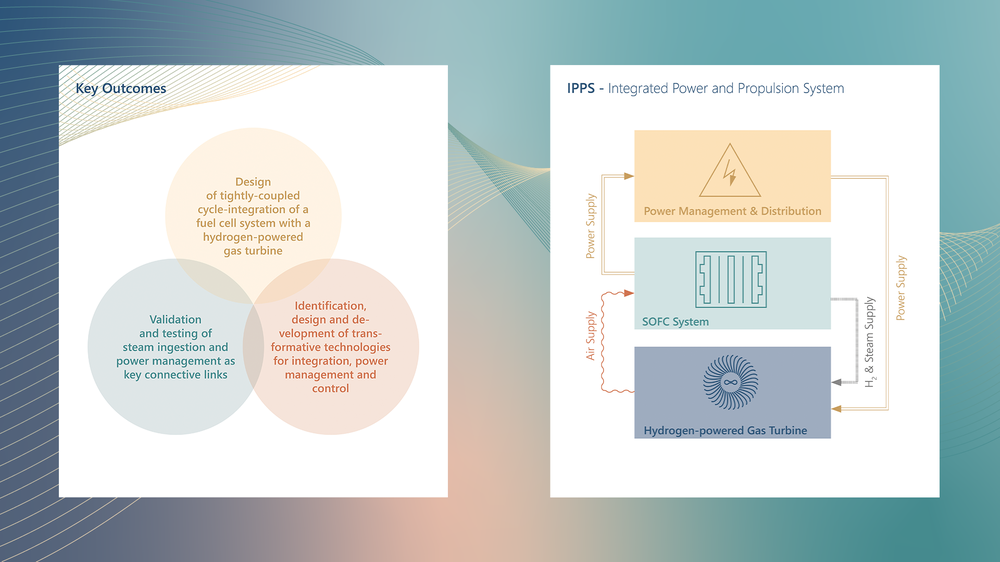
The EU project initiated by the EL Institute responds to the Horizon Europe call for the development of future technologies for a hydrogen-powered, electrified engine for clean aviation. The aim is to design a drive architecture that cyclically couples a fuel cell system with a hydrogen-powered gas turbine. The influence of vapour injection as an additional link and its influence on the reduction of emissions will be validated. In addition, transformative technologies for integration are being developed. Strategies for energy management and control of the system are optimised and verified.
Aviation’s carbon footprint poses a critical challenge to global sustainability, with emissions soaring as air travel becomes increasingly prevalent. Traditional jet engines burn fossil fuels, releasing CO2 and NOX into the atmosphere, exacerbating climate change. The urgency to decarbonise this sector is palpable, demanding innovative solutions to curb its environmental impact.
With this in mind, the EU-funded FlyECO Project offers a pathway to low-emission air travel and sustainable growth. Through the integration of innovative technologies like solid oxide fuel cells (SOFC) and the use of hydrogen as energy carrier, the project targets a 50 % reduction in NOX emissions while eliminating CO2 emissions altogether. The project’s simulation framework will help refine the integrated power and propulsion systems (IPPS) architecture, advancing towards real-world implementation. It will focus on commuter/regional aircraft class propulsion system.
FlyECO (Future enabLing technologies for hYdrogen-powered Electrified aero engine for Clean aviatiOn) is an EU project, initiated by DLR Institute of Electrified Aero Engines, in response to a Horizon Europe call to develop technologies for a hydrogen-powered, electrified engine for clean aviation.
FlyECO - Integrated Power and Propulsion System (IPPS)
Your consent to the storage of data ('cookies') is required for the playback of this video on Quickchannel.com. You can view and change your current data storage settings at any time under privacy.
FlyECO - Integrated Power and Propulsion System (IPPS)
FlyECO (Future enabLing technologies for hYdrogen-powered Electrified aero engine for Clean aviatiOn) is an EU project, initiated by DLR Institute of Electrified Aero Engines, in response to a Horizon Europe call to develop technologies for a hydrogen-powered, electrified engine for clean aviation.
Simulation and evaluation of the dynamic performance of GT, SOFC and batteries in a tightly coupled cycle-integrated hydrogen-based propulsion system of one megawatt.
Develop and mature necessary, transformative technologies for the coupling and the integrated operation of an airborne hybrid power and propulsion system of GT and SOFC.
Development of an overall controls approach to optimize power management and distribution of the IPPS and its validation in cyber-physical demonstrator of GT and SOFC coupling.
Cyber-physical demonstration for validation of TLR 3 of hydrogen combustion with steam ingestion to achieve zero CO2 emissions and at least a 50 % reduction in NOX emissions.
Contribution to Horizon Europe impact assessment, technical Committees, the Governing Board of the Clean Aviation and Clean Hydrogen partnerships, as well as the scientific community with a technology roadmap for GT-SOFC hybrid systems and open-access publication of datasets and models.
Funded by the European Union under grant number 101138488 and by the UK Research and Innovation (UKRI) funding guarantee under the project reference 10106893. Views and opinions expressed are however those of the author(s) only and do not necessarily reflect those of the European Union. Neither the European Union nor the granting authority can be held responsible for them.