Platform of a high-altitude aircraft design in kite configuration with growth potential for overnight flights
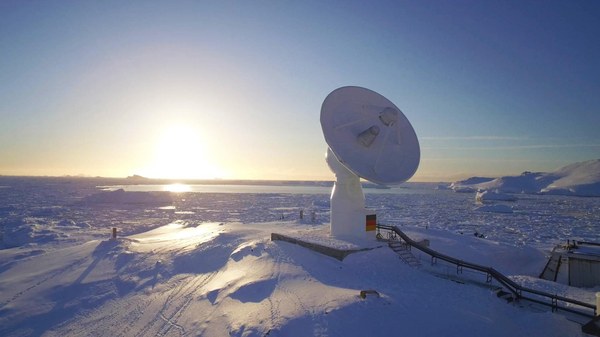
The HAP alpha platform has a comparatively robust design and is able to reach an altitude of over 15.5 kilometres at the potential flight test facilities in Sweden and Australia and remain there for two hours. The aircraft achieves this with a reduced solar generator and can still carry a payload of 5 kg. When the wing is fully occupied with a solar generator, this aircraft can achieve overnight flight capability. The ground segment is a deployable communication station with antenna, as well as an operations station for the remote guidance and testing team.
High altitude platforms (HAPs) continue to attract interest from research, industry and the military due to their great application potential in the field of earth observation. This also applies in particular to platforms that are used to test scientific experiments for new technologies and sensor concepts.
DLR has already demonstrated the benefits and advantages of such a solar platform in the previous cross-sectional project "High-Flying Unmanned Platform" (QSP HAP). The project also developed concepts for a solar-powered stratospheric aircraft, a deployable/mobile ground segment and two payloads from the field of earth observation. The payloads are a high-resolution optical camera system, MACS-HAP for short, and a radar with synthetic aperture, HAPSAR for short. These concepts were each transferred into a concrete technology demonstrator and developed within the project up to the finalised preliminary design (PDR).
This project is intended to build directly on the knowledge gained and development work carried out for HAP alpha in the cross-sectional HAP project. To this end, the work based on the preliminary design and the experience gained to date in the detailed design can be taken up and integrated into the further development of HAP alpha into a complete aircraft. The aircraft can then be subjected to a maiden flight at low altitude at the DLR flight test facility in Cochstedt. Following successful testing at low altitude, the first high-altitude flights with HAP alpha, initially with flight test instrumentation (FTI) and later with the sensor payloads (MACS-HAP and HAPSAR), can be carried out at flight test facilities in Sweden and Australia in a follow-up project.
Project goals
In addition to a large number of sub-results, the main project results include the available solar-powered high-altitude platform HAP alpha as a technology demonstrator and all associated results such as patents, publications and expertise.
The high-altitude platform is realised against the background of a multi-stage approach, whereby an aircraft with expansion potential from one stage to the next is created. The background to this is the gallium arsenide-based solar cells, which are the only ones suitable for high-altitude platforms and have already been tested. At around 90 k€/m², these are very expensive compared to other high-altitude platform components and cannot be removed without causing damage once they have been applied to the aircraft. For this reason, HAP alpha will initially be realised in expansion stage 1 within the project duration and tested at low altitude. Expansion stage 1 does not use a solar generator or a minimum surface area of approx. 1.5 m². The HAP alpha configured in this way can ascend and be tested up to around 8 km. This is sufficient to extensively test the flight characteristics and aircraft systems. The first test flights are expected to be carried out at the national drone testing centre in Cochstedt. Here, the flight test centre limits the flight altitude to a maximum of 500 metres. If the flight characteristics are satisfactory and the system has been successfully tested, the solar surface will be integrated for the high-altitude flights.
Testing at altitude will then take place in a further project successor via expansion stage 2 of the HAP alpha. This is equipped with a solar surface of around 12 m² and can ascend to altitudes of up to 20 km in suitable regions and remain there for around 2 hours. In principle, the HAP alpha already available in expansion stage 1 could be used and expanded for this purpose. The final expansion stage 3 of the HAP alpha has 22 m² of solar surface and batteries with a higher energy density and is potentially capable of flying overnight in suitable regions.
This expansion stage will not initially be considered in more detail in the project and probably also in the next project successor, as an update of the HAP alpha configuration with the findings of expansion stages 1 and 2 is likely.