Multidisciplinary methods and experiments for rotors (ROME)
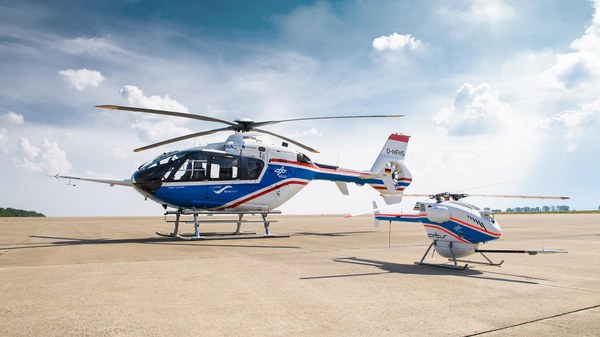
ROME serves to develop and provide validated digital tools that are used in the German and European aviation industry to develop new aircraft. The "ROME" project focuses in particular on various configuration variants of rotorcraft that are currently being discussed in industry and society, for example helicopters, multicopters or tiltwings.
For these configurations, the project enables the prediction of aeromechanics, aerodynamics, aeroelasticity and aeroacoustics with high reliability and accuracy. Furthermore, new process chains for rotor optimisation will be developed, which will enable the flight stability of new configurations to be analysed reliably and accurately. The expected project results are validated software tools, validation data and new measurement methods for the validation of rotor blade configurations.
Project goals
Construction of a new adaptive multi-rotor test rig (AMV), which serves to validate tools developed at DLR and used in industry to evaluate the aeromechanics and flight characteristics of new concepts
Experimental validation of rotor interaction models for tilt rotor configurations in hover and transition flight with regard to aerodynamics, aeroelasticity and aeroacoustics
Maturation of the existing, in principle functional optimisation chain (TRL/ARL 3-4) for helicopter rotors, into a strong coupling environment for aerodynamic design, structural design, powertrain analysis and aeromechanics for the design of new, optimised rotor blade sets with increased TRL/ARL (6)
Creation of a validation database for the decay and interaction process of rotor blade tip vortices and their turbulence spectra
Creation of a validation database for the propagation and distribution of the rotor outwash flow of a helicopter in hovering flight under the influence of wind
Validation of tools such as UPM and CODA for the aerodynamics and acoustics of rigid rotors in side flow with and without shrouding