
Modern product development faces a constant challenge: to design components that are more efficient, lighter and yet just as high-performing. In this context, lightweight design is not merely about reducing material usage, but rather about the strategic optimization of form and structure. Topology optimization is the key technology for this.
They enable the determinnation of the ideal distribution of material within a given design space, taking real loads into account. What results are structures that use material precisely where load-bearing capacity requires it, whilst eliminating unnecessary mass. However, the abstract results of an optimization require intelligent translation into designs suitable for manufacturing. This is precisely where we combine technological expertise with practical applicability: our expertise guides you from the initial simulation right through to the final design using our automated tool, TAKT.
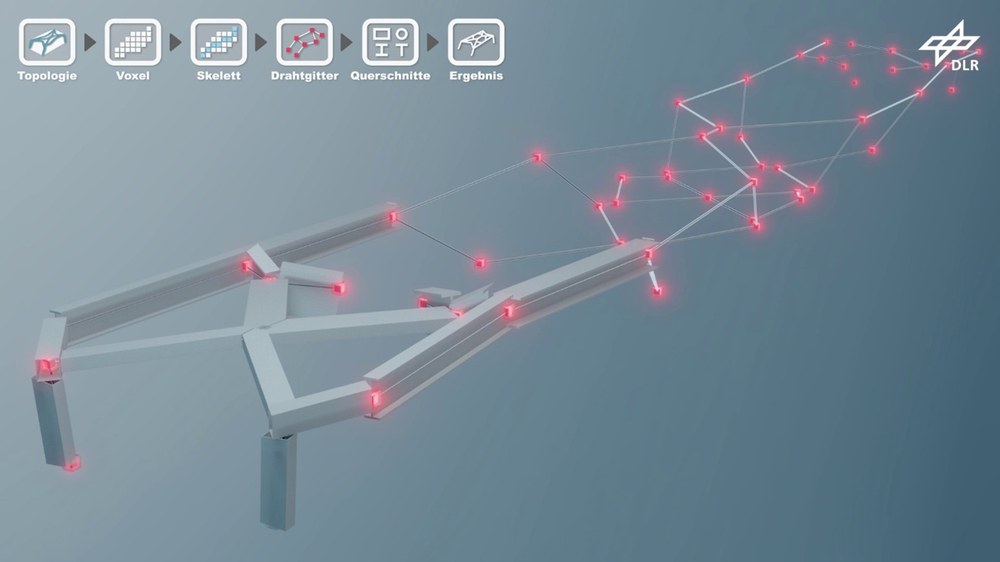
DLR TAKT Semi-automatic Design Tool
Your consent to the storage of data ('cookies') is required for the playback of this video on Quickchannel.com. You can view and change your current data storage settings at any time under privacy.
Areas of application
Originally developed for the complex requirements of rail vehicle construction, TAKT is designed for all industries that interpret and process topology-optimized structures in the form of trusses. In addition to vehicle construction, this also includes classical mechanical engineering with the development of both large and small lightweight components.
Our expertise: From topology optimization to a design proposal
We offer comprehensive expertise in carrying out topology optimization:
- Modelling and load case analysis: We create simulation models that realistically represent your components and structures, analyse your specific operating conditions and define suitable load cases
- Optimization and scenario studies: We use state-of-the-art topology optimization methods to unlock the maximum lightweight design potential of your structures and, where required, carry out parallel studies of different scenarios
- Design development: Our automated tool, TAKT, assists us in converting the optimization results into a manufacturable design
Output: A ready-to-use basis for design and validation
TAKT delivers a ready-to-use design proposal that can be utilized in three different ways:
1. A wireframe skeleton is generated. It represents the load paths from the optimization. It can be imported into CAD or FEM programmes and used for further processing.
2. Intelligent suggestions for cross-sections are generated based on an analysis of the stress distribution in the optimization result. They can also be imported into CAD or FEM programmes to begin the creative and customized development of the structures.
3. Automatic validation of the design proposal. Wireframe and cross-sections can be automatically combined with the original topology optimization setup (load cases, supports, etc.) in a new FEM model, enabling the design proposals to be automatically validated for structural integrity.
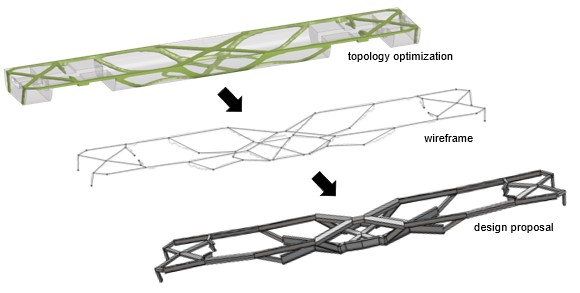

Advantages of lightweight construction with topology optimization and TAKT
The integration of TAKT into the development process offers measurable advantages. The fully automated workflow significantly reduces development time, as it eliminates the manual effort required to extract and assign geometric properties. Engineers are freed from monotonous tasks and can devote themselves fully to creative design work.
This allows different concepts to be implemented quickly and validated against one another, whether in terms of material selection, construction method, design principle or interfaces. This greater scope for exploration allows the full potential of lightweight design to be realized. TAKT thus supports a comprehensive lightweight design approach, starting in the earliest stages of development, whether as a standalone tool or as an integral part of our broad range of services.