
DLR joins new SESAR projects

SESAR Joint Undertaking
- DLR participates in 19 of 42 new SESAR projects to advance the Digital European Sky.
- Four DLR-led projects strengthen safety, sustainability, and innovation in aviation.
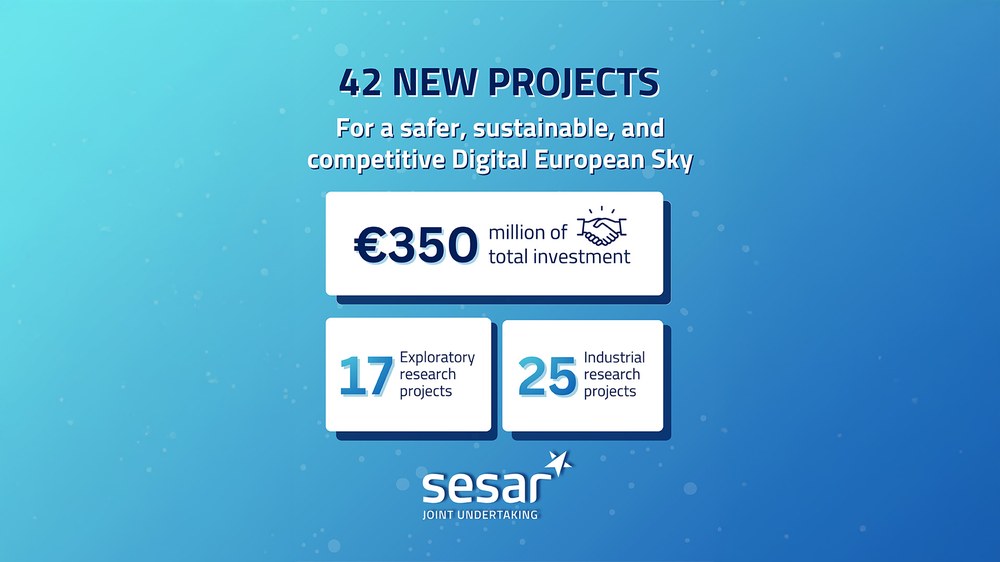
The SESAR Joint Undertaking has announced 42 new research and innovation projects aimed at making the Digital European Sky safer, more sustainable, and more competitive. These projects were selected from a pool of applicants in response to two research calls. The German Aerospace Center (DLR), a founding member of the SESAR 3 JU partnership, will participate in 19 of the 42 projects. This selection highlights DLR's strong position within European aviation research. The new SESAR projects represent a total investment of just over €350 million from the European Union and the aviation industry.
As part of the Digital European Sky call, these projects will focus on key enablers for the future of air traffic management, including automation, innovative air mobility, next-generation platforms, and air-ground connectivity.
The decisions now announced by the SESAR Joint Undertaking confirm the high quality and competitiveness of DLR’s contributions within the SESAR 3 programme. A substantial share of the submitted proposals has been selected, underlining DLR’s role as a trusted partner and driver of innovation at European level. DLR institutes will participate in 14 of the 25 Industrial Research projects and in 5 of the 17 Exploratory Research projects. These cover a broad range of topics, including higher airspace operations, future airport operations, the climate impact of contrails, and innovative air mobility.
Four of these projects will be led by DLR:
- The GARDA project enhances communication, navigation and surveillance (CNS) resilience by using dual‑frequency multi‑constellation satellite systems to mitigate interference such as jamming and spoofing to support safe and efficient flight operations.
- The DYN-MAX project develops solutions for ideal descents that reduce fuel consumption, emissions, and noise through improved flight management system functions and air traffic control tools and procedures.
- The EHRA project aims to provide a validated, regulator‑ready methodology for assessing human-automation interaction in highly automated civil and military air traffic management systems.
- The MEDUSA project develops a model‑based framework to ensure that AI systems used in safety‑critical applications are safe, secure, and transparent by design in line with EASA requirements.
These results reinforce DLR’s long‑standing commitment to collaborative research in Europe. Together with its partners, DLR continues to advance a safer, more efficient and more sustainable air traffic management system and to actively shape the future of the Digital European Sky.