Real-time intelligent support for selecting an alternative airport
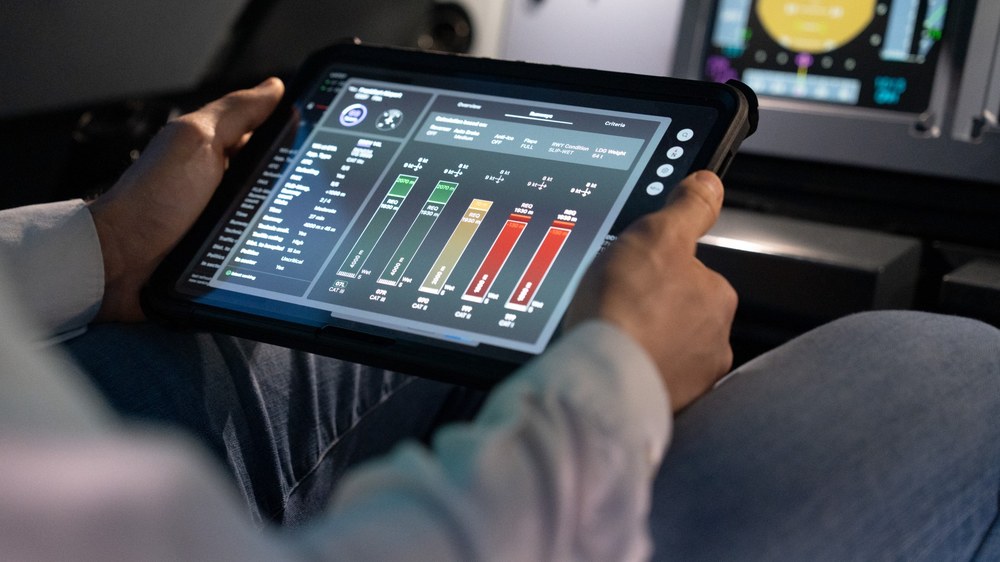
Unforeseen events during a flight, such as medical emergencies, technical issues, or sudden changes in weather conditions, require pilots to make rapid and well-informed decisions. One of the most important measures in such situations is the selection of a suitable alternate airport. In doing so, the flight crew is often under significant time pressure. They must weigh numerous influencing factors from various information sources while simultaneously choosing the safest and most efficient option (photo: DLR).
In practice, due to time constraints or insufficient information, crews often resort to nearby or familiar airports, even though better alternatives may exist. A comprehensive comparison of multiple alternate airports while considering a wide range of parameters is not feasible for humans in real time.
This is exactly where the Hawkeye project comes into play. Hawkeye is a system designed to be integrated into the Electronic Flight Bag (EFB) in the airliner cockpit, proactively supporting pilots in the selection of alternate airports.
Enabling faster and safer decision-making in the cockpit
Hawkeye aims to improve and accelerate pilots’ decision-making in the event that a diversion becomes necessary. To achieve this, an intelligent system is being developed that continuously evaluates potential alternate airports and prioritizes them in real time while considering safety-related, technical, logistical, and political aspects.
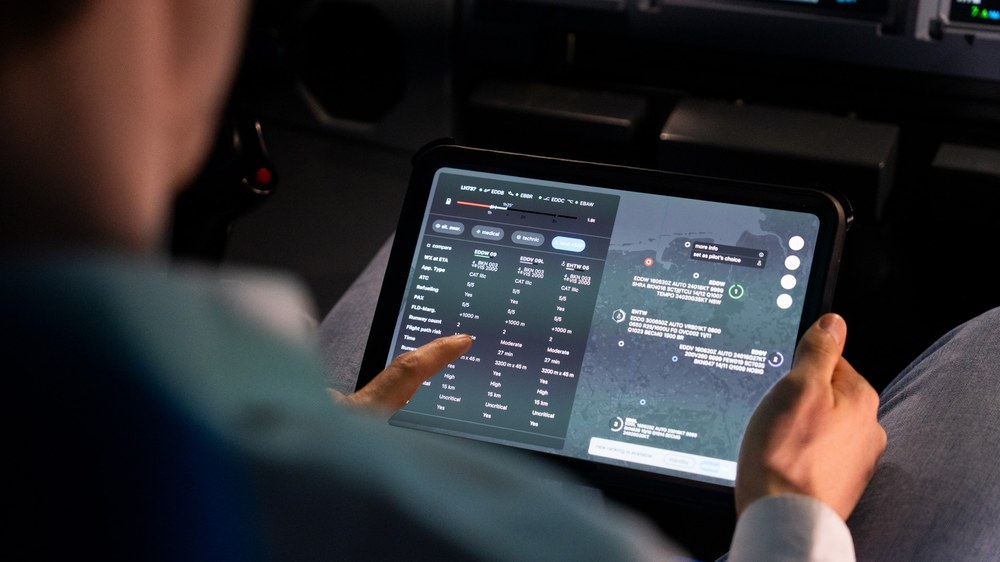
During a flight, the suitability of nearby airports as potential alternate airports in an emergency continuously changes. Hawkeye constantly analyzes and compares relevant parameters in order to always display the three optimal airports. Up to 15 factors are analyzed per airport, and the results are clearly visualized within the app. This allows pilots to directly compare potential alternate airports.
Hawkeye consolidates information from multiple continuously updated aviation databases. In addition, pilots have the option to have user-selected airports evaluated by the system. The airport assessment can be adapted to the current flight situation. Depending on whether the scenario involves a medical emergency, a technical aircraft malfunction, or the need for an immediate landing, Hawkeye applies different weightings to the parameters. In this way, the app consistently recommends the most suitable alternate airports.
Technological approach
The development of Hawkeye is based on a modular system architecture that can be seamlessly integrated into existing EFB systems. Hawkeye accesses a wide range of up-to-date data sources, including weather data, current notices such as NOTAMs, geopolitical information, technical airport infrastructure, medical facilities, and data related to the technical condition of the aircraft. By integrating aviation-certified data providers, Hawkeye has access to a large volume of live data and databases.
The underlying evaluation logic dynamically weights the individual factors depending on the flight situation to generate an overall ranking of airports suitable for landing. The assessment is continuously updated along the flight route and presented in a visually intuitive manner, ensuring that pilots maintain a reliable overview at all times.
Validation and technology transfer
As part of the project, the new Hawkeye system will be integrated into an EFB system and subsequently tested under realistic conditions in multiple validation phases. At the Institute of Flight Guidance, several flight scenarios will be simulated in collaboration with pilots. To validate the system’s support effect, these scenarios will be flown in the institute’s flight simulator both with and without Hawkeye support.
Expert feedback from the pilots will be systematically collected and analyzed. The results of this study will be incorporated into subsequent development iterations. Through this user-centered, iterative development approach, the needs of future pilots remain at the core of the system design. A primary objective is to establish appropriate and justified trust in the application through a well-designed user interface.
In later phases, Hawkeye will also be tested under real operational conditions during flights with European airlines. During various long-haul flights, pilots will validate the system directly in the cockpit. These studies will further contribute to optimizing the overall system and the app, while also providing valuable insights into its actual added value in cockpit operations.
Benefits and prospects
Hawkeye represents a system with the potential to sustainably improve safety and efficiency in air traffic. In critical situations, pilots are provided with a data-driven, intelligent decision-support tool to identify the best possible alternate airport.
In the long term, the technology can also be transferred to additional application areas, such as special-mission flights, medical air transport, or ground-based planning tools. The integration of future AI-based assistance systems is also conceivable.
The project advances the digital transformation of aviation and serves as an exemplary case of how intelligent assistance systems can effectively support human decision-making.
If you have any questions about the project or would like a demonstration of the app, please contact us!