
Ship deck simulator for maritime UAS
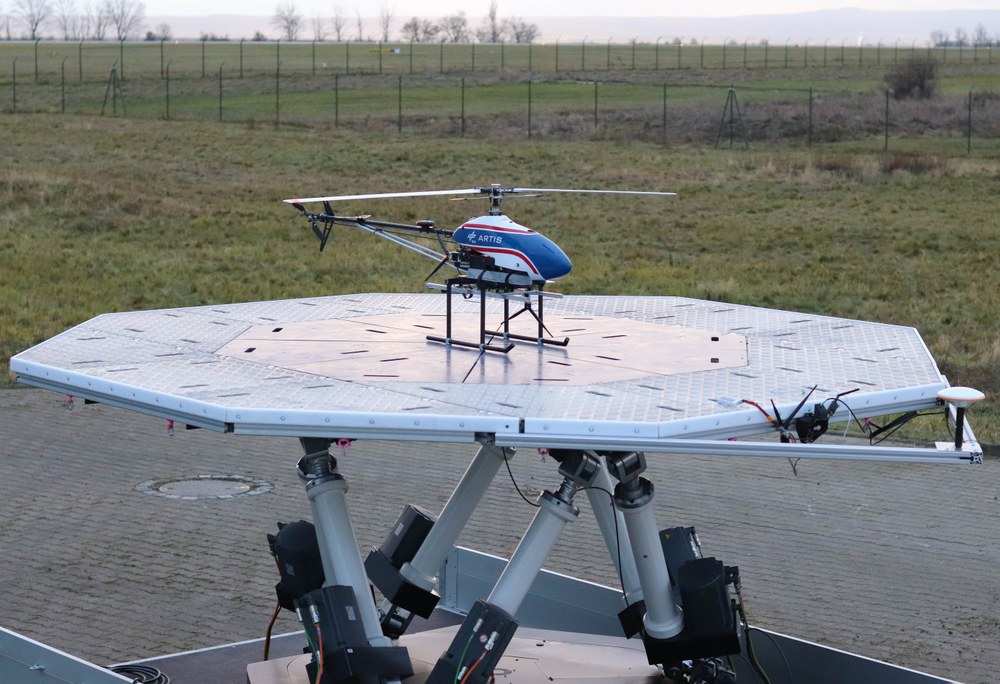

Motion platform enables controllable simulation of ship movements
The fully automatic take-off and landing of unmanned aircraft systems (UAS) on and from ships is among the greatest challenges for successful maritime operation, due to the harsh conditions at high sea.
At the department of Unmanned at the DLR Institute of Flight Systems, as well as at many other research sites across Europe, innovative solutions are being developed to equip UAS with this capability.The problem: The gap between simple laboratory experiments or land-based flights to testing on a real ship in open seas is often far too large.The solution: The ship deck simulator, which is being further developed and operated in close collaboration with colleagues from the National Experimental Test Centre for Unmanned Aircraft in Cochstedt.The simulator provides full control over ship motions, which can be reproduced for any sea state from calm conditions to storm-level scenarios depending on the maturity of the technology being tested. In this way, the gap between laboratory experiments and real-world testing at sea can be effectively further closed.
The simulator consists of a landing platform for small to medium-sized unmanned aircraft (up to 100 kg total mass), which can be configured to resemble either a ship’s landing deck or a vertipad. The landing deck is mounted on a motion platform capable of rotating around all axes and moving both horizontally and vertically, in order to reproduce realistic ship movements. To enable rapid deployment at different locations and to simulate a ship’s forward motion, the platform is mounted on a road-legal trailer and can even be operated while being towed by a vehicle. The platform is equipped with its own instrumentation system that measures motion and position data, which can be transmitted to an approaching drone. Depending on the technology under development, the modular landing deck can be adapted in a variety of ways, e.g., by adding markings, lights, data links, perforated plates, or even winches at low cost.
Highlights of the ship deck simulator
- Simulation of ship motions – Large angles and significant travel ranges enable the reproduction of a wide variety of sea states. Simple protocols and interfaces allow the use of various data sources.
- Adaptable landing area – The 4 m × 4 m landing surface is modular in design and can be quickly and cost-effectively expanded or reconfigured.
- Flexibility through trailer mounting – The platform is road-legal and can therefore be deployed flexibly. On the test site in Cochstedt, it can be towed at any desired speed by a vehicle. Thanks to a powerful generator, power supply is not an issue.
- Integration of common sensors – Satellite navigation and onboard sensors record the position and motion of the platform, either for data storage or to provide information to the approaching UAS.
Contact
Dipl.-Ing. Johann Dauer