Future Air-to-Air Refuelling Augmented, Assisted and Automated Operations
FARAO
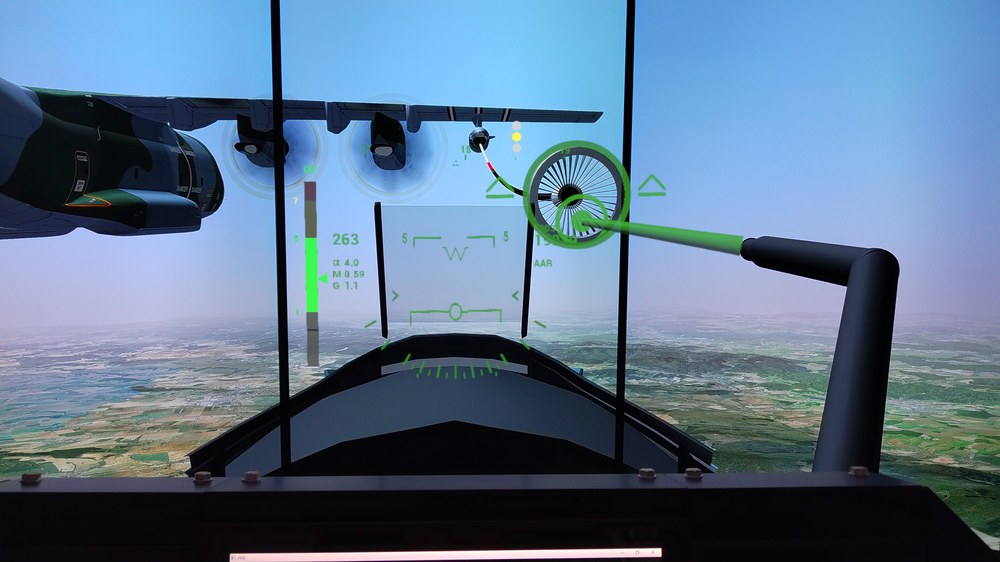
Air-to-Air refuelling (AAR) performed in MARS-FIT simulator with activated assistance systems
Additional information is displayed in the head-up display to assist the pilot with estimating the relative speed between the refueling basket and the refueling probe. A pointer, projected from the refueling probe, is designed to assist in the precise insertion of the refueling probe into the refueling basket. If necessary, additional information is displayed on the refueling drogue as an assistance system to facilitate the estimation of relative speed and the refueling process in poor visibility or at night.
The ability to conduct aerial refuelling safely and reliably, even under difficult conditions such as turbulent air or during operations at night, is essential for the success of military operations. The prevalent system in use in Europe is the probe and drogue system where a refuelling probe attached to the receiver aircraft must be flown manually into a drogue that is attached to the tanker aircraft. This requires a significant amount of training, harbours an increased risk and is a situation that is associated with increased stress even for very experienced pilots. As part of the research project FARAO (Future Air-to-Air Refuelling Augmented, Assisted and Automated Operations), assistance systems to support manual air-to-air refuelling and automation concepts for fully automated aerial refuelling are developed and tested on the institute's own simulators for fighter aircraft, transport aircraft and helicopters. In addition, the adaptation of automation functions to unmanned aerial vehicles and the related sensor technology is investigated and flight-tested in the unmanned aerial vehicle test centre in Cochstedt.
From theory to practical evaluation
Two different simulation environments are available for a practical evaluation. Their ability to realistically depict the air-to-air refuelling process will also be further improved in the frame of this project. The Military Air Vehicle Simulator - Fast Integration Testbed (MARS-FIT) is used for the evaluation of fighter aircraft, while the Air Vehicle Simulator (AVES) is used for transport aircraft and helicopters test with their respective cockpit units. Since only military pilots have practical experience in the field of air-to-air refuelling, the evaluation of the assistance and automation functions that are developed in the frame of FARAO is carried out with aircrews of the German Armed Forces in cooperation with various departments of the Bundeswehr.
Essential research to obtain a relative position between two aircraft in flight
In order to be able to implement automated air-to-air refuelling in practice, the receiver aircraft must know its relative position to the tanker aircraft and the refuelling drogue. To determine the aircraft position relative to the tanker, it is planned to install a mobile GLASS station in an A400M transport aircraft. GLASS stands for GLS approaches based on SBAS. This system provides signals that the receiver aircraft uses to carry out a landing (GLS is short for GBAS Landing System). In this context a virtual runway is generated for the approach to the tanker aircraft.
To determine the aircraft position relative to the refuelling drogue, an AI model is trained to automatically recognise the drogue based on synthetic sensor data. In a second step the system is validated with real sensor data that are obtained in a scaled flight test with unmanned aerial vehicles.
System for assisted and automated AAR (Air-to-Air refuelling)
The assistance systems that are developed in the frame of FARAO include the display of additional information in the pilot’s field of view using augmented reality (HoloLens 2) to improve situational awareness. In addition, semi-automated concepts that directly affect the control system are developed to relieve the pilot of part of the control task by.
An additional means to improve air-to-air refuelling is the “Smart Drogue” concept. For this concept the air refuelling basket is equipped with additional aerodynamic control surfaces in order to position itself independently in front of the refuelling probe of the receiver aircraft as it approaches.
Systems for fully automated AAR envisage the automation of all phases of aerial refuelling, including contact establishment, contact maintenance and disconnection. The transition between the individual phases is analysed in particular.
All means of full or partial automatization additionally involve suitable human-machine interfaces and consider the question of whether pilots can build trust in the systems and whether the current system status can be tracked at all times. In addition to flight dynamics, the focus is hence always on the person in the cockpit.