
Study explores how bacteria exposed to Mars-like conditions affect the human immune system

- Joint study by the DLR-Institute of Aerospace Medicine and the Radboud University Medical Center in the Netherlands.
- Study analysed at how certain bacteria, after being exposed to conditions like those on Mars, interact with the human immune system.
- Paper on the study published in the scientific journal mBio.
- Focus: Space exploration, space medicine
A new study by the Institute of Aerospace Medicine of the German Aerospace Center (DLR) and the Radboud University Medical Center in the Netherlands has taken a closer look at how certain bacteria, after being exposed to conditions like those on Mars, interact with the human immune system. In earlier research, the team had already shown that some bacteria can survive in simulated Martian environments. Now, they’ve gone a step further to study how these bacteria affect human immune cells.
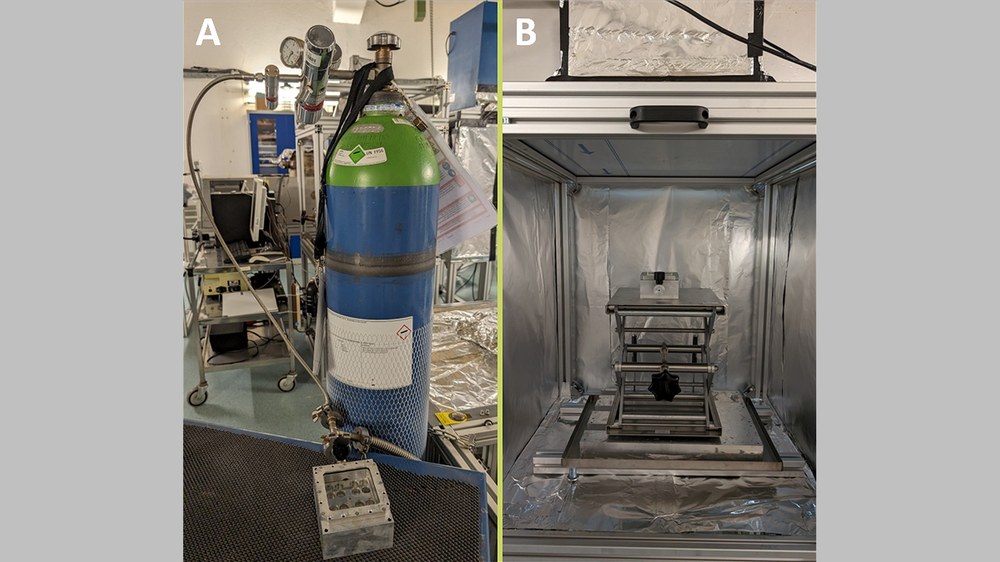
The experiments were carried out in Cologne, Germany, and Nijmegen, the Netherlands. The bacteria were first exposed by the authors to Martian-like conditions – such as low pressure, Mars-like atmosphere, strong ultraviolet (UV) light, and extreme dryness – using special simulation equipment at the DLR’s Astrobiology space simulation facilities at the Institute of Aerospace Medicine. After this, scientists tested how the bacteria affected human immune cells. These cells, taken from blood samples, were exposed to the bacteria Klebsiella pneumoniae and Serratia marcescens, which had been treated under Martian conditions. These bacteria are human pathogens and can often be found in the human microbiome.
The results showed that after exposure to the Martian conditions the bacteria changed in ways that affected how the immune cells responded. For example, the immune system released different levels of certain signaling molecules (called cytokines), and the ability of the immune cells to clear the bacterial infection (through a process called phagocytosis) was also altered. Immune cells also released different reactive oxygen molecules – another tool the immune system uses to fight infections – compared to standard conditions. However, once the bacteria were grown again under normal conditions after being exposed to the Mars simulation, the immune system responded to them as usual. This suggests that while the bacteria can temporarily change under Martian conditions, they don’t become unrecognizable to our immune system after returning to Earth-like environments. The researchers also studied how the bacteria physically changed using microscopes, and found noticeable differences, especially after UV exposure and drying out.
Investigations are important for the preparation of future human missions to Mars
This study is important because these types of bacteria can naturally live in the human body, meaning they could potentially travel with astronauts on future missions to Mars. Since space travel also weakens the immune system, understanding how bacteria behave in space-like environments is crucial.
The authors recommend that more studies should be done with other types of bacteria, and in living organisms, to better prepare for human missions to Mars.
Related links
- The paper “Effects of simulated Martian environmental stressors on specific human pathogen–immune system interactions” was published in the scientific journal mBio