
CARIOQA Research Spotlight: Space Weather Research
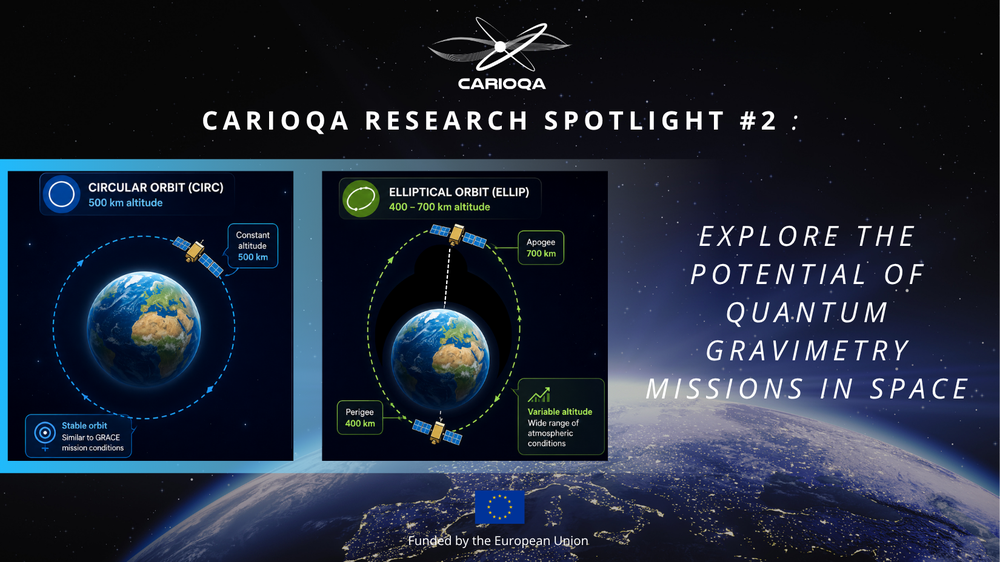

The CARIOQA Quantum Pathfinder Mission will test a quantum accelerometer in space for the first time. Data from this novel instrument could make an important contribution to measuring the density of the atmosphere at the satellite's orbit. A publication by the institute presents initial simulation results.
Space weather has a far-reaching impact on both satellites and terrestrial infrastructure. Among other things, solar activity excites the Earth’s atmosphere, so that as solar activity increases, the density of the atmosphere at the altitude of satellites in low Earth orbits also increases. This atmospheric drag affects the orbit by exerting forces, known as non-gravitational accelerations, on satellites and space debris. A precise understanding of the density of the upper atmosphere allows for more accurate orbit predictions during mission planning and helps prevent potential collisions between satellites and space debris.
The density of the atmosphere can be derived from measurements of these non-gravitational accelerations on satellites. An example of an operational mission that applies this principle is the GRACE-FO mission. This consists of a pair of satellites equipped with accelerometers to determine variations in the Earth’s gravitational field caused, among other things, by climate change processes. Using a 3D satellite model and data from the accelerometers that measure non-gravitational accelerations, the density at the satellite’s position is calculated.
Quantum accelerometers are a promising development that can overcome the limitations of classical sensors, such as those used on the GRACE-FO mission. The primary goal of this technological development is to produce higher-resolution models of the Earth’s gravity field, both in terms of time and space. An additional benefit is the ability to determine density from the acceleration measurements.
The study CARIOQA Quantum Pathfinder Mission for Space Weather Research (Open Access) analyzes the orbital options preferred in CARIOQA Phase A given the solar activity predicted at the time of the mission launch. It also examines the performance of the quantum accelerometer in measuring non-gravitational accelerations and the resulting atmospheric density. The results show that, for both evaluated orbital options, the instrument’s design specifications enable it to measure non-gravitational accelerations across a broad frequency band, thereby allowing for high-frequency density measurements along the orbit.
Further information about the publication is summarized in a fact sheet on the CARIOQA Quantum Pathfinder Mission website.