
Loading
CARIOQA
The CARIOQA (Cold Atom Rubidium Interferometer in Orbit for Quantum Accelerometry) project is a key European endeavour to secure the European Union's leading role in the development and application of quantum technologies in space. As part of the Horizon Europe programme, CARIOQA will lay the foundations for future high-precision space missions in gravity measurement as a quantum pathfinder mission.

Credit:
CARIOQA / G.A.C. Group
Under the leadership of the French space agency CNES, DLR and leading quantum research institutes, institutes for space geodesy and geosciences as well as partners from the space industry in France, Germany, Italy and Spain are working on the mission, which is scheduled for launch in the early 2030s
The main objective of the project is to develop and test a quantum accelerometer based on Bose-Einstein condensates in space and to assess its performance and limitations. The validation of this key technology in the real space environment will ensure that Europe has the necessary technological sovereignty to develop highly sensitive quantum sensors for satellites in the future.
Project phases
The individual steps for validating the technology and planning the Pathfinder mission will be carried out in various project phases, the specific content and objectives of which are described on the following pages:
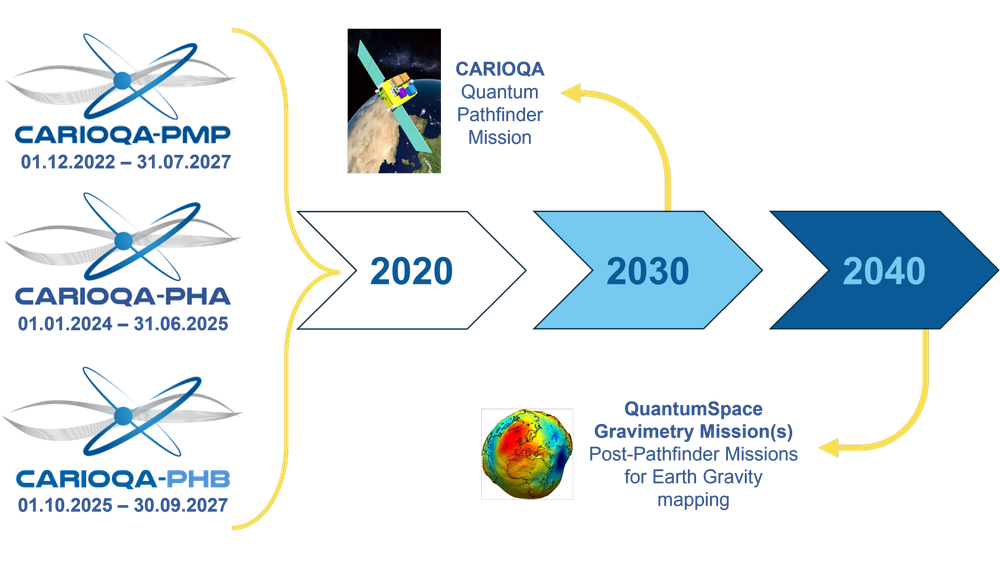
Roadmap of the CARIOQA project from the Pathfinder mission to the quantum technology-based gravitational field mission.
Credit:
CARIOQA / G.A.C. Group / DLR
The CARIOQA Pathfinder mission is the first step in a long-term strategy. After successful testing in space, the findings and technologies will be used for subsequent, ambitious post-Pathfinder missions to precisely observe the Earth. The future missions will set new standards in the observation of the Earth's gravity field and thus make decisive contributions to research into climate change, monitoring the global water cycle and assessing the risk of earthquakes and other natural hazards. CARIOQA also opens up new perspectives for basic research: the extreme precision of the quantum sensors enables precise tests of the weak equivalence principle - a central building block of the general theory of relativity - in space for the first time.
DLR's Research and Exploration and Earth Observation departments of the German Space Agency, the Mission Operations department of the Space Operations and Astronaut Training Facility, the Flight Software department of the Institute of Software Technology and the Quantum Sensing, Relativistic Modelling and Satellite Geodesy and Geodetic Modelling departments of the Institute of Satellite Geodesy and Inertial Sensing are involved in the project.
Further information on the CARIOQA project can be found at https://carioqa-quantumpathfinder.eu.
News
Loading

Contact
Prof. Dr. Matthias Weigelt
Head Satellite Geodesy and Geodetic Modelling
German Aerospace Center (DLR)
Institute for Satellite Geodesy and Inertial Sensing
Satellite Geodesy and Geodetic Modelling
Callinstrasse 30b, 30167 Hannover
Germany