
Two new GIFDS VLF stations in Finland

Daniela Banys
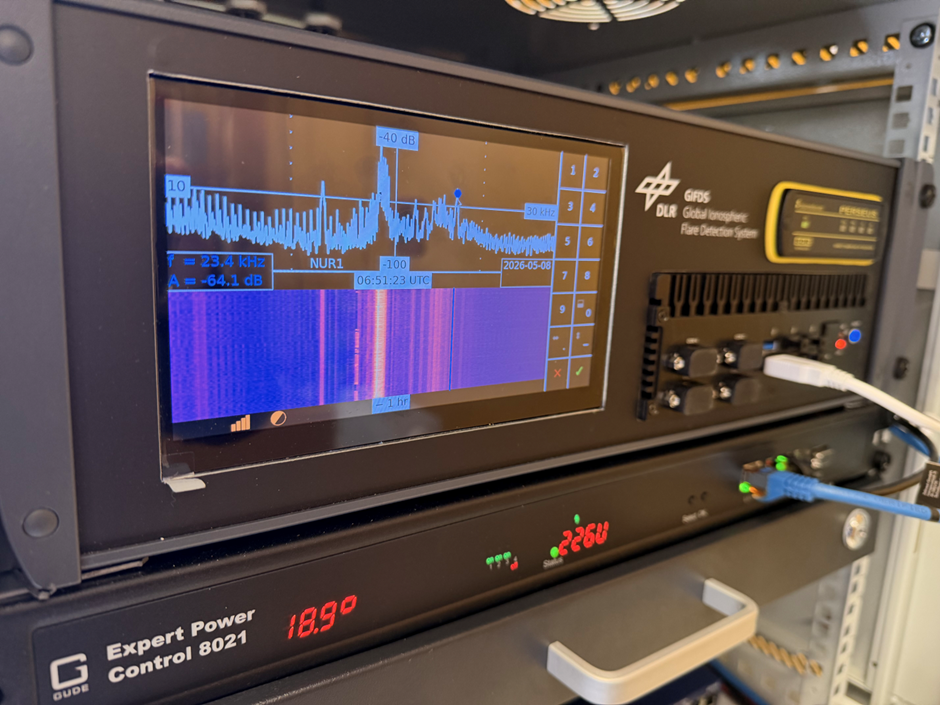
Two new Very Low Frequency (VLF) receiver stations of the Global Ionospheric Flare Detection System (GIFDS) have recently been installed in Finland as part of the AIR-MoPSy project. The new stations strengthen monitoring capabilities in Northern Europe and provide valuable observations for ionospheric and space weather research over the Baltic region.
The GIFDS network continuously monitors VLF transmitter signals to detect sudden ionospheric disturbances caused by solar flares and other space weather events. These solar flares can in particular, disrupt radio communications and satellite navigation that depend on stable ionospheric conditions. The AIR-MoPSy initiative combines atmospheric and ionospheric monitoring technologies to investigate how solar activity influences radio-wave propagation and critical technological systems.
The GIFDS VLF stations receive signals transmitted by powerful Navy transmitters operating in the VLF range. These radio waves propagate within the Earth–ionosphere waveguide, particularly the D-region at altitudes between approximately 60 and 90 kilometers. Variations in the amplitude and phase of the received signals reveal changes in the electron density of the lower ionosphere and therefore enable continuous monitoring of this region.
Thanks to the dense network of VLF transmitters across Europe, the measurements provide good coverage of the Baltic and Northern European region. Space weather events such as solar X-ray flares can rapidly increase ionization in the D-region, altering the propagation conditions of radio waves from VLF up to High Frequencies (HF). By analysing these signal disturbances, the GIFDS stations can directly monitor the ionospheric response to solar flares and help to investigate impacts on communication and navigation systems.
The new VLF stations have been installed at the Finnish Meteorological Institute’s observatory in Nurmijärvi and at the Nyrölä Observatory near Jyväskylä, operated by the astronomy association Sirius.
We would like to sincerely thank our Finnish collaborators for their support, expertise, and hospitality in making these installations possible.
Special thanks go to Kirsti Kauristie, Elias Hirvonen, Arto Oksanen, and Juha Oksa.

