
Research transfer from the road to the building sector

DLR
- Based on a market-ready fuel cell system from the car manufacturer Honda, the HyNRGCube research project is currently developing stationary units to supply energy to residential areas or sensitive building complexes such as hospitals.
- Measurements carried out on the DLR test bench have shown overall efficiency figures of up to 97 per cent for the provision of combined electricity and heat for base load.
- The concept behind these so-called ‘Hy Energy Cubes’ enables an efficient, decentralised, emission-free and resilient supply of electricity and heat. It also opens up new prospects for the heat transition in Germany and worldwide in terms of technological diversity.
- Focus: Energy, transport, resilience, hydrogen, fuel cells
Originally developed for vehicle propulsion, today a promising option for greater resilience in the energy system: based on market-ready fuel cell systems from the automotive industry, stationary units for emission-free supply of electricity and heat are currently being created in the HyNRGCube research project, in which the German Aerospace Center (DLR) is involved. Permanently installed in standardised 20-foot containers, these so-called 'Hy-Energy Cubes' are intended to ensure particularly efficient energy supply in residential quarters or sensitive building complexes such as hospitals in the future – and even completely off-grid in a crisis. A ‘Hy-Energy Cube’ has now commenced initial operations in Emsdetten under the leadership of the project partners H2Powercell and Honda R&D Europe (Germany).
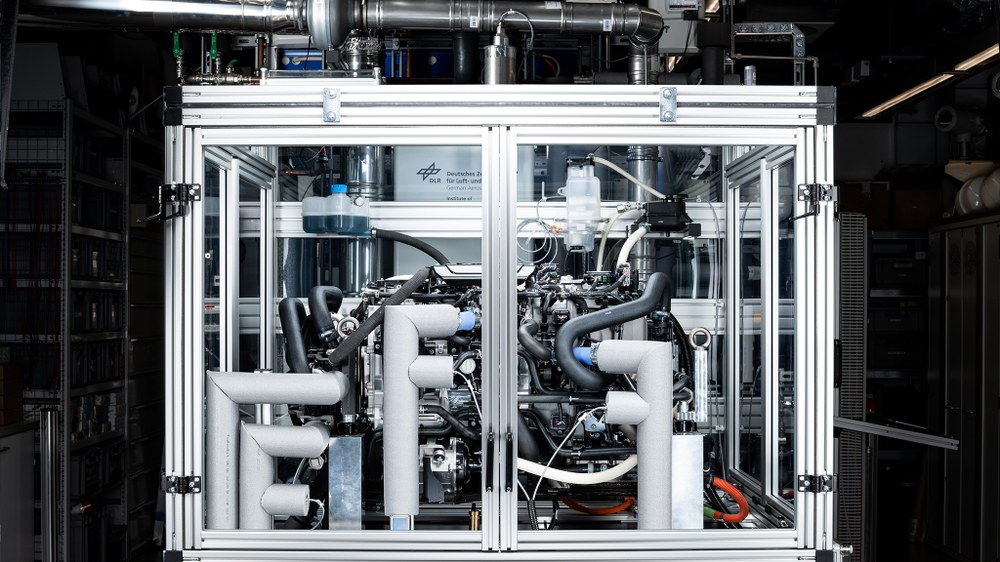
The DLR Institute of Networked Energy Systems significantly supported the commissioning of the prototype regarding questions on electronics and hydraulics as well as hydrogen components. The researchers gathered decisive insights during the first project phase in the DLR laboratory, where they had evaluated the fuel cell system provided by the automotive manufacturer Honda at a specially set up test bench for several months. In a realistic test environment, the system was evaluated here for the first time worldwide regarding its properties in combined heat and power (CHP) using very precisely calibrated and coordinated measurement techniques in high-resolution measurements.
Tests in a realistic system environment
The high practical relevance plays a decisive role in this and comparable analyses, as Dr Hendrik Langnickel, HyNRGCube project leader at the Institute of Networked Energy Systems, emphasises: 'The unique networked laboratory environment at the institute allows us to evaluate the system under a wide variety of requirements: for example, with regard to the electricity and heat demand for residential units or commercial operations across seasonal temperature profiles or regarding energy provision at charging stations based on high-resolution consumer data'. Currently, the DLR researchers are investigating possible later application scenarios for the fuel cell system based on these results, for example in residential quarters. Equally indispensable alongside the technical equipment: years of know-how regarding heat extraction as well as profound technical understanding of cross-sector energy use regarding hydrogen.
Overall efficiency of up to 97 per cent
Langnickel explains why a mature technology still needs to be measured with the originally intended application: 'In a fuel cell system constructed for mobility, thermal output plays a rather subordinate role. Excess heat is usually dissipated into the environment as a 'waste product' in the transport sector, so that no detailed data on thermal performance were known in the project'. When the measurement results from the HyNRGCube project were finally available, it became clear how much potential the intended research transfer from the road to the building sector holds: overall efficiencies of up to 97 per cent were determined at the test bench for the provision of the combined electricity/heat base load. For comparison: with separate supply systems for electricity and natural gas, the efficiency values are around 20 to 40 percentage points lower. Thus, Hy-Energy Cubes are suitable for future energy supply concepts not only because they can provide energy without CO2 emissions. They also open up new perspectives in terms of efficiency and technology diversity for the heat transition in Germany and the world.
An interesting option for crisis preparedness
The research approach from the HyNRGCube project is a very application-oriented example of how an already mature technology can be used efficiently in a completely different context. Because the 'Hy-Energy Cubes' are designed modularly as compact units, they can be individually configured and thus support stationary electricity and heat demand at specific points. Especially where it comes to supplying critical infrastructures, the concept could make an important contribution to greater resilience and security in the future: 'Hydrogen-operated fuel cells have the decisive advantage that they can provide electricity and heat completely off-grid. In the event of large-scale power outages or disturbances, for example in the natural gas infrastructure, they can also be operated autonomously in island mode in combination with an H2 storage', says Langnickel. This makes the technology very interesting for crisis preparedness, for example in energy centres or in emergency medicine, as Langnickel adds. 'And in contrast to emergency generators, which remain unused outside of emergencies, the Cubes are already a systemic component of the energy supply in regular operation. This leads not only to continuously efficiently used energy, but also to much higher operating times – and thus to greater economic efficiency.'
Synergy effects for manufacturers and consumers
The financial view of the later practical application played a major role from the start of the project anyway: so far, no cost-effective solutions for stationary fuel cell systems in this performance class are available on the market, because there is no series production with large quantities required for this in this market segment. However, by repurposing already developed systems, any costs still outstanding for product development are eliminated. In addition, advantageous synergies could arise for manufacturers and consumers, leading to cost degression via higher quantities.
Perspective-wise, the Hy-Energy Cubes are intended to provide part of the base load energy-efficiently in individual applications – supplementing the grid connection – and bring up to 80 kilowatts of power off-grid in the event of large-scale disturbances. As another particularly efficient application, the project team has identified use as a backup for electric charging infrastructure to compensate for peak loads in the electricity grid. In addition, within the scope of the project, it is to be researched simulatively based on the measurement data to what extent Hy-Energy Cubes are suitable for coupling with a heat pump in applications with particularly high heat demand.
About the HyNRGCube Project:
The HyNRGCube project, funded by the German Federal Ministry for Economic Affairs and Energy (July 2024 – November 2027), adapts a fuel cell module with 80 kW of electrical output, proven in the automotive sector, for stationary applications. The goal is to develop so-called Hy-Energy-Cubes – flexible, modularly expandable units that deliver a particularly efficient energy supply, for example in residential neighbourhoods or sensitive building complexes such as hospitals. Efficiency and heat-delivery profiles are modelled to assess the extent to which the module can, as a grid-independent emergency power and base-load solution, contributing to the resilience of the future energy system. Project participants include the DLR Institute of Networked Energy Systems, Honda R&D Europe (Germany) GmbH, H2 POWERCELL GmbH, the Gas Technology Institute (DBI), and HS-Drives GmbH.
More information:
- Potential of a Honda fuel cell module developed for mobility applications in stationary CHP configuration – Scientific article, published at ScienceDirect on 9 November 2026
- Honda develops new combined heating and power system using hydrogen fuel cell technology – Honda press release dated 16 March 2026
- Project description: HyNRGCube