Digital toolbox for strategic regional energy planning
Knowledge exchange
Digital toolbox for strategic regional energy planning
Tools from the ReStEP research project enable analysis of development paths for the Wesermarsch district
A digital toolbox for strategic energy planning is now available to municipal decision-makers in the Wesermarsch district, developed by the Institute of Networked Energy Systems in collaboration with Jade University as part of the ReStEP research project ("Regional Strategic Energy Planning"; funded by the Lower Saxony Ministry of Science and Culture). The tool supports data-based planning of energy supply infrastructure and takes into account factors such as heat demand, potential areas, existing infrastructure, grid connection, and future technologies. The results were presented using interactive scenarios for heat planning and the expansion of PV and wind power plants, as well as electrolysis facilities, at the project's final conference in June 2025 in Elsfleth, Lower Saxony.
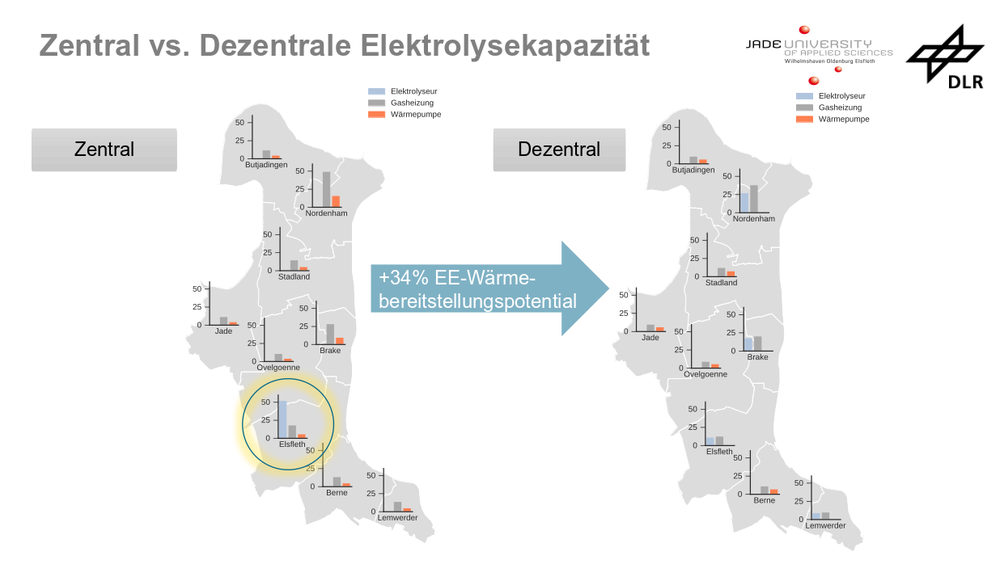
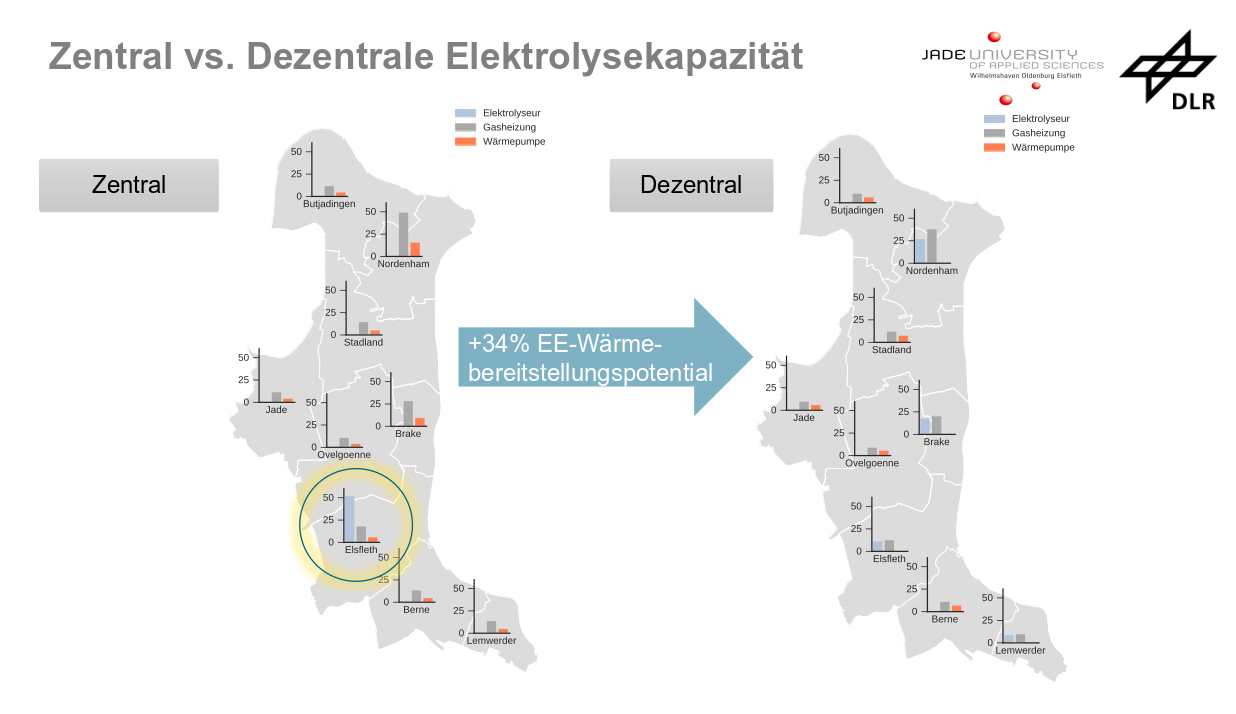
Scenarios show options for how different regional energy planning can affect the technological demand for heat supply. Using the example of decentralised waste heat utilisation from electrolysis facilities for the Wesermarsch district (right scenario), it becomes clear that this would be the more attractive option from the perspective of the heat transition, rather than installing a central large-scale electrolyser in the municipality of Elsfleth (left scenario). The total demand for heat supply is identical in both scenarios; however, the solution with decentralised electrolysis facilities allows for a 34% higher use of technologies based on renewable energies (utilisation potentials depicted in diagrams at the municipal level).
The high practical relevance of the ReStEP tool had already become apparent during the project phase on site. Possible decisions on municipal energy planning can be compared with supra-regional scenarios using a "what-if" analysis, for example, regarding opportunities for waste heat utilisation or electrolysis expansion. When weighing options - such as between heat pumps, district heating, or storage solutions - the tool offers regional authorities a comparison of different generation options for the municipalities in Wesermarsch. Additionally, possible development paths can be mapped and compared in terms of costs, benefits, space, and environment.
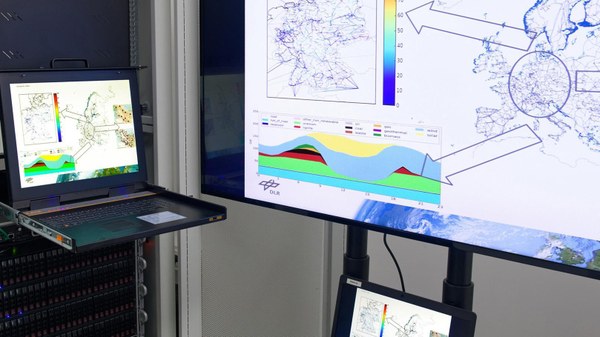
A central element in the development of the tool is the energy system optimisation framework REMix, developed at DLR. It is used, among other things, for scenario analyses and technology evaluation, as well as for suitability analysis of areas for PV and wind power plants. This supports decision-makers in setting the potential of areas and yield performance in relation to each other. Using REMix, the use, generation, and storage of energy across different sectors were also modelled to optimise costs, technology deployment, and flexibility options. For the first time, a sector-coupled energy system model for an entire district was spatially resolved and subsequently embedded in the surrounding Lower Saxony power supply system.
Due to its modular structure, the planning tool developed exemplarily for the Wesermarsch district can also be adapted to other districts or municipalities with different framework conditions. In a future research project, artificial intelligence could be used to support user-specific data exploration.
Background on the topic
As the importance of renewable energies grows and the need to implement energy transition goals locally increases, the complexity of regional energy planning is rising. In particular, decisions on wind farms and solar parks that are relevant to land use have significant impacts on landscapes, nature, and populations, as well as their acceptance. Therefore, not only technical but also economic, ecological, and social criteria must be considered for informed evaluations. The selection of technologies also requires robust decision support. Furthermore, it must be ensured that the generated energy can be effectively fed into the grid. Here, topics such as grid stability, load management, storage capacities, and connection to the superior energy system play a central role.
Against this background, the ReStEP project aimed to analyse the long-term energy supply in the Wesermarsch district over a period of up to 30 years. The basis for this was the REMix modelling tool developed at DLR, which enables the planning and optimisation of technology mixes, flexibility measures, and infrastructure investments with high temporal and spatial resolution.
Core topics and challenges with thematic relevance: