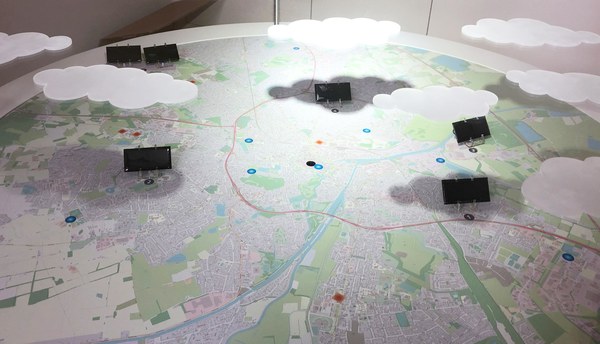
The continuous advancement of solar energy presents politics, the economy, and society with the growing challenge of integrating decentralised photovoltaic systems into the existing power grid. To promote the local aggregation of production and consumption and to relieve the electricity grid, the European Union requires the introduction of so-called renewable energy communities in the amendment of the Renewable Energy Directive1. The goal is to allow more citizen participation in the electricity system by enabling members of these communities to share energy directly and specifically with each other in the public grid (‘Energy Sharing’). Parallel to this, the Federal Government has created the legal foundations for Energy Sharing from June 2026 with the reform of the Energy Industry Act. Against this background, the core problem arises: the profitability calculation for renewable energy communities requires the combination of spatially and temporally varying solar radiation on the one hand and local load profiles on the other (see picture). The research project Co-DatES, funded by the Federal Ministry of Transport, is developing methods to utilise remote sensing and weather data available to the public for the evaluation of Energy-Sharing models.
Research project Co-DatES
Duration
October 2024 to September 2027
Funded by
Federal Ministry of Transport
Project participants
DLR Institute of Networked Energy Systems
OLEC - Oldenburger Energiecluster e. V.
greenventory GmbH
City of Oldenburg
Figure 1: Calculated global radiation over Oldenburg, determined from data from the Eye2Sky cloud camera network for a sample day. The arrows symbolise PV plants from a participating renewable energy community.
The project Co-DatES examines and quantifies the extent to which public data from the European earth observation programme Copernicus and other sources can be made available for quantifying production and consumption potentials in renewable energy communities. Extensive data sets on existing solar systems, the solar potential of roof areas as well as regional sun radiation and load profiles of potential consumers in the vicinity are required, which are not yet available. The goal is to collect these and integrate them into a comprehensive model for profitability analysis.
The Institute of Networked Energy Systems is investigating the necessary temporal and spatial resolution of meteorological data to allow a sufficiently accurate estimation of profitability in Energy Sharing. For this purpose, weather data from the Eye2Sky cloud camera network, the European CAMS project, as well as numerical weather model data from the DWD is compared, and their effects on an energy community model are examined.
In a second work package, the project team of the DLR is dedicated to the automated recognition of PV systems from public and non-public remote sensing data sources. For this purpose, the researchers use various algorithms on images from WorldView and RapidEye as well as local flight data. The recognised PV systems can then be incorporated into newly formed renewable energy communities.