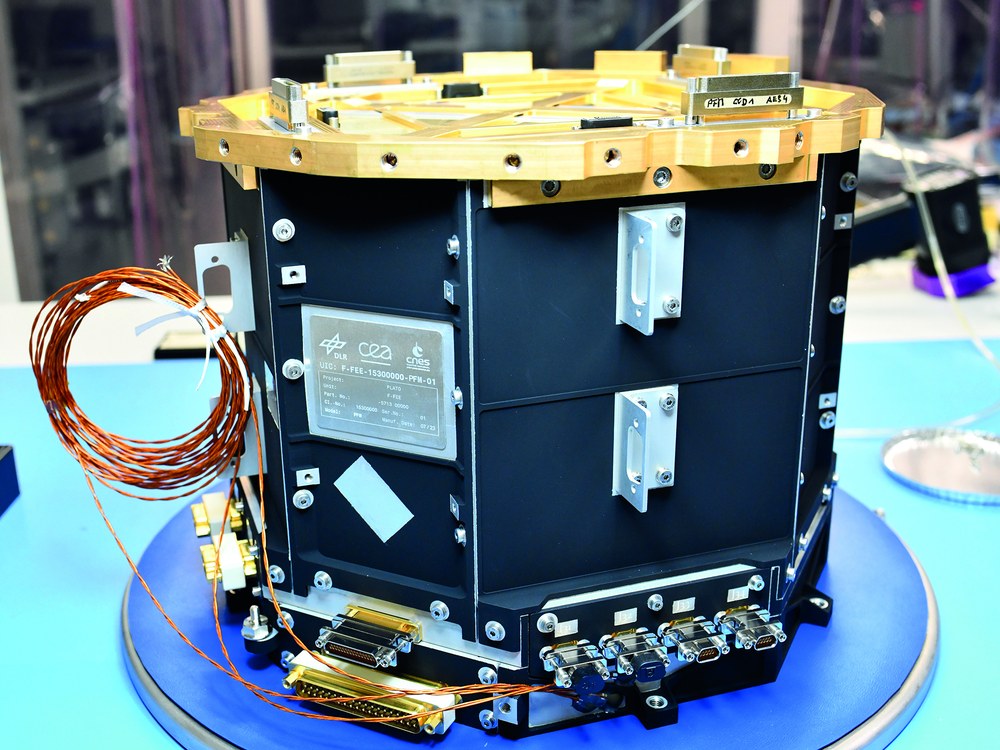
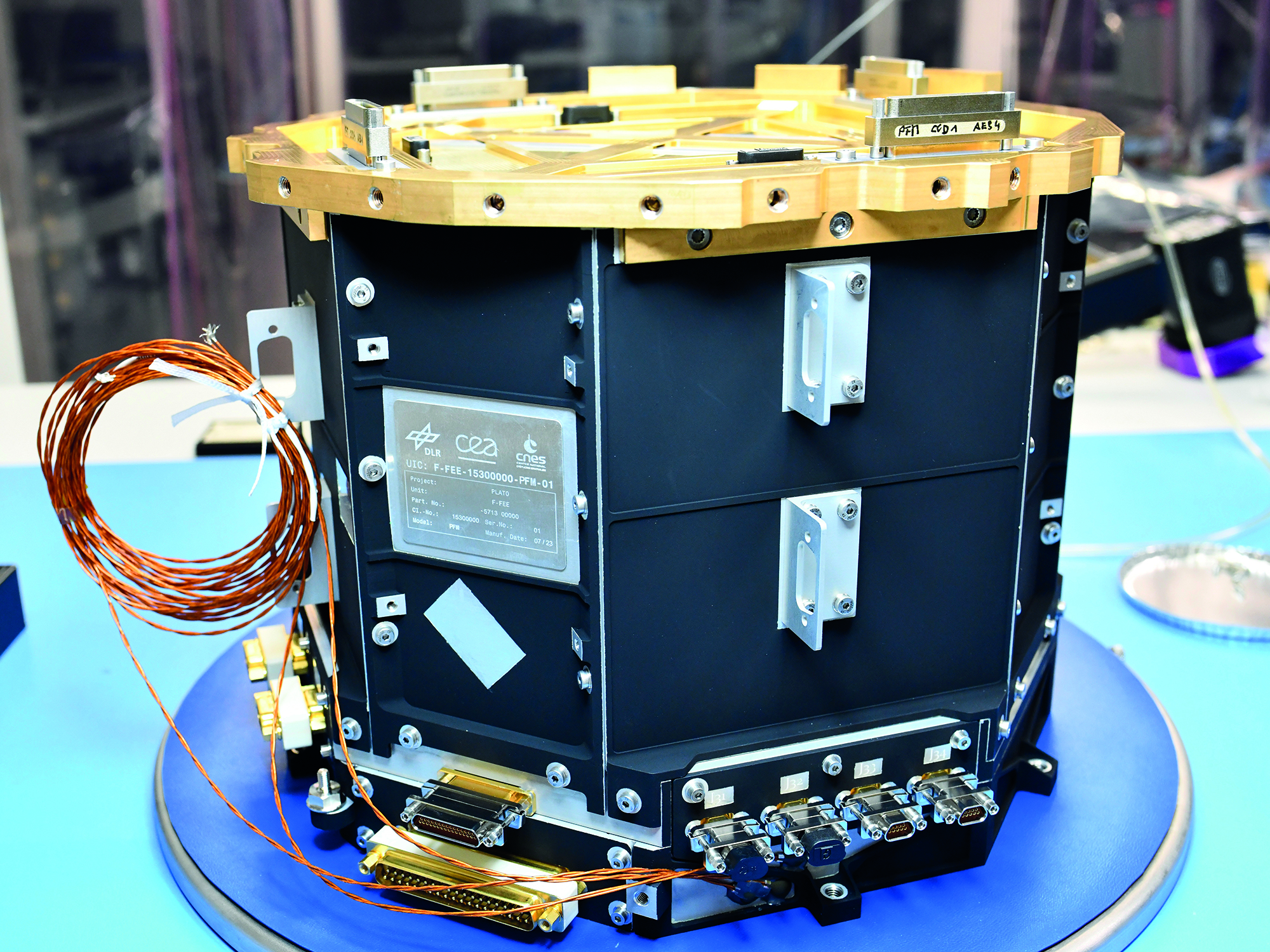
Flight model of the electronic module for the fast cameras
Flight model of the electronic module for the fast cameras, the CCD arrays sit on the top of the module, connections for data transfer and electronic supply are on the bottom side
The PLATO Mission Consortium at DLR Berlin provides the overall consortium management together with ESA and contributing partners. The team has also been responsible together with ESA for mission and payload design.
The Institute of Space Research leads the team demonstrating and verifying the overall performance of the PLATO project during the different mission phases, ensuring a close link between the mission and payload development and the ground section activities. We also lead the team responsible for the instrument calibration and operations. Our scientists are responsible for the definition of the planet search and planet characterisation tools exploiting the scientific data. Our goal is to maximise the scientific output and information retrieval from future PLATO photometric time-series.
Hardware and Software
The team at the Institute of Space Research – formerly the Institute of Planetary Research and the Institute of Optical Systems – designed and implemented the front-end electronics of the two fast cameras. The fast cameras are required for the satellite’s fine guidance and the precise measurement of very bright stars. The fine guidance system (FGS) algorithm is used in closed loop between the fast cameras and the satellite’s attitude control system and has also fully been developed by DLR in Berlin.
This is part of the overall responsibility for the management, development, testing and validation of the entire data processing system (DPS) on board PLATO.
Finally, we are also responsible for the payload system engineering for the scientific consortium as counterparts to our ESA colleagues. This included for example the definition of the payload design requirements (for both the cameras and the DPS) in the early project phases, and more recently the validation and verification plans and activities.
Together with other consortium teams, we took part in the preparation and execution of the Thermal Vacuum Campaign of the cameras and have contributed to the evaluation of the camera testing and in the analysis of calibration data. One very crucial point is the evaluation of the non-uniform behavior of the CCDs pixels. This determines the satellite fine pointing and the photometric quality of the data.
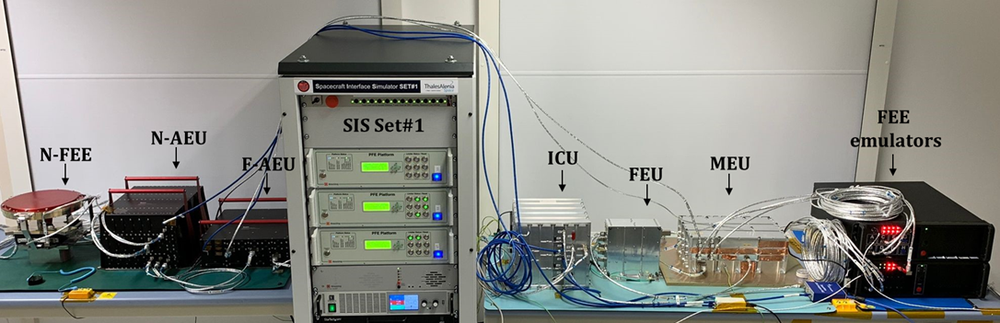
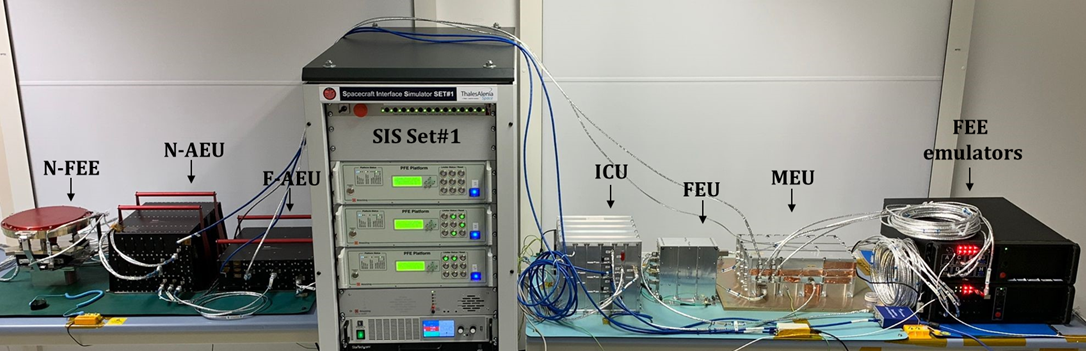
Engineering Model test bench
Engineering Model test bench of the Data Processing Unit (DPU) at DLR