FlexFuture II
Integrated flight and load control for highly flexible aircraft with very high aspect ratio for future, climate-neutral aircraft
FlexFuture II
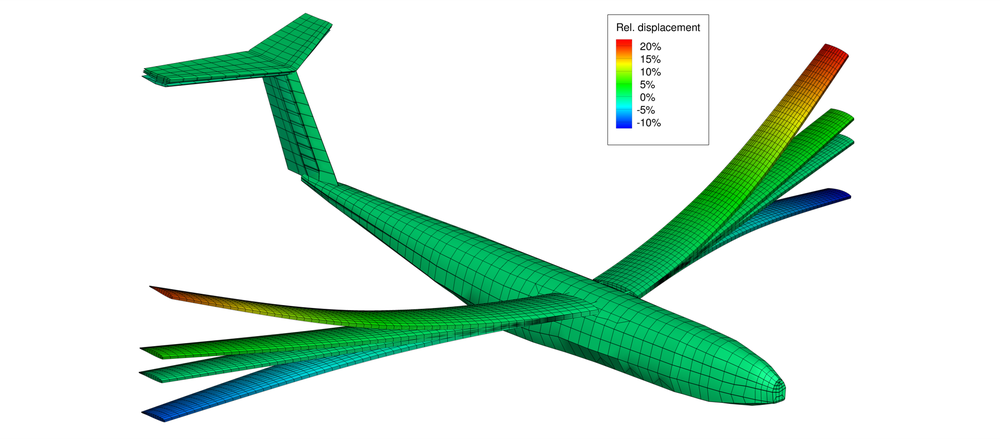
Future climate-friendly aircraft designs will be characterized by aerodynamically and structurally highly efficient wings with high aspect ratios. Such highly flexible wing structures exhibit very large deformations and low natural frequencies. They are therefore much more sensitive to loads and structural vibrations, and rigid body and structural dynamics are also coupled. Future high-performance flight control systems must therefore explicitly take the increased structural flexibility into account. FlexFuture II aims to further develop the methods for modelling and integrated flight and load control developed as part of the FlexFuture project with a focus on industrialization.
Work content of the DLR
In the FlexFuture II project, DLR aims to further develop and industrialize methods that can be used for the aeroelastic analysis of high aspect ratio wings. High aspect ratio wings are a current development trend in both new commercial aircraft and newly developed regional aircraft, both for configurations with conventional propulsion systems and for those with alternative propulsion systems (e.g. (hybrid) electric, hydrogen). Highly stretched wings reduce the induced drag of an aircraft and are thus an important step towards reducing aircraft emissions and therefore an essential step towards climate-neutral flying.
Highly stretched wings are very flexible and pose a number of new challenges. One important point is the question of how increased wing aspect ratio can be achieved without increasing the wing mass compared to a classic design. Such a mass reduction can only be achieved through passive and active load reduction. A further challenge arises because large wing deformations have an effect on the flight mechanics, both statically and dynamically. Requirements for the controller design for flight mechanics and load control can overlap. Large, geometrically non-linear deformations occur in high aspect ratio wings under high loads and influence the results of load and flutter analyses both qualitatively and quantitatively. Conventional design methods assume a linear behavior for the structure as well as analysis methods for loads and aeroelasticity, which is only given for small wing deformations. The development of non-linear methods is necessary here.
All these open points are essential for the design of aircraft with high aspect ratio wings and are evident in the current development processes of aircraft manufacturers. The FlexFuture II project is therefore addressing issues relating to integrated flight and load control as well as aeroelastic modeling of aircraft with high aspect ratio wings.
Objective
Specifically, in FlexFuture II DLR is developing a method ready for use with which the structural dynamic and aeroelastic properties of wings with large, non-linear wing deformations can be simulated quickly and accurately. Furthermore, DLR's modeling capabilities are to be expanded in the individual project to include the integration of flight and load controllers in the design. Finally, validation calculations for the analysis of aircraft with high aspect ratio wings and large, non-linear deformations are to be carried out based on measurement data collected in the project. To this end, DLR is supporting TU Berlin in carrying out wind tunnel tests with the wing of the TU-Flex demonstrator.
DLR's work will address a relevant and realistic industrial target configuration, thereby reducing the environmental impact of aviation, strengthening Germany's competitive position as an aviation location and securing value creation in Germany. After the project, the processes developed will be available for use by industrial partners and in research projects.
Project | FlexFuture II - Integrated flight and load control for highly flexible aircraft with very high aspect ratio for future, climate-neutral aircraft |
|---|
Duration | 01/2026 - 03/2029 |
Partners | |
Type of project | Joint project aeronautics research program VII-1 |
Funding | Federal Ministry for Economic Affairs and Energy (BMWE) |