
LamAiR model

More efficient, fuel-saving and climate-friendly flying with the forward-swept laminar wing
Our concept of a forward-swept low-turbulence aircraft
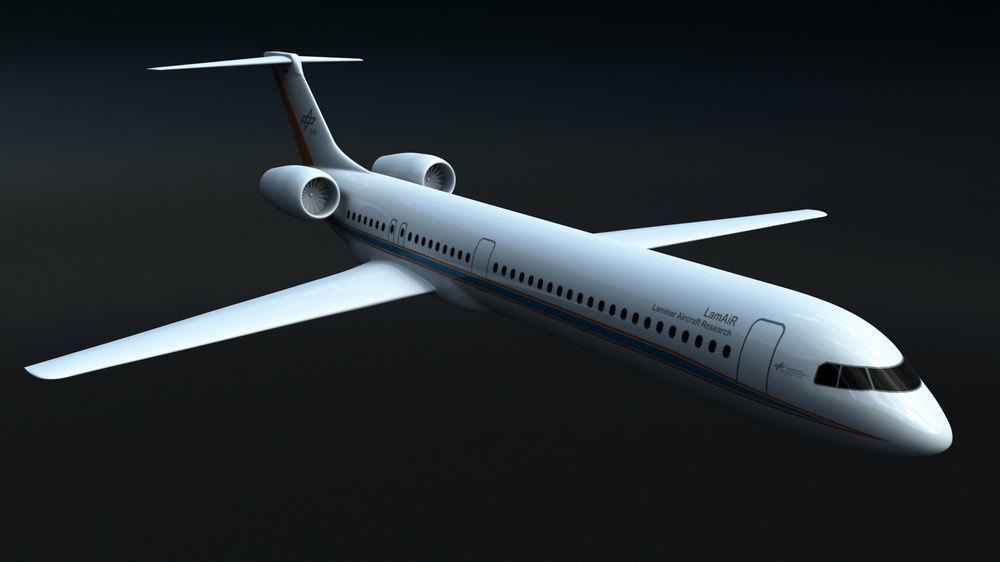
Future commercial aircraft should be significantly more fuel-efficient, cost-saving and environmentally friendly. In the LamAiR (Laminar Aircraft Research) project, we have designed a medium-haul passenger aircraft that can make air transport more sustainable. The concept is based on a forward-swept wing that enables a largely laminar flow and significantly reduces drag.
The forward-swept wings enable natural laminar behaviour of the boundary layers on the wings. This means that the airflow remains free of turbulence over large areas of the wing. This property, which is achieved by the precise shaping of the wings, significantly reduces drag and lowers fuel consumption compared to conventional aircraft.
As part of the LamAiR project, the forward-swept wing was not only designed but also extensively analysed. The researchers were able to show that the configuration is not only more efficient, but can also maintain a cruising speed of Mach 0.78.
Compared to conventional aircraft, the LamAiR concept could reduce fuel consumption by up to 9 %. This makes it an important step towards more climate-friendly aviation.
Why forward sweep?
The forward sweep of the wing enables a significantly less disturbed airflow in the area of the wing leading edge. In contrast to backward swept wings, this allows the airflow to be maintained naturally by the shape of the wing profile alone. This design not only offers aerodynamic advantages, but also the possibility of maintaining the previous cruising speeds.
Our model: An unconventional configuration visualised
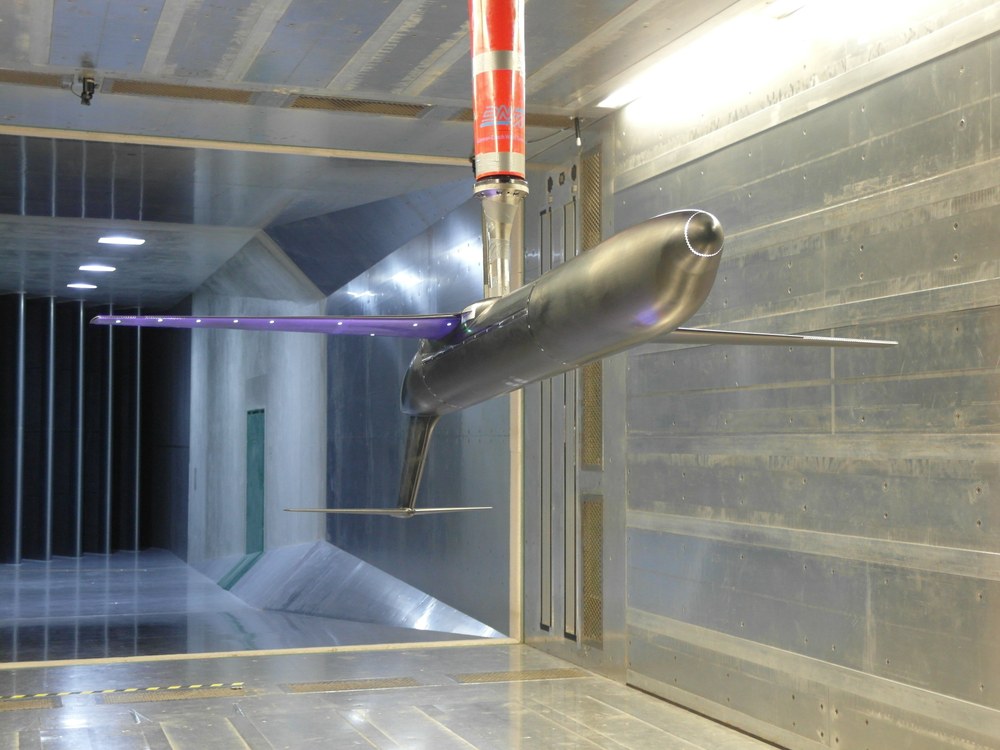
The LamAiR model is a detailed plastic exhibit that clearly illustrates the innovative aircraft configuration. This design is a lead configuration of our institute and was used in the LamAiR and NumEx projects. Back in 2012, it was used in wind tunnel measurements and numerical investigations to evaluate the static and, in particular, the dynamic flight behaviour of such a configuration.
Technical details at a glance
Dimensions of the exhibit:
- Scale of the model: 1:25
- Length: 230 cm
- Wingspan: 200 cm
- Height: 50 cm
- Weight: 20 kg
Further Links: