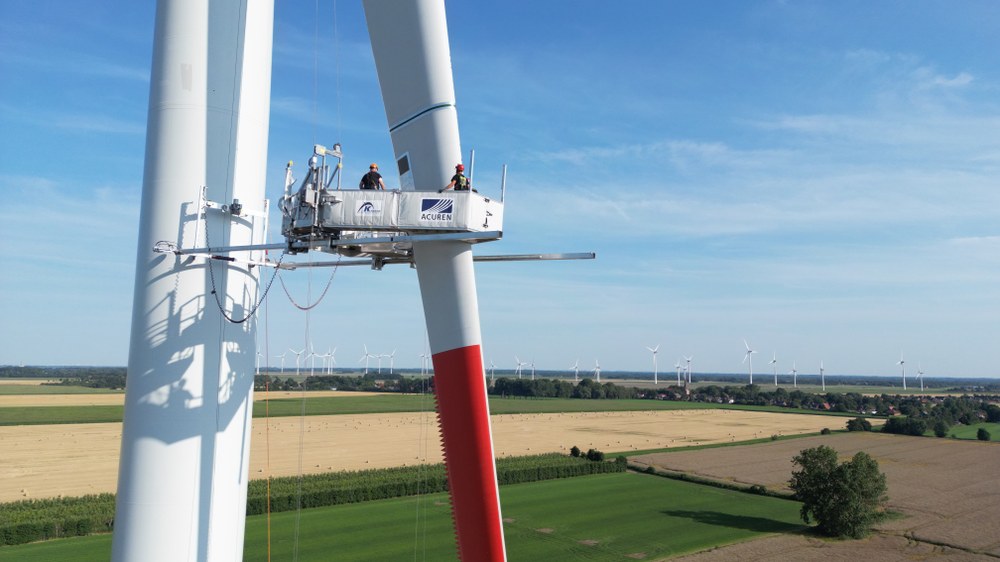
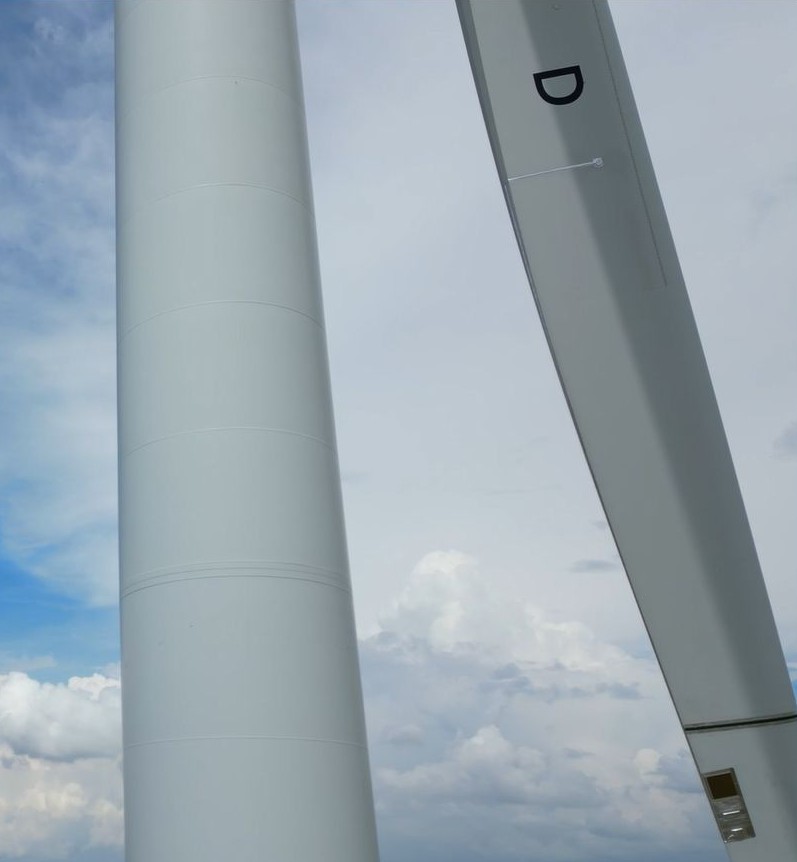
In the validation of methods and the control of wind turbines, there is a gap in the process chain: Although loads and turbine behaviour result from aerodynamics, validation and turbine control have so far been based primarily on integral quantities such as power, rotational speed and bending moments. This is due to the lack of suitable aerodynamic sensors and corresponding data processing. The A2Monitor project (Aerodynamic and Aeroacoustic Condition Monitoring on the Rotor Blade of a Wind Turbine) aims to close this gap.
DLR sub-project: Aerodynamic pressure measurement and reconstruction of operating conditions
MEMS instrumentation on the rotor blade. Pressure measurement belt and surface microphone array for characterising the unsteady flow around the blade.
In the DLR sub-project, we are further developing a pressure measurement system based on micro-electro-mechanical systems (MEMS) for use on the rotor blade. We have already developed such a system for aviation and successfully used it in flight testing.
For operation on a wind turbine, however, the overall system needs to be adapted to the specific environmental conditions, such as rain, dust, icing and lightning strikes.
In the project, we are focusing in particular on:
MEMS-based pressure measurement: Further development of the pressure measurement system and prototype implementation on the rotor blade of one of the two Enercon E-115 EP3 turbines at the DLR research wind farm WiValdi.
Reconstruction of operating conditions: Development of a multi-fidelity data processing approach that is as close to real time as possible, based on simulation models. Local, transient profile angles-of-attack are determined from the measurement data and used to validate simulations on the rotor blade.
Aerodynamic and aero-acoustic measurements: Combining the pressure measurement data with high-frequency surface pressure fluctuations recorded on the rotor blade using DLR MEMS-based microphone arrays. This is intended to enable active detection of acoustic and angle-of-attack margins, providing the basis for future power- and noise-optimised turbine control.
By incorporating aerodynamic sensors, manufacturers can avoid unnecessary margins in rotor blade design and reduce design conservatism. In addition to rotor blade instrumentation, extensive acoustic field measurements are planned at the research wind farm WiValdi as part of the project.
The A2Monitor Project
Your consent to the storage of data ('cookies') is required for the playback of this video on Quickchannel.com. You can view and change your current data storage settings at any time under privacy.