Key technologies for future Strut-Braced-Wing aircraft
AWATAR
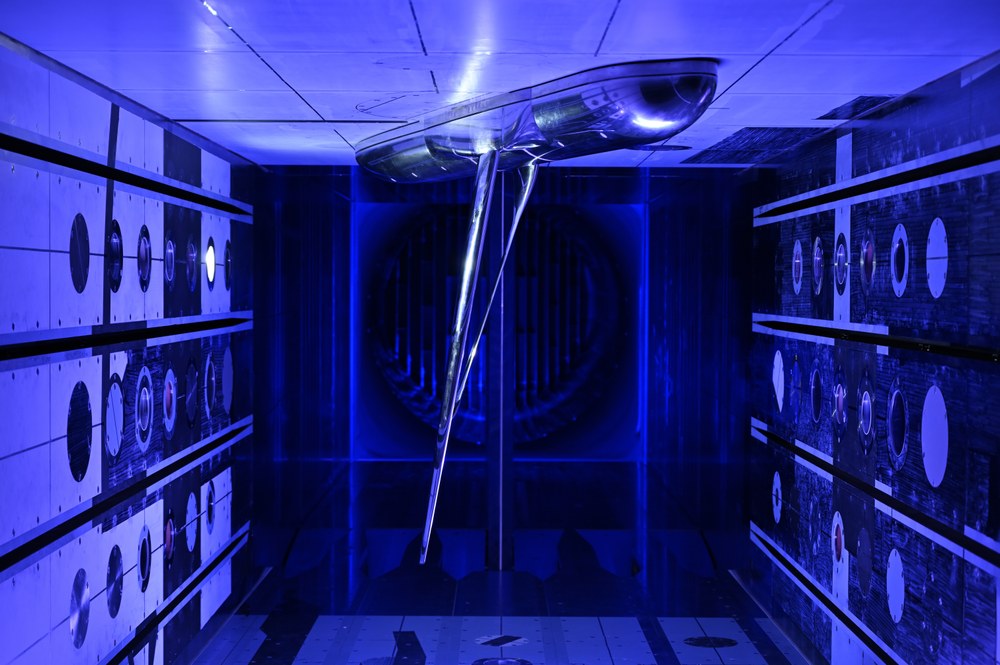
Half-model setup of the strut-braced-configuration in the ETW test section
Credit:
ETW
The aviation industry is pursuing the goal of achieving net-zero carbon emissions by 2050. Alongside sustainable aviation fuels and new propulsion concepts, significantly more efficient aircraft configurations are required to achieve this goal. In the AWATAR (Advanced Wing MATuration And integRation) research project, partners from research and industry are therefore developing key technologies for future short- and medium-range aircraft and preparing them for industrial introduction and subsequent certification.
At the heart of the project is the maturation of a novel wing concept based on four key technologies:
Strut-Braced-Wing: High-aspect-ratio, strut-braced wing to reduce aerodynamic drag.
Laminar flow: Laminar flow in the outer-wing regions to reduce aerodynamic drag.
Innovative leading-edge system: Energy-efficient ice protection as an alternative to conventional de-icing systems.
Open-Fan integration: Aerodynamically optimised integration of future Open-Fan engines.
The technologies are being developed and validated using high-fidelity numerical simulations, wind tunnel tests and a ground-based demonstrator.
In addition, an integrated aircraft design is being developed for a hydrogen-powered short- and medium-range aircraft with Open-Fan propulsion. This design brings together all the technologies and assesses their impact at aircraft level.
Efficiency potential of the integrated technologies
At aircraft level, the novel aerodynamic configuration enables significant efficiency improvements. The wing geometry, featuring a very high aspect ratio and laminar flow in the outer-wing regions, reduces aerodynamic drag. At the same time, the innovative laminar-capable ice protection system in the leading edge reduces energy consumption compared with conventional de-icing systems. With the efficient integration of the large Open-Fan engine, the combination of these technologies is expected to reduce the block energy consumption of a future short- and medium-range aircraft with 250 passengers and a range of up to 2,000 nautical miles by around 18 per cent compared with the 2020 baseline.
At the DLR Institute of Aerodynamics and Flow Technology, we are responsible for the design of the Strut-Braced-Dry-Wing configuration, in which no hydrogen is stored in the wing, including the integration of the Open-Fan engine. The Institute of Aeroelasticity contributes its expertise in structural pre-design, structural dynamics and structural sizing. Together, we are also developing the wind tunnel configuration for the European Transonic Windtunnel (ETW) a Strut-Braced-Wet-Wing configuration with hydrogen storage in the wing, but without an engine, which serves as the basis for experimental validation.
The project is accompanied by the European Union Aviation Safety Agency (EASA) and is closely linked to other Clean Aviation projects.
ETW Test of the Strut-Braced-Wing Configuration
A key feature of the Strut-Braced-Wing configuration is the wing being braced to the fuselage by a profiled strut. At the DLR Institute of Aerodynamics and Flow Technology, we designed the strut attachment to the wing in combination with reshaping for a defined planform so that no flow separation occurs either in cruise or at the maximum operating Mach number (MMO) and the loads imposed to the structure do not exceed the allowed stress limits at off-design conditions. During a two-week measurement campaign in the European Transonic Windtunnel (ETW), we tested this design under cryogenic conditions in the transonic regime up to the allowed maximum structural stress level.
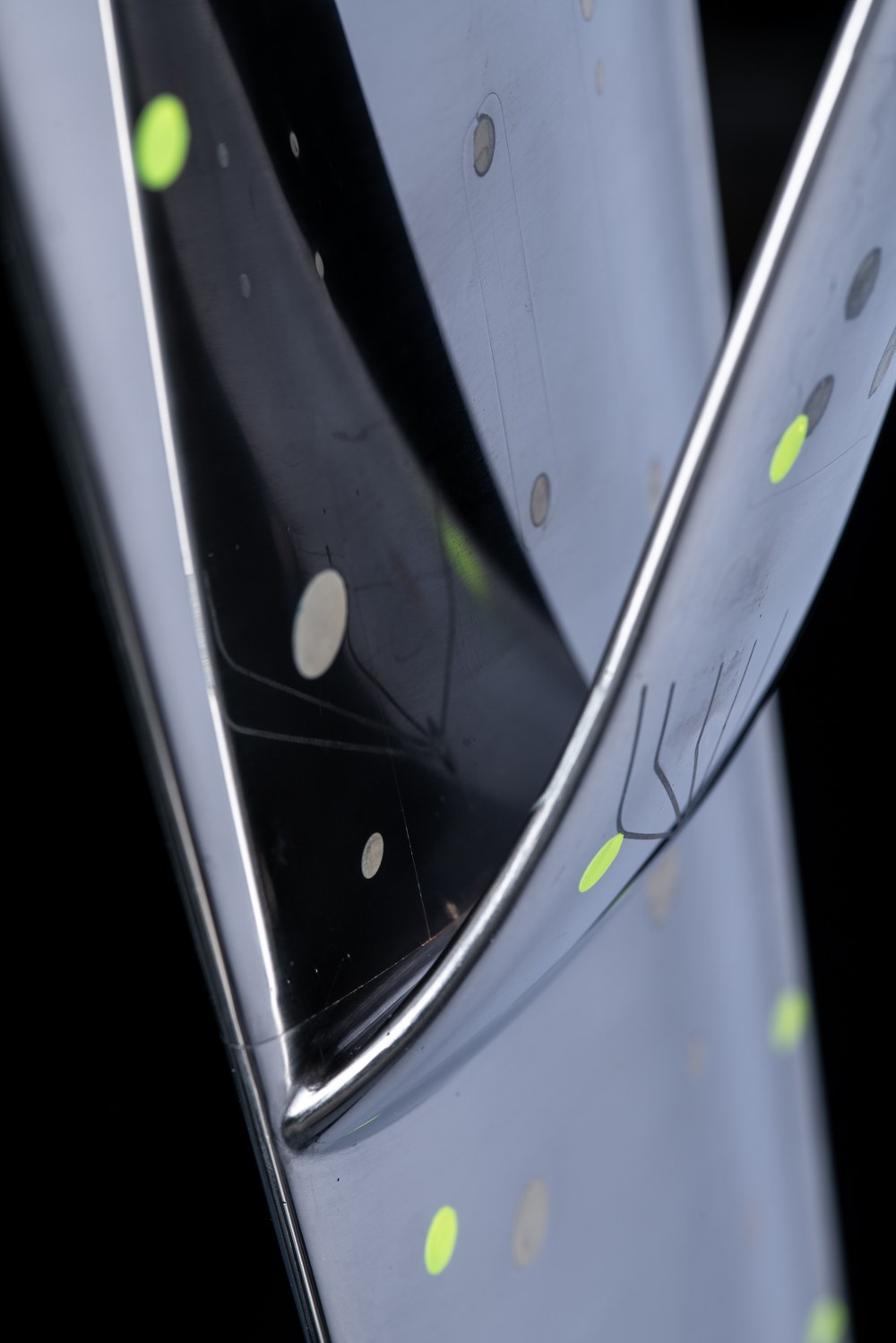
Strut Attachment on the Wing Using Stereo Pattern Recognition (SPR) Technology
With this validation test, we successfully investigated a Strut-Braced-Wing configuration for the first time in Europe at flight Reynolds numbers and transonic Mach numbers. The data obtained on pressure distributions (pressure taps and Pressure Sensitive Paint (PSP)), deformation (Stereo Pattern Recognition (SPR) Technology) and aerodynamic loads provide a valuable dataset for validating the numerical methods used for design and analysis. The validated methods will subsequently be used to design the high-performance Strut-Braced-Dry-Wing configuration with integrated Open-Fan and laminar outer wing.
Project
AWATAR - Advanced Wing Maturation and Integration
Term
1/2024 - 12/2026
Project Participants
ONERA
Airbus Operations
Dassault Aviation
NLR
Collins Aerospace
Goodrich Aerospace Europe SAS
European Transonic Windtunnel (ETW)
Technische Universität Delft
Université de Montpellier
DLR Institute of Aerodynamic and Flow Technology
DLR Institut of Aeroelasticity
Funding
AWATAR project is part of the the Clean Aviation Joint Undertaking (CAJU) under the Horizon Europe programme. Grant agreement no. 101140588