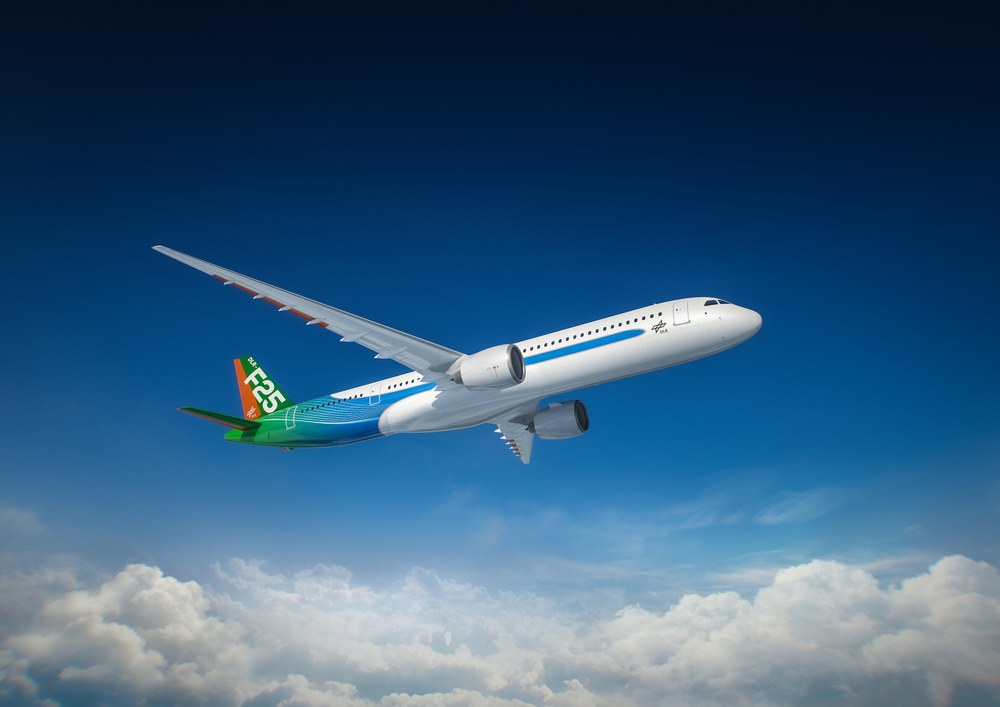
To achieve the European Union’s 2035 target of increasing the energy efficiency of commercial aircraft by 10–15% compared to the reference year 2018 through new technologies, short- and medium-range aircraft in particular must make a significant contribution. Technologies for reducing weight and drag are of central importance in this regard. Recent studies indicate that high-aspect-ratio, load-controlled wings offer particularly great potential, as increasing the wingspan and aspect ratio directly reduce induced drag.
A high-aspect-ratio wing with a more highly swept outer wing offers great potential for increasing the proportion of passive load control and reducing the need for active systems. This can reduce the technical complexity of control surfaces and actuators, as well as the associated costs and weight, are decreasing. At the same time, technical risks are reduced, meaning that this wing concept offers favourable conditions for rapid integration into future aircraft programmes.
EDGE therefore focuses on the design and characterisation of a high-aspect-ratio, double-swept wing based on the DLR-F25 research configuration, with an emphasis on high-lift performance. For both load control and high-lift performance, the design, integration, analysis, and evaluation of the control surface configuration on the wing are crucial and are therefore investigated in EDGE.
The three main objectives of EDGE are:
Evaluation of the high-aspect-ratio, double-swept wing, which promises significant advantages in reducing costs and risks through reduced requirements for active load control,
Conducting the first experimental investigation under flight conditions and evaluating the high-aspect-ratio wing in high-lift conditions, and
Industrialisation of the CFD Software by ONERA, DLR and Airbus (CODA) for the future, cost-efficient design of high-aspect-ratio wings with integrated propulsion systems, enabling the timely implementation of new, energy-efficient technologies in future medium-range aircraft.
With its research focus on aerodynamic design, control surface layout, and high-lift performance, EDGE directly strengthens Germany’s position as a hub for high technology and the aerospace industry.
DLR sub-project:
In EDGE, we are establishing the capability to assess the efficiency and feasibility of high-aspect-ratio, double-swept wings across the entire flight envelope. Our focus is on load control during cruise and high-lift performance during low-speed flight for take-off and landing. We assess the balance between passive and active load control and investigate the active load control measures required, including the necessary control systems. In the low-speed flight regime, we also assess compliance with the approach-speed requirements (TLAR), which are influenced by the flow physics, such as flow separation.
A further focus is on developing rapid design capabilities for control-surface concepts within a continuous end-to-end design process. On the simulation side, we are validating CODA for the cruise and low-speed flight (high-lift) of the high-aspect-ratio, double-swept wing. In addition, we are developing simulation- and gradient-based optimisation methods at different levels of modelling fidelity, both for wings with propulsion systems and for installed propulsion systems.
We are also expanding our predictive capabilities through data-driven approaches that combine numerical and experimental data. For high-lift applications, we use data from ETW tests, while for the investigation of flow-separation phenomena, we are developing data-driven turbulence models based on data from the Cryogenic Rohrwindkanal Göttingen (KRG).
Finally, we are qualifying cryogenic-compatible TSP measurement technology for measuring time-resolved temperature distributions in the outer wing region. We analyse the TSP data to quantify leading-edge vortices and visualise areas of flow separation.
Project
EDGE - Ultraefficient Aircraft Integration, based on cutting -edge capabilities
Term
6/2026 - 11/2029
Project Participants
Airbus Operations GmbH (Project Coordinator)
Technische Universität Braunschweig
Universität Stuttgart
RPTU Kaiserslautern/Landau
European Transonic Windtunnel (ETW)
DLR Institute of Aerodynamics and Flow Technology (Leader DLR sub-project)
DLR Institute of Aeroelasticity
DLR Institute of Flight Systems
DLR Institute of Lightweight Sysems
DLR Institute of Software Methods for Product Virtualization
Virtual Product House (VPH)
Funding
Federal Ministry of Economic Affairs and Energy (BMWE), Aviation Research Programme (LuFo 7.1), ref. no. 20A2401 B