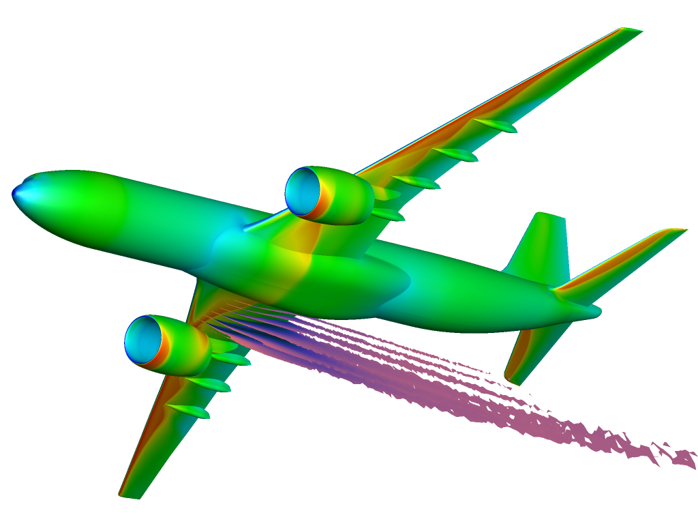
Already in the early development phase of new transport aircraft, it is crucial to know the aerodynamic loads occurring in flight as precisely as possible in order to realize potentials for weight reduction and the associated fuel and emission savings, as well as to ensure safety in all phases of flight. This applies in particular to the borders of the flight envelope, where the occurring flow phenomena such as massive, unsteady separation are not sufficiently understood and difficult to predict. A particular challenge arises for configurations with modern engines with high bypass ratio (UHBR = Ultra-High Bypass Ratio), which lead to strong unsteady interactions (buffet) on the lower side of the wing at high flight speeds.
With this background, the DFG Research Unit 2895, coordinated by the University of Stuttgart, is dedicated to gaining a better understanding of the relevant phenomena and critical interactions in the aerodynamic border region at high flight speeds with the aid of synergetic experimental and numerical investigations on a modern transport aircraft configuration. In addition, numerical simulation methods are to be further developed and validated with the help of measurement data so that future industrial design processes can rely on reliable and qualified calculation tools for these phenomena.
On the one hand, the Institute of Aerodynamics and Flow Technology is involved in the high-precision experimental measurement of the flow field and unsteady surface data on the XRF-1 aircraft configuration in the ETW (European Transonic Wind Tunnel) transonic wind tunnel. In addition, the scientists developing turbulence-resolving simulation methods (hybrid RANS/LES) for the unsteady phenomena and loads in the installation area of UHBR engines on the lower side of the wing. With the help of these methods, they also develop a fundamental understanding of the relevant interactions in different flight conditions, also taking into account the engine jet.
Project
FOR 2895 - DFG Forschungsgruppe 2895 "Erforschung instationärer Phänomene und Wechselwirkungen beim High-Speed Stall"