FAME
Fuel cell propulsion system for Aircraft Megawatt Engines
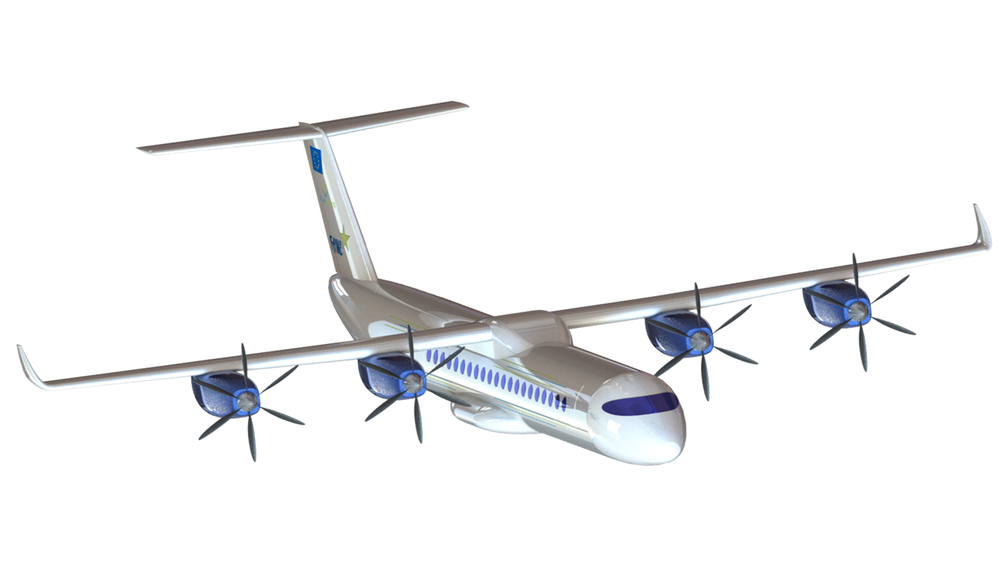
The overall goal of FAME is to pave the way for a complete, compact, and lightweight high-efficiency full-electric propulsion system (drive train) sized for regional aircraft application up to at least FL250. This system will be based on an aviation native fuel cell (with LH2 as energy source) at multi-MW power level (2-4 MW) and associated sub auxiliary systems, including nacelle and propeller.
Green hydrogen as a fuel offers the possibility to significantly reduce or even eliminate all of aircraft’s greenhouse gas emissions. When liquid hydrogen (LH2) is used in fuel cells (FC) for power generation, this results in no CO2, no SOx and no NOx emissions.
The best way to achieve this solution is to develop a hydrogen propulsive FC system as an integral part of a new LH2 aircraft concept. This means moving away from the current “plug and play” (separate motor development and aircraft architecture) philosophy towards a disruptive integrated way of development, which requires a co-creation approach of the propulsion system and the aircraft. FAME follows this approach by collaborative research and development between on one hand partners involved in development of the needed systems of the fuel cell and on the other hand Airbus as and aircraft designer, manfacturer und integrator. Thereby it is ensured that on all levels from material over component and sub-system up to propulsion system on aircraft level an optimization is realized.
The focus of FAME is on developing a complete compact high-efficiency full electric propulsion system based on LH2 as energy source for short to medium range (SMR) aircraft. FAME will develop all the subsystems which are needed and integrate these in a MW FC Propulsion System ground demonstrator with the vision to scale it up to aircraft level (sufficient for SMR aircraft). FAME shows the feasibility of a multi-MW FC Propulsion system for hydrogen-powered SMR aircraft. The system will provide the basis for Clean Aviation in phase 2 to undergo a system flight test.
Project goals
... address the design optimisation of a multi-MW FC propulsion system for hydrogen-powered aircraft with the unique 101 PAX capacity based on design of electric motors on the wing with liquid H2 FC with a MW ground demonstrator.
... cover the full chain of components and subsystems from LH2 tank to propeller (Hydrogen line, Air systems line, FC stack subsystem, Cooling Line and Power Line).
... closely collaborate with the HERA and SMR ACAP architecture to align aircraft design at the beginning and during the project with the efforts on the multi-MW FC propulsion system and co-design in an integrated manner the aircraft architecture and the overall FC propulsion system, thereby differing greatly from the “plug and play” solution, but working on an innovative, disruptive solution.
... include the design optimisation of the FC propulsion system in parallel to the subsystems developing towards TRL 5 and evaluating the coupling effects between the subsystems. The overall (ground demonstrator) system will come via gap analysis and scalability studies to a reliable system for flight tests towards an aircraft solution.
... lead to proper certification specifications and qualification of FC systems for large airplanes (CS-25) by collaboration with EASA.
... focus on the use of PEM FC and will not include batteries.
Project period
01.01.2024 - 31.12.2026
Promotion
EU - Clean Aviation Joint Undertaking