Comparative study of SOFC drive concepts for aviation
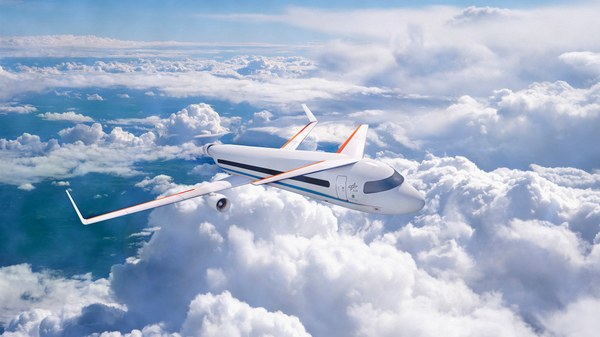
As part of the H2EAT project, two aircraft configurations for the regional segment with fuel cell-based propulsion concepts will be iteratively developed and evaluated. As a large amount of the energy converted in a fuel cell is converted into waste heat, new challenges arise for aviation in terms of thermal management. For this reason, customised solution concepts for temperature control and heat dissipation or reuse are a focus of the project. Another focus is on enabling the use of solid oxide fuel cells in aviation.
To limit climate change, the international community set targets in the Paris Agreement, which were taken up by the European Commission in the Flightpath 2020 aviation strategy paper. They include a 75% reduction in CO2 emissions, a 90% reduction in NOx emissions and a 65% reduction in noise emissions compared to a comparable aircraft from the year 2000. The German government therefore decided to promote hydrogen-based technologies as part of the national hydrogen strategy. One promising drive technology that makes it possible to operate without a carbon cycle is the use of hydrogen-powered fuel cells that supply electric motors with electrical energy.
The H2EAT project ties in with the DLR's "Electric Flying" flagship concept, among other things. In addition to the widely used low-temperature proton exchange membrane fuel cells (LT-PEMFC), fuel cells with a high operating temperature, such as high-temperature PEM fuel cells (HT-PEMFC) and solid oxide fuel cells (SOFC), which can be operated with climate-neutral fuels such as green hydrogen, are particularly suitable for aviation. In order to enable the use of these fuel cell systems in a regional aircraft, they must first fulfil aviation-specific requirements such as operation at low and high ambient pressures and temperatures, good electromagnetic compatibility (EMC), high reliability and the necessary safety. A key technical challenge arises from the amount of waste heat released by fuel cells. This can reach the same order of magnitude as the electrical energy generated. In order to utilise as much of this heat energy as possible and to dissipate excess energy, it is necessary to develop functionally highly integrated concepts for thermal management. These concepts can contribute to an increase in the efficiency and power density of the electric drive system and thus further increase its sustainability. As the electrified aircraft propulsion systems described above also emit noise and also favour the formation of contrails, their environmental impact must also be evaluated.
Project goals
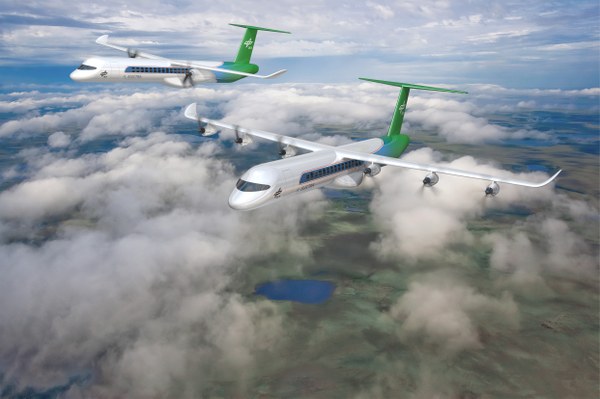
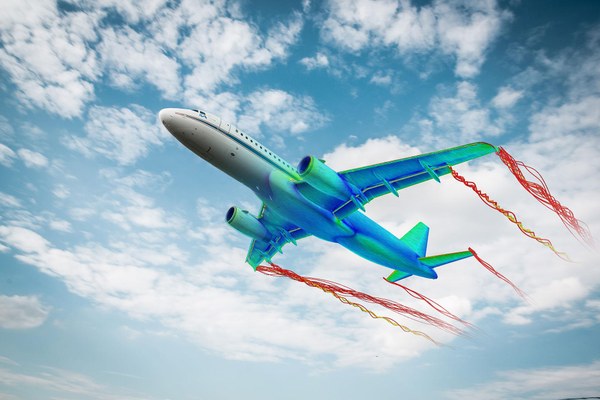
In a comparative study, the respective aircraft concepts with partially fuselage-integrated and nacelle-integrated propulsion systems are to be evaluated in terms of their suitability for aviation, expected noise emissions and climate impact.
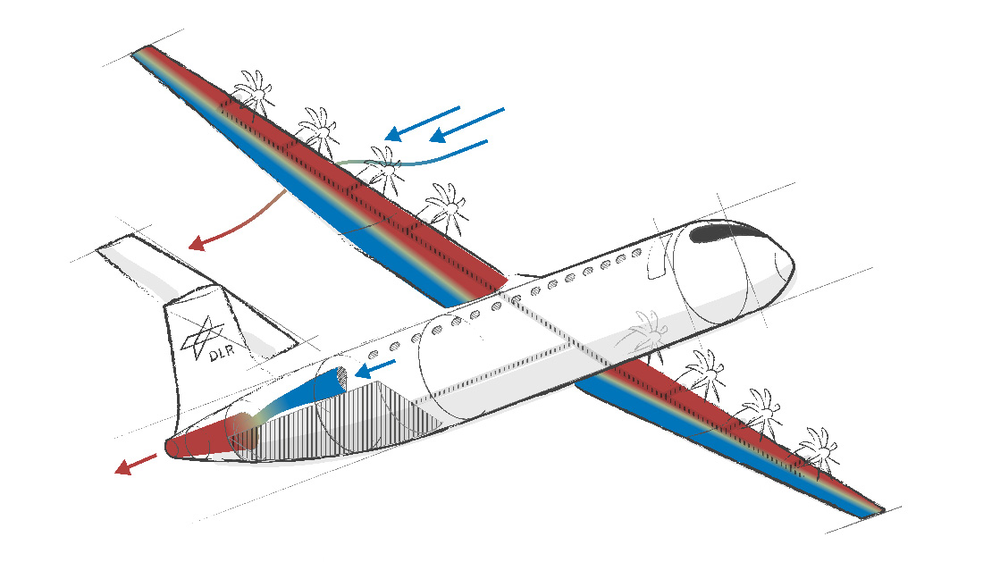
Centralised arrangement of fuel cell system and hydrogen storage in the aircraft fuselage
Functional integration of the heat exchangers in the wings and fuselage areas of the aircraft
Reduction of the amount of heat to be dissipated through proportional conversion into electrical energy via suitable placement of thermoelectric generators
Integration potential of the wings of the aircraft with regard to lift generation, absorption of structural loads, heat transfer or de-icing of aerodynamic contours
Ensuring low-loss transmission of the generated electrical energy to the propulsion units
Possibilities of improved lift, which may lead to a mass reduction of the aerofoil structure
Answering questions on waste heat utilisation with regard to conditioning the cabin air and de-icing aerodynamic surfaces
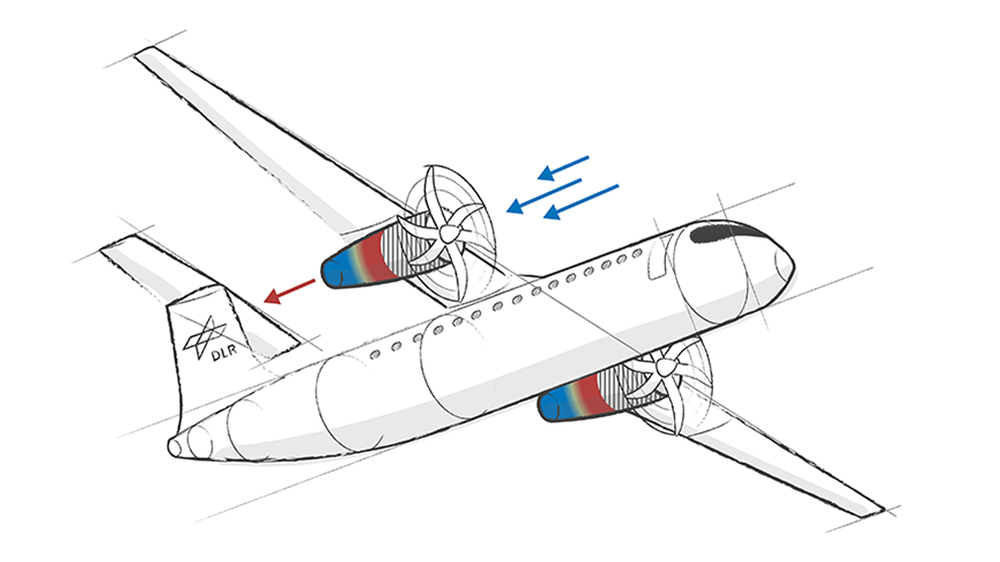
Arrangement of smaller fuel cell systems in nacelles under the wings and direct connection to the propulsion units
Minimisation of cable routes and spatial separation of independent and thus redundant systems
Heat exchangers should be an integral part of the nacelles installed under the wings
The possibility of using thermoelectric generators to minimise the amount of heat to be dissipated should also be evaluated here
Identification of the ideal storage concept for the fuel
Examination of the utilisation of wings as storage for hydrogen