
Home
>
Research & Transfer>
Projects>
Vehicle systems and Technology Assessment>
VECTOR21 – Vehicle Technology Scenario Model
VECTOR21 – Vehicle Technology Scenario Model
How will evolving battery chemistries and ADAS technologies reshape vehicle markets over the next decade? Which regulatory and socioeconomic conditions decide whether a promising technology reaches the mass market or stalls? VECTOR21 answers these questions by simulating the market ramp-up of future vehicle technologies across European markets. The model gives political and economic decision-makers an independent, scientifically grounded basis for strategic planning. The software is being continuously extended and adapted to specific research questions.
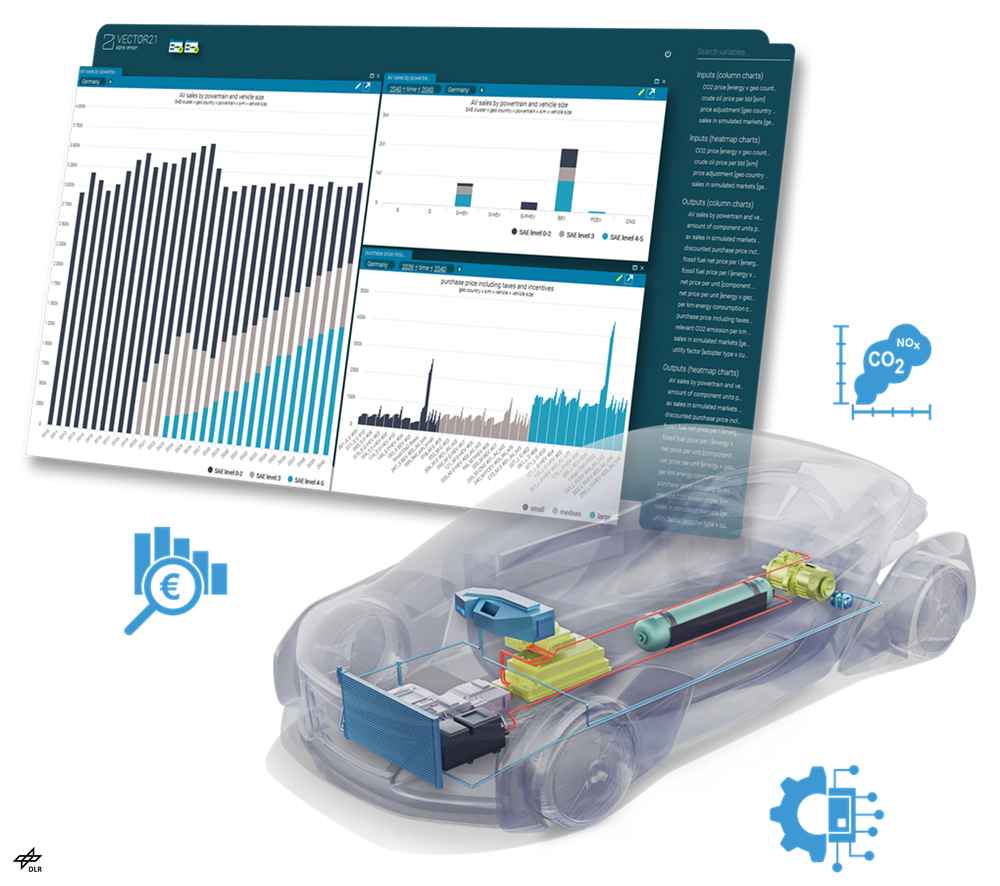

Vector21 Keyvisual 2026
Credit:
Since 2007, the DLR Institute of Vehicle Concepts has researched the key technologies and market mechanisms shaping vehicle adoption. We have built this knowledge into VECTOR21, a detailed bottom-up scenario and market analysis tool that combines agent-based customer modeling with discrete-choice purchase decisions. The model covers both passenger car segments and commercial vehicle weight classes. It simulates how powertrain technologies, automation levels, and circular economy elements diffuse across German and European markets through 2050.
Technology Impact
- Quantify market potential and production volumes for new components and vehicle technologies
- Stress test your own component developments against realistic market viability
- Assess how evolving battery chemistries and bidirectional charging affect competitiveness
- Track ADAS and automation diffusion across car and truck markets
- Analyze fleet level adoption of circular economy elements, from battery second life to recycling
Strategic Insights
- Techno-economic assessment of vehicle concepts across segments and weight classes
- Model emerging technologies: battery chemistries, bidirectional charging (V2G), autonomous driving levels
- Compare market entry conditions across varying socioeconomic and regulatory scenarios
- Identify the barriers and success factors that determine technology adoption speed
Policy Implications
- Design and test policy measures such as CO₂ fleet regulation, subsidies, or fuel and energy pricing before implementation
- Quantify greenhouse gas impacts of regulatory packages and transformation pathways
- Provide an independent evidence base for national and European automotive strategies
- Support cross sectoral climate neutrality assessments in combination with other DLR models
VECTOR21 has informed projects including the Strukturstudie BW 2023, Ariadne and BEniVer, and is currently applied to policy quantification for the Federal Ministry of Transport. The model is continuously extended to address new research questions.
Let's talk
If you are weighing how a new technology, component, or policy measure will perform in the market, we are glad to discuss your specific question and how VECTOR21 can provide an independent, data driven answer. Contact us to arrange a conversation.
VECTOR21
Your consent to the storage of data ('cookies') is required for the playback of this video on Quickchannel.com. You can view and change your current data storage settings at any time under privacy.
VECTOR21
Credit:
What Makes VECTOR21 Unique
Neutral and Scientifically Founded Consulting
VECTOR21 provides political and economic decision-makers with independent, science-based market analyses. The software can be continuously extended and adapted to specific research questions.
Research-Driven Innovation
Ongoing research and technology assessments ensure that VECTOR21 reflects the latest developments in vehicle concepts and provides scientifically robust market analyses.
Regional to International Market Modelling
The software enables market segmentation at regional level (e.g., NUTS3, RegioStaR4), incorporating country-specific policies as well as interdependent simulation of international markets.
Integrated and Regularly Updated Datasets
VECTOR21 is based on extensive, regularly updated input datasets. Simulations can start immediately, with users modifying only the inputs needed for their scenario.
Dynamic Scenario Development
Our team develops additional software functions and scenarios together with various internal and external partners. Core datasets can be shared across projects via GitLab and updated based on stakeholder inputs.
Intuitive Data Visualization
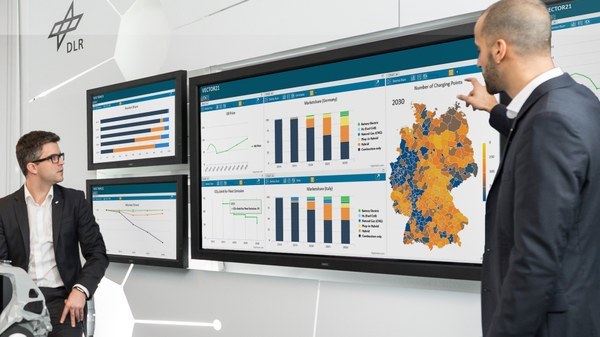
Complex data is prepared and discussed in an understandable way. Strategic conclusions can be drawn quickly through interactive result dashboards and scenario managers.
How VECTOR21 works
VECTOR21 Methods
Credit:
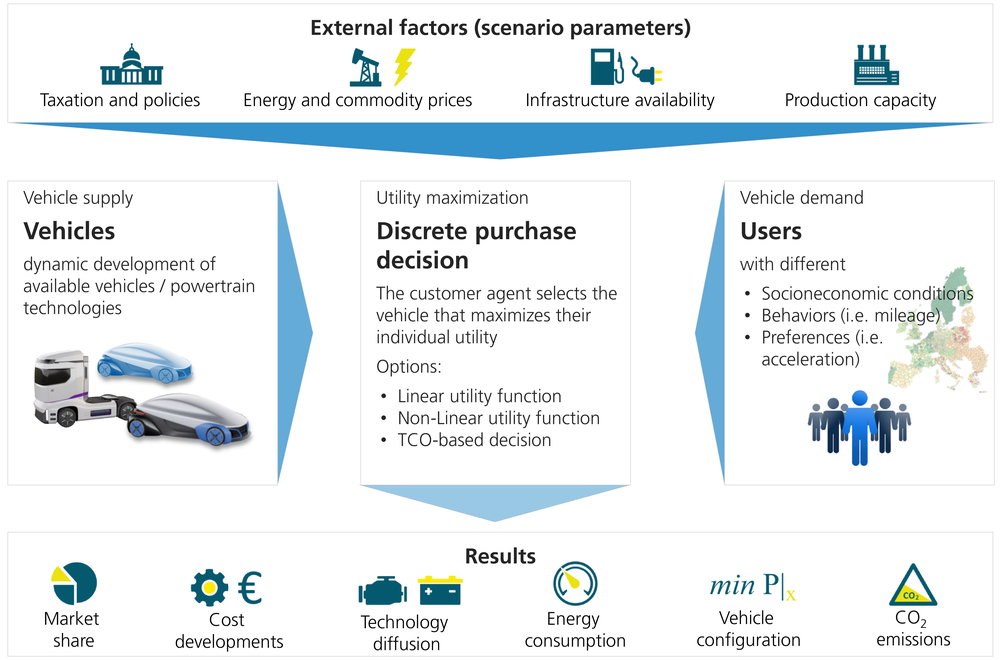
VECTOR21 divides the simulated market into various clusters. Each cluster, representing a certain market share, is represented by a customer agent with specific customer characteristics. On the supply side, the offered vehicles are dimensioned bottom-up based on the required vehicle components. Year by year, the discrete choice algorithm calculates the purchase decision of each customer agent.
Customer Side
A customer agent is modelled for each customer segment. The granularity of customer characteristics can be adjusted, as can their geographical distribution. A customer segment represents a group with similar socioeconomic characteristics (e.g., income, location, driving behaviour). In addition to private customers, a distinction can also be made between corporate take-home vehicles and fleet customers.
Utility-Based Purchase Decision
The purchase decision of each agent is simulated by an algorithm that compares the customer's needs with the characteristics of the offered vehicle. Each agent selects an offer and maximizes its utility function.
Factors Considered:
- Purchase price
- Operating costs
- Acceleration
- Range
- CO₂ emissions
- Charging speed
- Vehicle lifetime
- Bidirectional charging
- Safety
- Time benefit
Supply Side
The bottom-up generated vehicles feature detailed vehicle technologies and costs. VECTOR21 considers various vehicle segments and powertrain types:
Technology Type:
- Internal combustion engines incl. mild hybrid (gasoline, diesel), hybrid (HEV), plug-in hybrid (PHEV), battery electric (BEV), fuel cell (FCEV), compressed natural gas (CNG), synthetic fuels
- Different battery chemistries (NMC, LFP, Na-Ion, SSB)
- SAE Levels of automated vehicles
Passenger Cars:
- Size segments: Small, Medium, Large
Commercial Vehicles:
- Weight classes: 3.5 t, 7.5 t, 12 t, 18 t, 26 t, 40 t
- Vehicle classes: N1, N2, N3
The granularity of vehicle modelling as well as the predefined technology development steps can be adapted to the needs of our stakeholders. For each agent, the model generates a set of vehicle options that reflect the latest technological standards and cost developments in the automotive industry, including improvements in battery systems, electric motors, and power electronics.
External Factors

VECTOR21-Icons
Credit:
VECTOR21
Infrastructure Modelling
The regional distribution of infrastructure vailability
Political Influences
Country-specific taxes, subsidies and regulations
Supply-side Framework
Model availabilities, strategies to respond to CO₂ regulations, production constraints
Energy Costs
Modelling of energy prices from source to end user
Battery Techno-Economics
Cell chemistry-specific cost developments
VECTOR21 Simulation Results
The VECTOR21 simulation delivers a wide range of results that support your strategic decisions in vehicle markets. The most important results are:
Market Shares
Of powertrain systems and components in different socio-demographic and geographical segments
Cost Development
Of vehicles and vehicle components over time
Diffusion of New Technologies
With feedback loops regarding vehicle component costs
Energy Consumption
Development of energy and fuel demand of the vehicle stock
Emissions and CO₂ Limits
CO₂ emission balance of the vehicle fleet
Battery Capacity
Capacity and utilization of the battery electric vehicle fleet incl. discrete modelling of bidirectional BEVs
Further Information

Contact
Dr.-Ing. Stephan Schmid
Head of Department
German Aerospace Center (DLR)
Institute of Vehicle Concepts
Vehicle Systems and Technology Assessment
Pfaffenwaldring 38-40, 70569 Stuttgart