
Digital twins for integral vehicle safety
Digital twins are essential for vehicle safety analyses in order to assess the safety of passengers and vulnerable groups such as pedestrians. The institute develops complex crash models of innovative vehicle concepts in order to analyse the safety issues of future autonomous vehicle generations and develop suggestions for improvement.
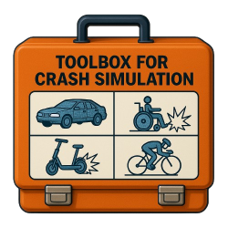


Future vehicle concepts, especially autonomous shuttles, will place completely new demands on crash safety. Due to their very different design, energy absorption mechanisms must be rethought and structurally integrated. In addition, the positioning of occupants in such vehicles is no longer clearly defined, which requires an expanded understanding of restraint systems and their protective effect in so-called "out-of-position" scenarios. In addition, the acceleration loads acting on the occupants in the event of a crash have changed and place new demands on safety features. There are also challenges for vulnerable road users such as pedestrians or cyclists, as the front design of autonomous vehicles differs from conventional designs.
In order to address these complex requirements, the Institute of Vehicle Concepts is developing digital crash models of future vehicle types - from scooters and wheelchairs to large autonomous shuttles. These digital twins enable realistic crash tests and serve as a development platform for innovative safety systems. By using detailed human models, a wide range of crash risks can be analyzed and the potential of new technologies for safe mobility in the future can be demonstrated.