
Analysis and energy simulation for rail vehicles - pySimRail simulation framework
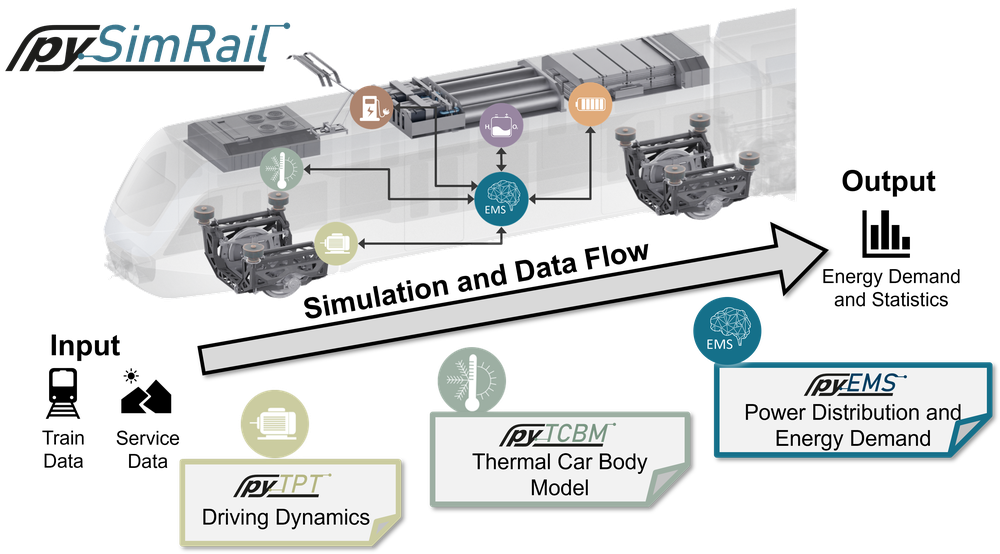
The energy flow in the operation of rail vehicles passes through a large number of complex processes - from the provision of energy via pantograph or fueling station to the intelligent control of energy sources (e.g. battery and fuel cell) through to efficient use for propulsion and the supply of internal consumers such as air conditioning. A holistic view of this entire energy path is essential for a needs-based, economical design and energy-optimized operation. We can map this with our holistic rail vehicle simulation framework pySimRail.

Motivation
Operators and vehicle manufacturers are faced with the challenge of integrating vehicles with alternative drive concepts on existing infrastructure without having extensive operating experience with these new technologies. Against this background, data-based, holistic planning is crucial, for which pySimRail provides the necessary insights:
- Based on operational requirements and existing infrastructure, vehicle manufacturers must evaluate new technologies, design the corresponding drive systems in a cost-efficient manner and develop energy-optimized operating strategies. pySimRail can also provide information on any necessary infrastructure measures during the overall design and evaluation process.
- During ongoing operation of the new vehicles, there is also a growing need for operators to systematically record and analyze fleet data in order to identify optimization potentials. By simulation, energy requirements, losses and operating strategies can be quickly evaluated. In this way, weak points can be identified and targeted measures can be developed to save energy and optimize energy management, charging and refueling processes, driving style, timetable and maintenance.
Research Portfolio
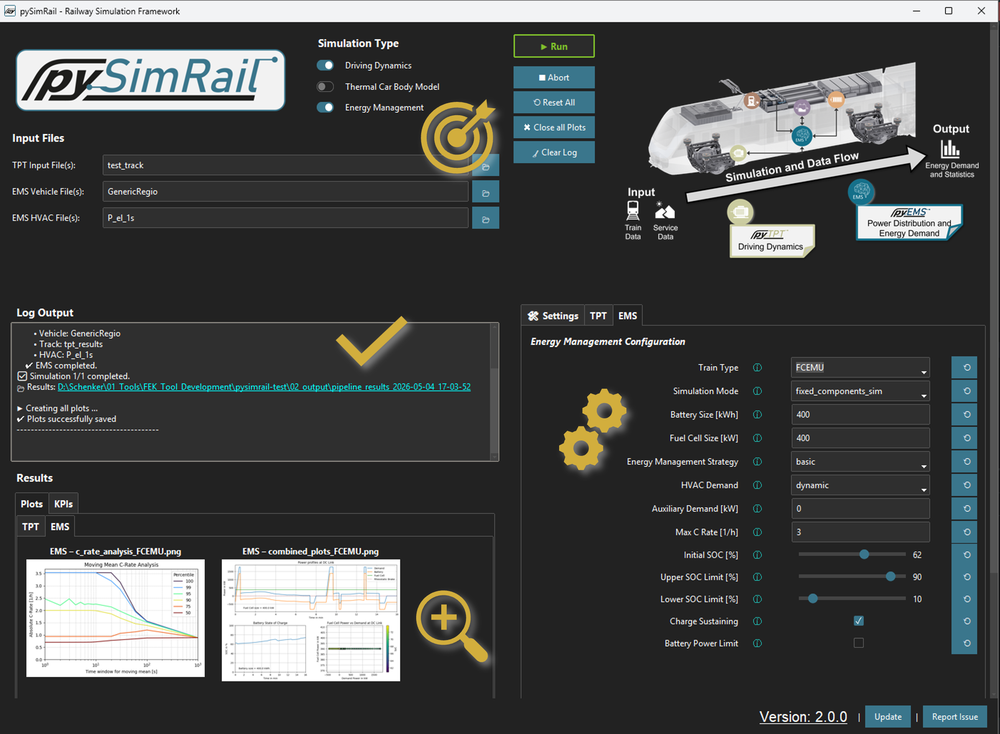
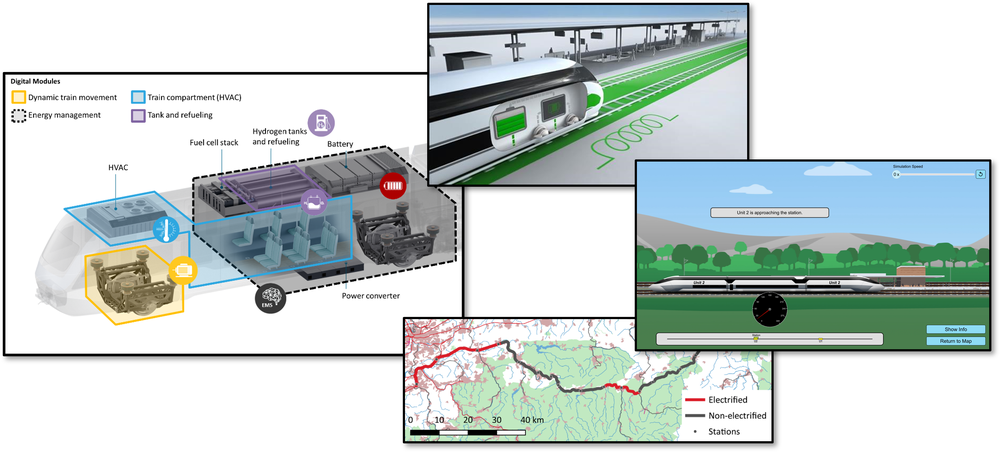
Building on our many years of experience, we develop digital system models with virtual component representations in order to generate holistic knowledge for sustainable and needs-based transportation solutions in rail transport. With pySimRail - a multi-level, modular Python framework - we can digitally map the entire operation sequence of (alternatively powered) rail vehicles. It combines detailed submodels for:
- Longitudinal dynamics to simulate vehicle movement,
- Passenger compartment model with a focus on heating, ventilation and air conditioning,
- Energy management system for intelligent power distribution and efficient, component-friendly operation management (e.g. battery and fuel cell),
- Smart Energy and Speed Optimizer Rail (SEnSOR) - optimization module
Our approach provides support both in the concept phase during the development of economically feasible vehicle and infrastructure concepts and during ongoing operation through a comprehensive service for recording, analyzing and optimizing real operating data of alternative drive systems.
Projects References
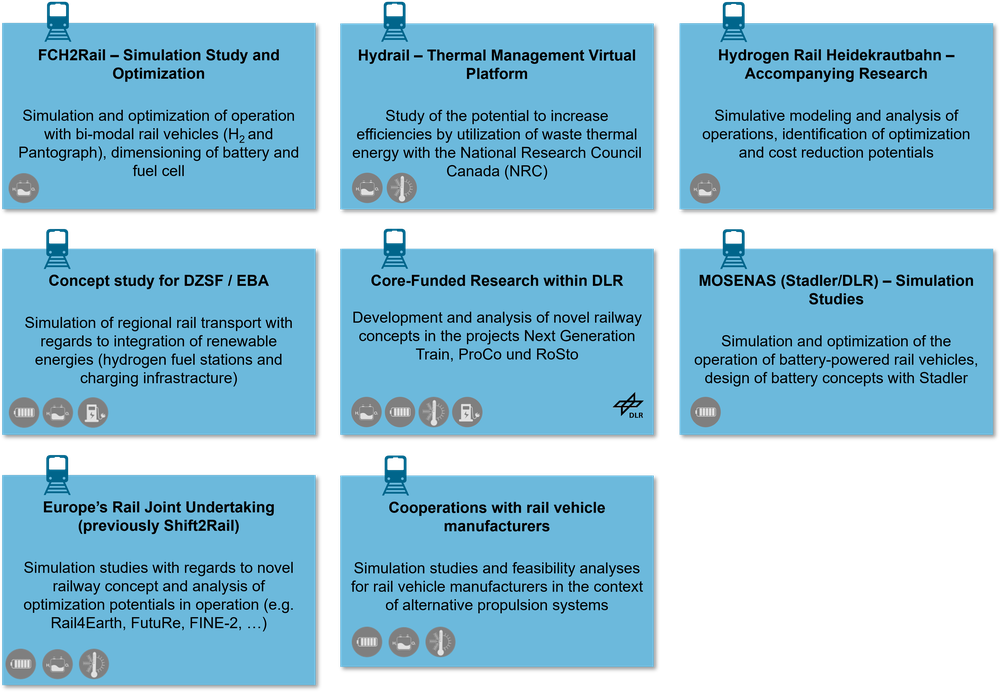
- FCH2Rail - FCH2RAIL – DLR Transport
- Research project DZSF - Forschungsprojekt DZSF – Versorgungskonzept und Integration von erneuerbaren Energien in neuartige Tank- und Ladeinfrastrukturen
- Europe's Rail - Flagship Project 4: RAIL4EARTH - A sustainable and green rail system - Europe's Rail - Flagship Project 6: FUTURE - Regional rail services/Innovative rail services to revitalise capillary lines - Europe's Rail
- Hydrail project
- Core-funded research - ProCo - Propulsion and Coupling - FCHPP
- Hydrogen Rail Heidekrautbahn - H2BAR - Begleitforschung Fahrzeuge und Tankstelle
- MOSENAS - MOSENAS – „Modularer skalierbarer Energiespeicher für einen nachhaltigen Schienenpersonennahverkehr“
Publications
- Accompanying research Heidekrautbahn - Description of simulation framework and application to real hydrogen train operation: electronic library - Holistic Modeling and Optimization of Hydrogen-Powered Trains for Zero-Emission Railway Operation
- Research report DZSF - Supply concept and integration of renewable energies in novel refueling and charging infrastructures (DE): DZSF - Forschungsberichte - Versorgungskonzept und Integration von Erneuerbaren Energien in neuartige Tank- und Ladeinfrastrukturen
- FCH2RAIL - Application to Fuel Cell Power Pack: electronic library - The FCH2RAIL Project: A Demonstration of a Modular Fuel Cell Hybrid Power Pack
- FCH2RAIL - Dimensioning of battery and fuel cell: electronic library - IRSA 2023 Proceedings: Comparison of simulative methods for dimensioning of fuel cell-battery hybrid powertrains in FCH2Rail and VirtualFCS
- MOSENAS - Simulations for Efficient Indoor Air Conditioning: electronic library - Efficient Air Conditioning of Battery-Electric Multiple Units (BEMU): Modeling and Optimization
- ProCo (DLR core-funded research) - Optimization of driving style and energy management for any type of rail vehicle: electronic library - Optimization algorithm for minimizing railway energy consumption in hybrid powertrain architectures: A direct method approach using a novel two-dimensional efficiency map approximation
- ProCo (DLR core-funded research) - Optimization of recharging infrastructure based on simulation series: electronic library - AN OPTIMIZATION MODEL FOR COST-MINIMAL CONFIGURATION OF BATTERY TRAINS AND RECHARGING INFRASTRUCTURE
- ProCo (DLR core-funded research) - Dimensioning of drivetrain components: electronic library - Standardized Sizing for Alternative Drivetrains in Rail Vehicles: A Modular Approach for Enhanced Efficiency and Cost Reduction