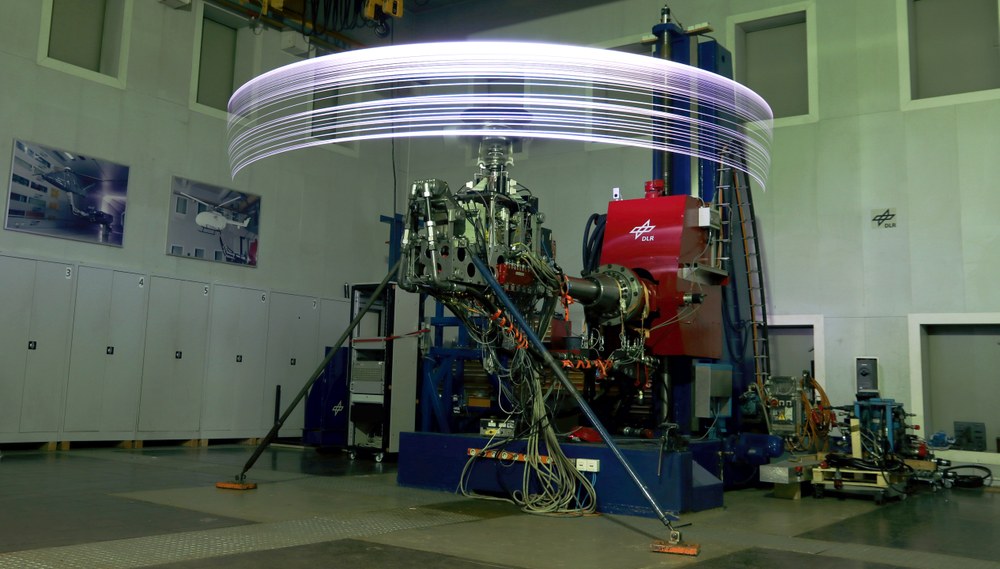
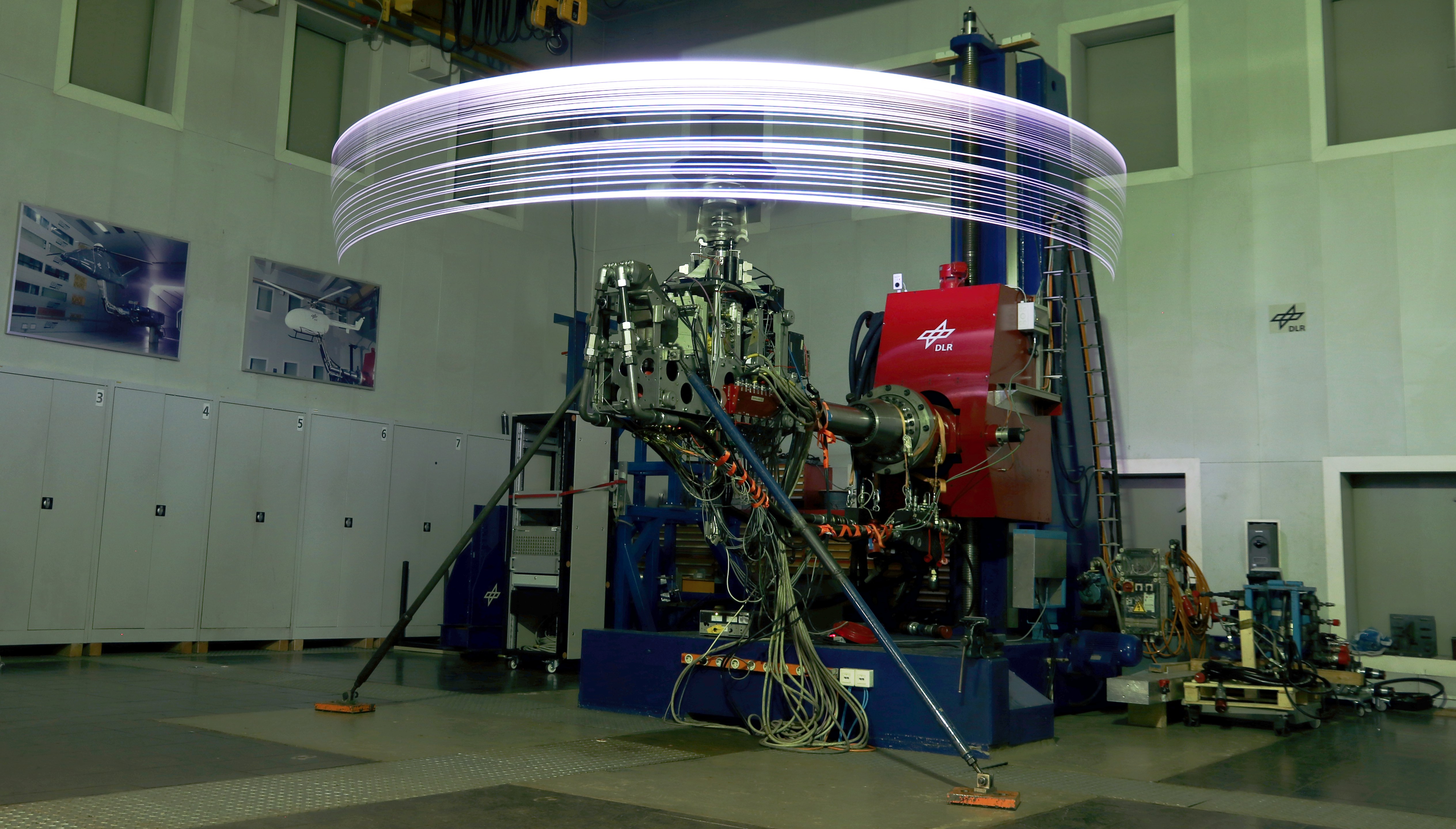
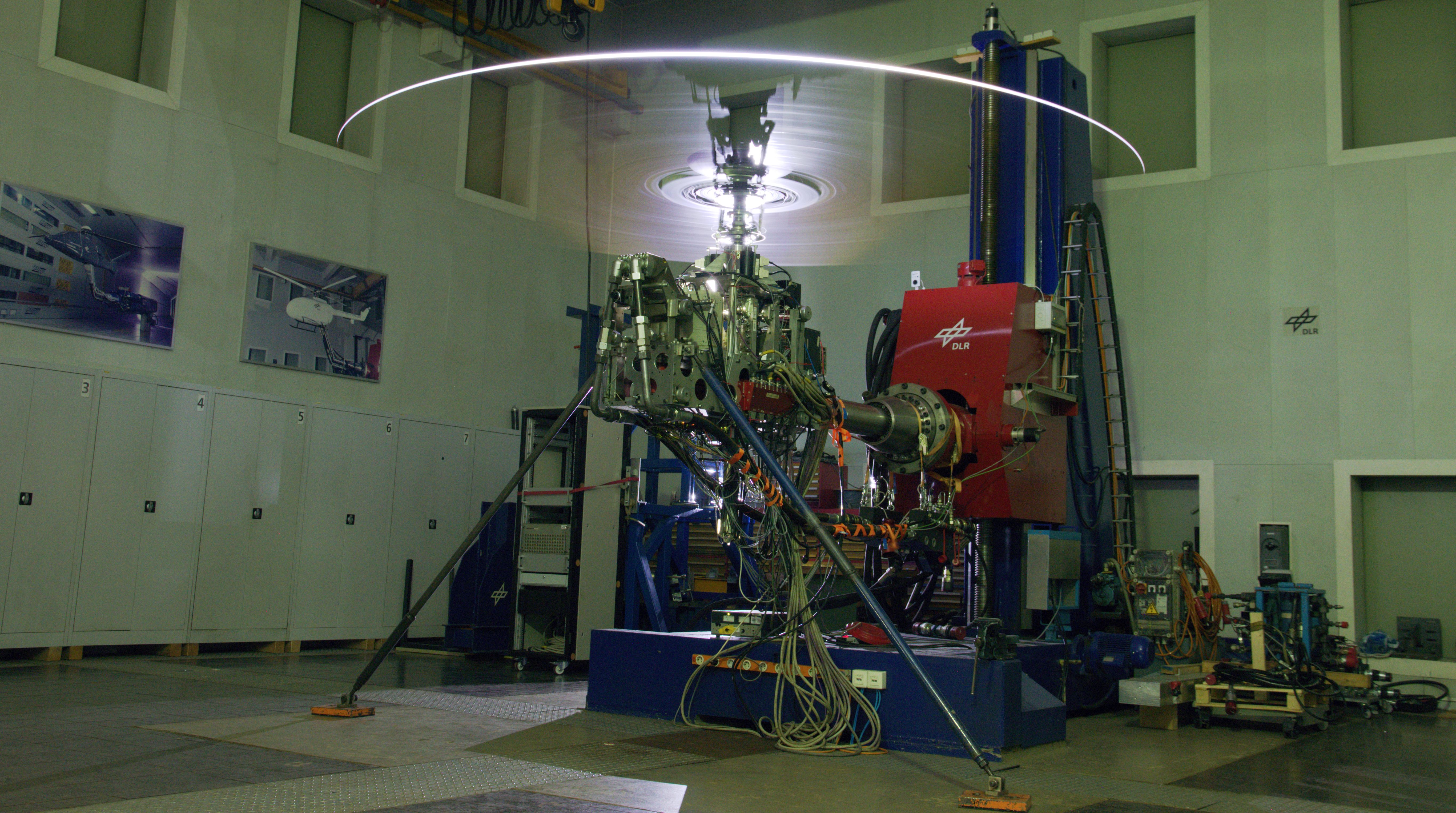
Spinning up the rotor from rest to nominal speed. The blade tip LEDs generate a light trail that visualizes the flapping of the blades as the thrust increases.
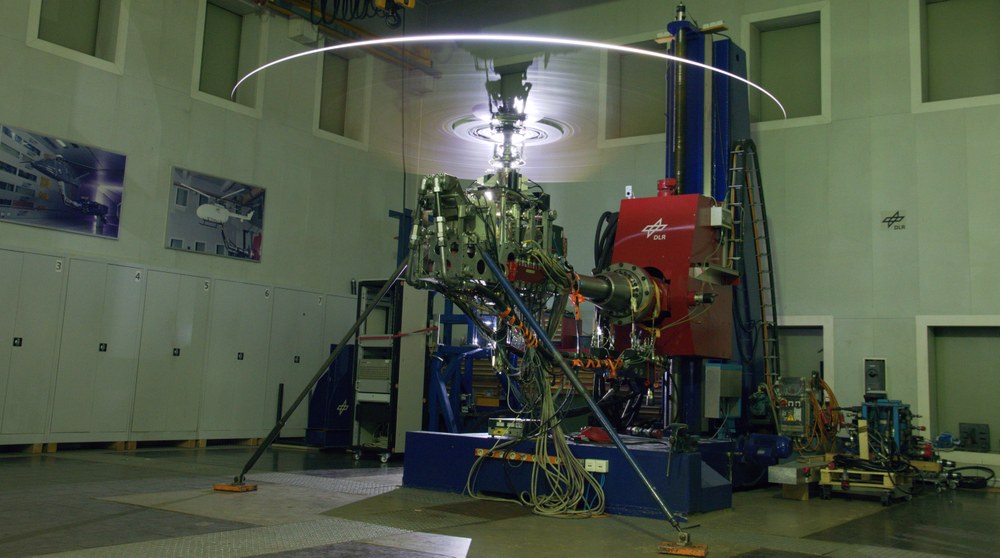
STAR rotor at nominal speed. The blade tip LEDs generate a light trace that visualizes the blade tip path plane and, with active higher-harmonic control, the corresponding periodic waves in the blade tip path plane.
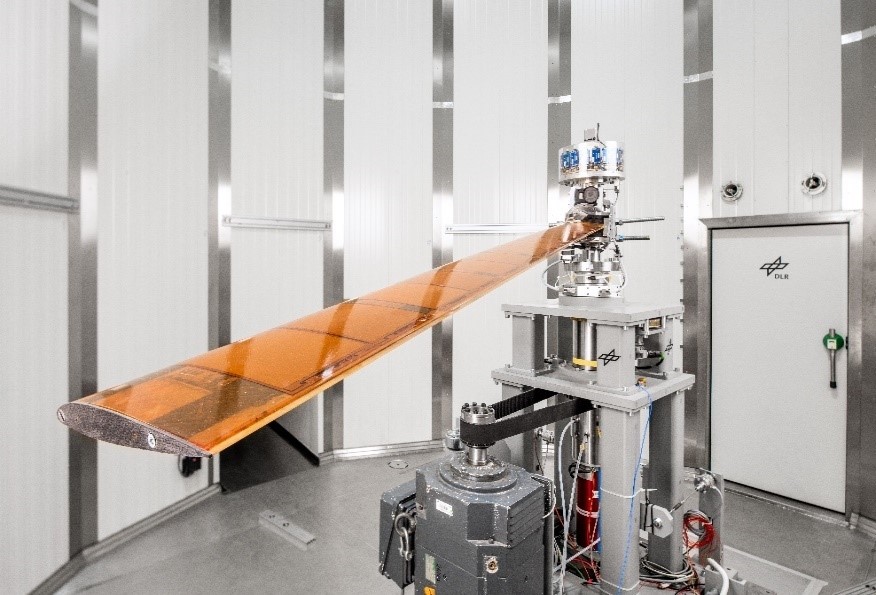
Individual rotor blade pre-test in the rotor tower
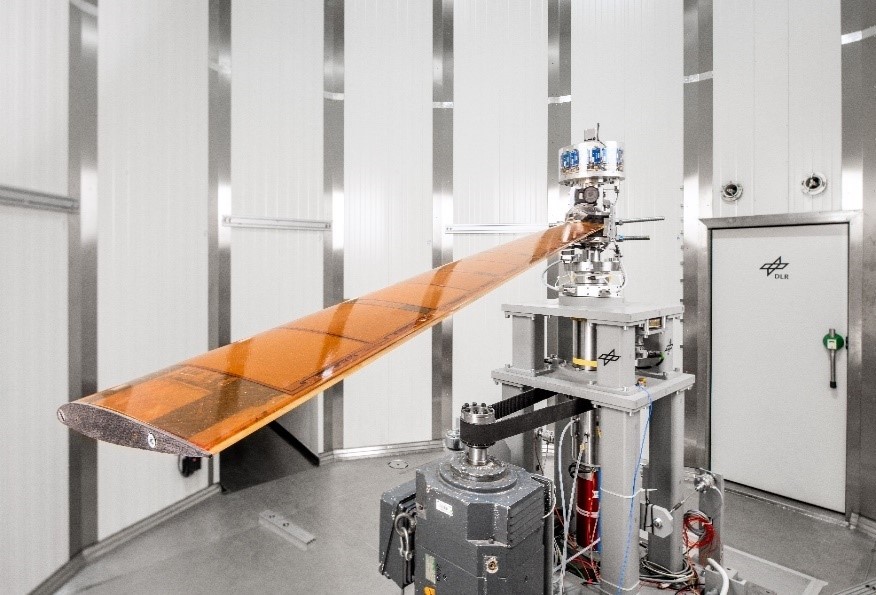
Single STAR rotor blade in the centrifugal rotor tower. The individual actuators on the blade surface are clearly visible. Here, the blades are individually tested for the performance of the actuators under centrifugal force.
In addition to the lift required for flight and control, helicopter rotors also generate a considerable level of vibration and noise. For a long time, attempts have been made to reduce (noise) or even eliminate (vibrations) these undesirable characteristics through rotor blade design, the number of rotor blades and additional high-frequency blade control. Despite good test results from active blade pitch angle adjustment at the blade root, or from flaps in the outer area of the rotor blades, these systems have not been able to establish themselves due to their mechanical complexity, weight, costs and approval problems.
As an alternative, STAR is working with piezo-ceramic actuators incorporated into the blade skin which, when an electrical voltage is applied, twist the rotor blade elastically like an artificial muscle in order to achieve the desired noise and vibration reduction and, if necessary, to improve the efficiency of the rotor by better adapting it to the respective flight condition. This active twisting of rotor blades no longer has any mechanical elements and is only slightly affected by the large centrifugal forces acting on the rotor blades; it therefore represents a pioneering technology.
The rotor blades were developed and built at the Institute of Lightweight Systems together with the Institute of Flight Systems. An international team consisting of NASA, the U.S. Army, Office national d'études et de recherches aérospatiales (ONERA), Korea Aerospace Research Institute (KARI), Konkuk University and Japan Aerospace Exploration Agency (JAXA) was recruited in 2005 to co-finance the test of the rotor and actuators in the DNW-LLF's (DNW-LLF, Large Low-speed Facility) large subsonic wind tunnel, which is scheduled for October 2025. A management team, a prediction team and a test team were established with the participation of all partners. Since then, simulation activities have been underway with all partners in preparation for the test in order to identify the most important operating conditions and the impact of active twist control: Hovering flight with active twisting to increase efficiency, forward flight up to maximum speed, noise and vibration reduction by means of active twisting during landing approach, maximum rotor thrust during cruise flight and reduction of flow separation due to active twisting, high rotor advance ratios at reduced rotational speed.
During the test, all partners will jointly accompany the test execution and participate in the on-site evaluation for rapid assessment of the measurements; the Institute of Flight Systems of DLR is in charge of the test. After the test, a joint evaluation over several years is planned. Subsequently, an international workshop for worldwide participation is planned with a selection of the data in order to provide a basis for validation of the various simulation methods.