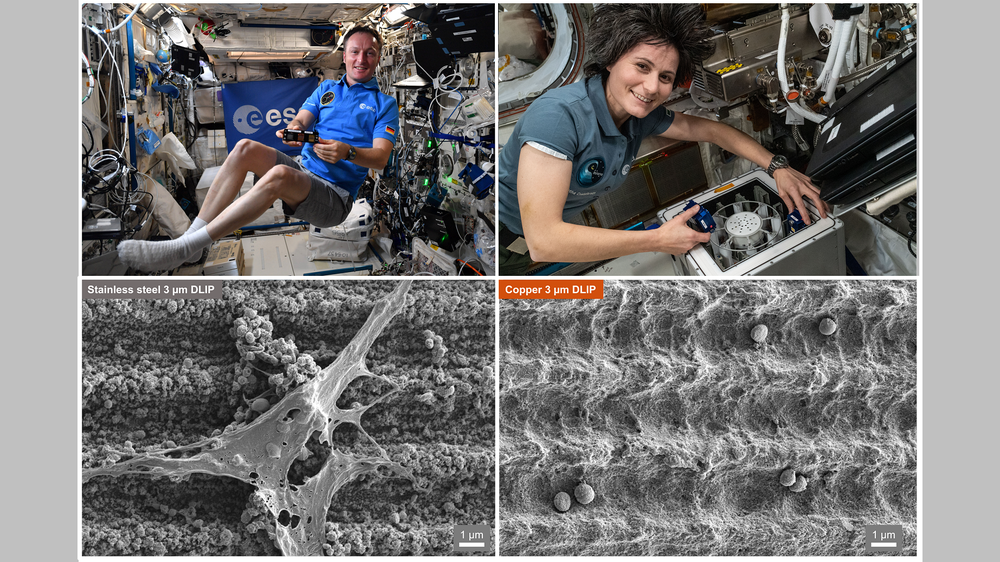
The images show two experiments conducted on the International Space Station (ISS) to investigate antimicrobial materials under real space conditions. The "BIOFILMS" and "Touching Surfaces" experiments analyse the effect of different surfaces on biofilm formation and antimicrobial efficiency. One focus is on changes in effectiveness due to repeated contact with the materials in the course of everyday astronaut activities. The investigations were carried out during missions on the International Space Station, including with the participation of Matthias Maurer as part of the Cosmic Kiss mission in close cooperation with Bonn-Rhein-Sieg University of Applied Sciences and Saarland University.
Image: 2/5, Credit:
DLR/ESA
Biotechnological use of microorganisms
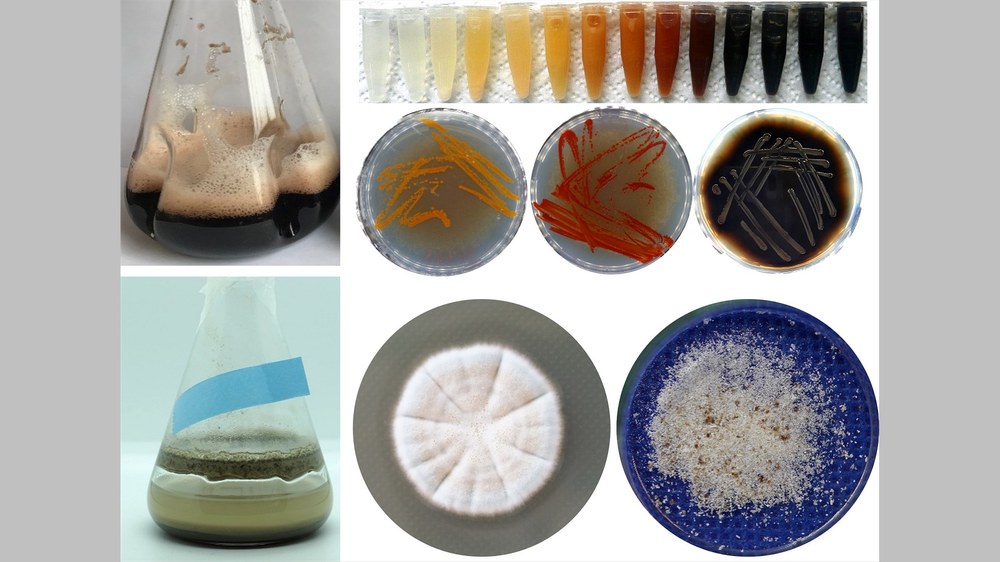
The figure illustrates various approaches to the biotechnological use of microorganisms. One focus is on the isolation and investigation of pigment-forming microorganisms from (extreme) habitats, including the production of melanin and other pigments with functional properties, for example with regard to radiation protection. In addition, the figure shows an example of microbial bioleaching processes in which microorganisms such as Penicillium simplicissimum are used to mobilise and release metals from mineral substrates, in this case simulated moon dust. This work contributes to the evaluation of microbial resource utilisation strategies.
The Aerospace Microbiology Working Group conducts research into maintaining human health in environments relevant to aviation, space travel and transport. The aim of our work is to systematically identify microbial risks as well as the functional properties and potential uses of microorganisms, to evaluate them scientifically and to derive suitable preventive, technical and biotechnological measures – both for public transport and for astronautical space missions.
A key focus of the working group is the investigation of microbial contamination and microbial communities in closed environments in the context of transport, aviation and aerospace. Microbial exposures and changes in environmental microbiomes are recorded and evaluated in order to establish a basis for maintaining human health and for appropriate preventive measures. In addition, strategies for controlling microbial contamination and the use of suitable materials and processes are being investigated.
We are also investigating the survival and adaptation mechanisms of microorganisms under extreme environmental conditions such as weightlessness, radiation, vacuum and dehydration. This work is carried out in laboratories and space simulation facilities as well as in real space experiments, for example on the International Space Station (ISS). In addition, we contribute to microbiological quality assurance in the context of issues relating to the detection, assessment and limitation of microbial contamination in space missions (planetary protection).
Microbiological aspects of human health
We record the extent, composition and dynamics of microbial contamination in aviation, space travel and transport-related environments, particularly in passenger areas and cabins. In addition to monitoring and characterising microorganisms, we evaluate preventive and control measures, including antimicrobial materials, surface coatings and innovative disinfection concepts. Another focus is the microbiological monitoring of enclosed spaces related to local public transport. Long-term stays in space affect human physiology. How this changes the human microbiome and thus affects the health and performance of astronauts is also one of our fields of research. In various studies, including bed rest studies in a head-down position as a model for weightlessness, we are investigating the effects of simulated microgravity on the human microbiome and researching possible countermeasures.
Microbiological adaptation mechanisms and functional utilisation
Extreme habitats are considered natural reservoirs for microorganisms and enzymes with functional potential for technical, medical and preventive applications. One focus of our research is the investigation of microbial processes for resource utilisation under extreme conditions, including in the field of biomining, where microorganisms are studied for the extraction of raw materials from regolith – both with a view to Earth-based applications and future space missions.
In addition, we are investigating the molecular and physiological mechanisms that enable microorganisms to survive under environmental stress such as radiation, dehydration or altered gravity. In addition to studies on human pathogenic strains, this also includes studies on extremophilic and pigmented strains isolated from extreme habitats. These organisms are analysed with regard to their functional properties, particularly in relation to their potential contribution to biological radiation protection for maintaining human health in extreme environments.
We also investigate microbial interactions, molecular adaptations and growth under real and simulated space conditions. For example, using fluorescence-based methods, we analyse processes such as bacterial conjugation in flight experiments, including with the FLUMIAS microscope system. These investigations provide important insights into the possible changes in the adaptation and propagation mechanisms of microbial properties under microgravity and contribute to the assessment of potential risks to human health in closed space systems.