
Atomic sensor at the quantum limit
In a collaborative project between the Optical Frequency Metrology Department at the DLR site in Hanover and the Leibniz University, as part of the Collaborative Research Centre DQ-mat (Designed Quantum States of Matter), the team led by Carsten Klempt has now, for the first time, demonstrated the operation of an atomic quantum sensor close to the Heisenberg limit. The results of this work have been published in the journal Nature Physics.
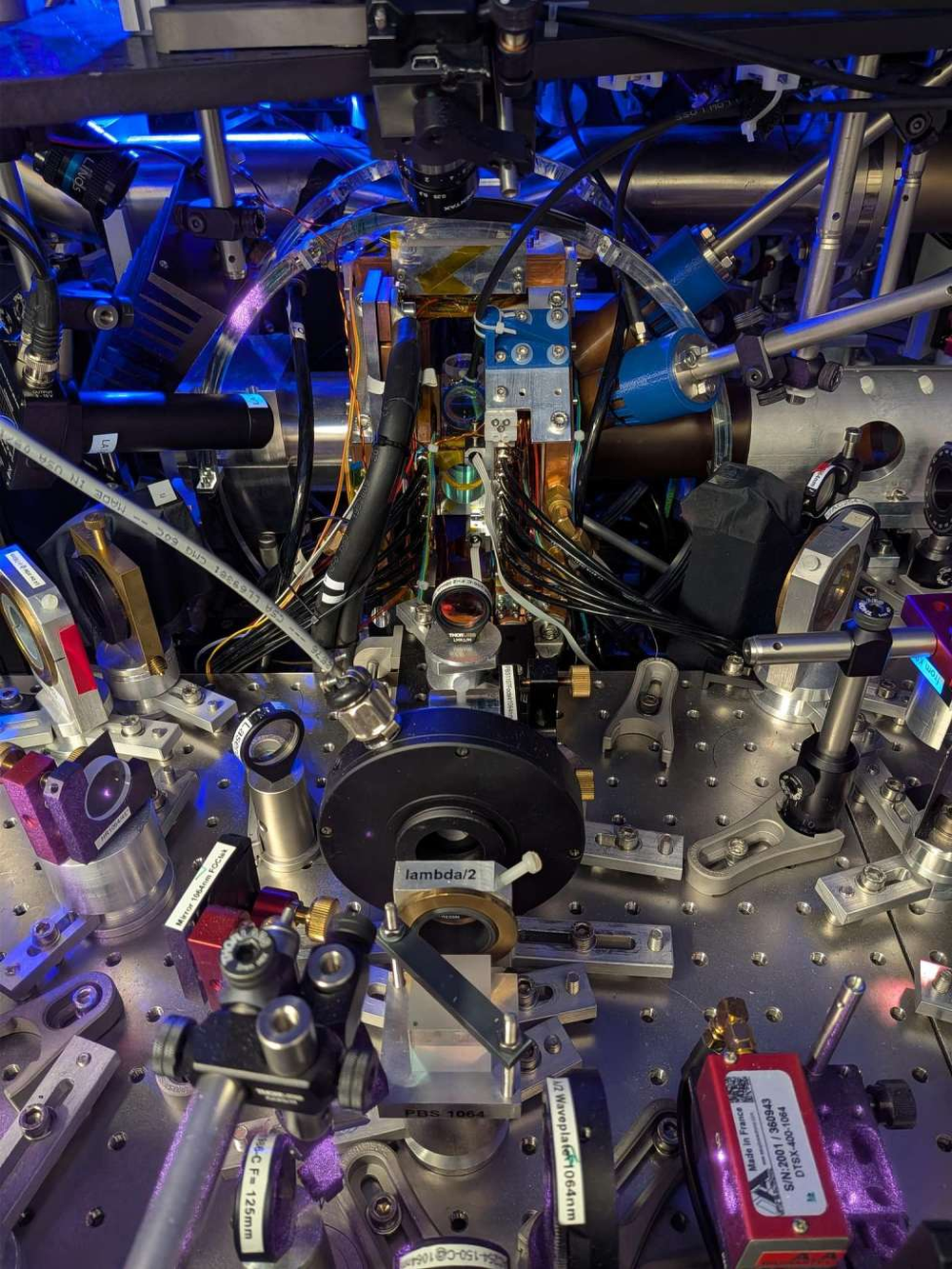

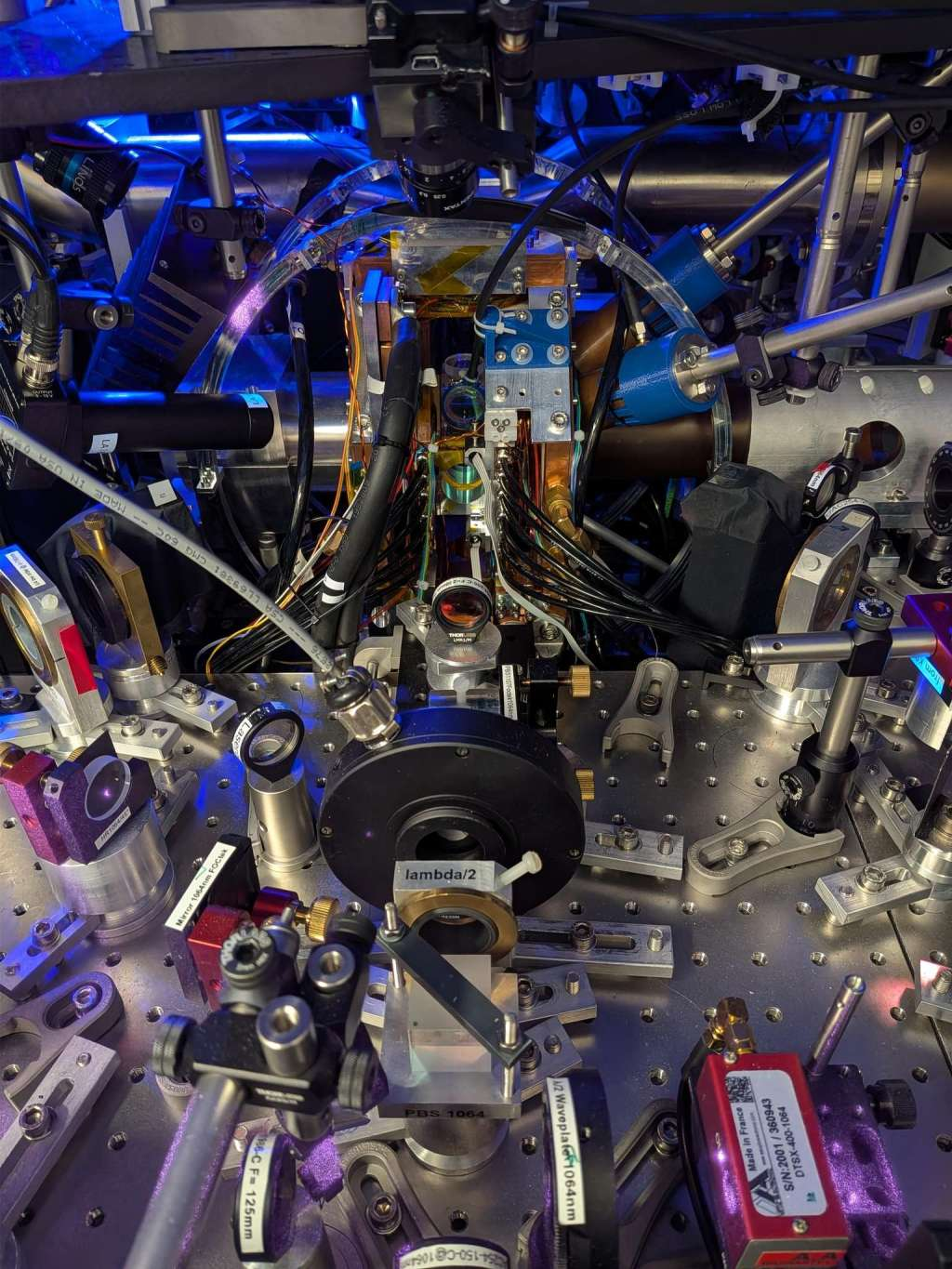
QAI - Experiment
The "Quantum Atom Interferometer" was developed in the group of Prof. Dr. C. Klempt.
The resolution of quantum sensors is fundamentally limited by what is known as the Heisenberg limit. Resolution at the Heisenberg limit can only be achieved by entangling the atoms with one another. Quantum mechanical entanglement – as is also used in the operation of quantum computers – refers to correlations between atoms that cannot be explained by our conventional intuition.
An essential prerequisite for this demonstration is improved fluorescence detection. Using six intersecting laser beams, the ensemble of atoms is illuminated in such a way that the atoms barely move and heat up only slightly during the process. This significantly increases the signal from each individual atom, allowing it to be clearly distinguished from technical noise and background light: single-atom resolution has been achieved.
Such a precise measurement of the quantum state of many indistinguishable particles – in this case, a Bose–Einstein condensate (BEC) – is a genuine breakthrough in the field. Until now, this capability has largely been the preserve of interferometers that operate with light particles (photons). To demonstrate control over the quantum system at this ultimate single-particle level, an iconic quantum interference phenomenon – the Hong-Ou-Mandel effect – was observed. Through multi-particle interference, the output states are occupied exclusively by an even number of atoms. Such a parity signal could be used directly in the future for high-precision measurements in atomic interferometers.