
Dr. -Ing. Dimitrios Milakis for the sixth time among top 2 % of the Stanford‑Elsevier ranking

DLR
- Dr‑Ing. Dimitrios Milakis for the sixth time among top 2 % of the Stanford‑Elsevier ranking in the field of logistics and transport.
- Honoured for his globally influential research on the interplay between transport innovations and societal dynamics.
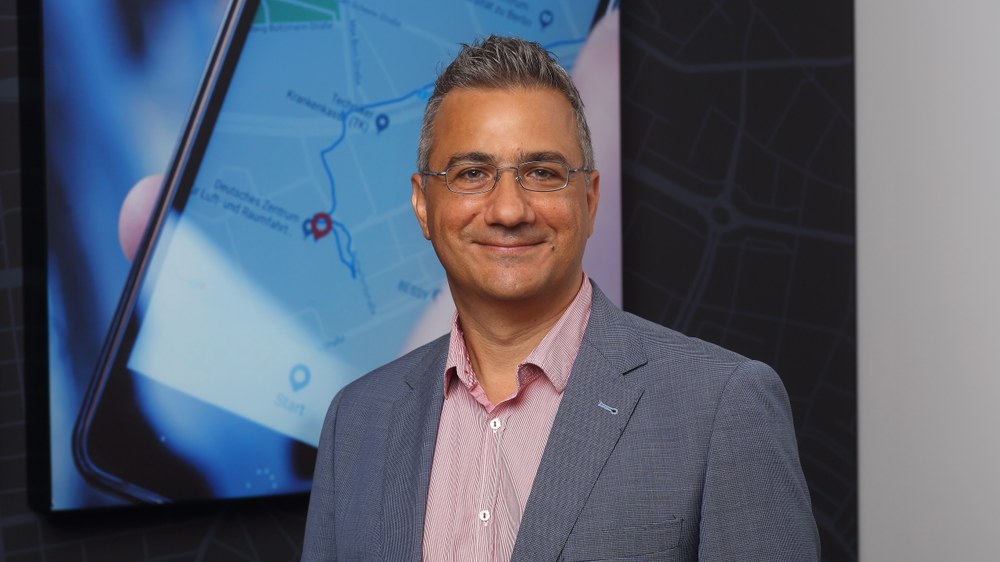
Dr‑Ing. Dimitrios Milakis – since 2018 a staff member at the DLR Institute for Transport Research – is for the sixth consecutive time among the world’s top 2 % of researchers in the Stanford‑Elsevier ranking for the field of logistics and transport. The ranking is a list developed at Stanford University in collaboration with the scientific publisher Elsevier, which identifies the top 2 % of researchers worldwide using standardised citation metrics.
Human beings at the centre of transport innovations
With an engineering background, Dimitrios Milakis has specialised in the fields of transport geography, planning and policy. He primarily examines the interaction between transport innovations and societal dynamics, adopting a socio‑technical perspective that places societal actors at the centre of innovation. He advocates expanding innovation processes to include a societal perspective and linking technical developments more closely with societal requirements and impacts.
Worldwide research impact
His work on transport innovations and society is the most frequently read and cited in this field. Half of his publications (50 %) rank globally within the top 10 % most cited (according to Scopus). Moreover, roughly 62 % of his outputs are cited in policy documents from over 50 institutions across 22 countries, including the European Union, the United Nations, the OECD, the World Bank and the Council of Canadian Academies. They have a strong impact on UN Sustainable Development Goals 11 (Sustainable Cities and Communities) and 9 (Industry, Innovation and Infrastructure).
Milakis has led, contributed to and advised several research projects in Greece, the Netherlands, Germany, Norway and under EU research programmes on transport innovations and society, the interactions between land use and transport, as well as on human mobility and bicycle perception. He has also held teaching and research posts at leading universities, including Delft University of Technology, the University of California, Berkeley, the Technical University of Munich and the National Technical University of Athens.
In my research, I strive to make complex socio-technical mobility systems understandable – to connect the dots – so we can design transport innovations and policies that are deeply beneficial for society
Selection of research contributions from the last five years:
- Van Acker, V., Cornet, Y., Milakis, D., Malichova, E., Ojeda Cabral, M., 2025. Understanding worthwhile travel time: an empirical study of travel experiences across travel modes. Transportation Research Part A: Policy and Practice 192, 104336.
- Milakis, D., Seiber, D., 2024. The illusion of the shared electric automated mobility transition. Transportation Research Interdisciplinary Perspectives 26, 101171.
- Milakis, D., 2024. Beyond Rockets: transport planning for permanent space settlements. Transport Reviews 44(1), 1-7.
- Kroesen, M., Milakis, D., van Wee, B., 2023. Automated vehicles: Changes in expert opinions over time. Transport Policy 136, 1-10.
- Milakis, D., Müller, S., 2021. The societal dimension of the automated vehicles transition: Towards a research agenda. Cities 113, 103144.
- Pangbourne, K., Stead, D., Mladenovic, M., Milakis, D., 2020. Questioning Mobility as a Service. Unanticipated societal and governance implications. Transportation Research Part A: Policy and Practice 131, 35-49.