PowerForecastMapper2MarketPFM2M
Charging infrastructure on schedule: PowerForecastMapper launches on the market
- The DLR transfer project PowerForecastMapper2Market (PFM2M) is developing the PowerForecastMapper (PFM) to market readiness within Germany between 1 February 2026 and 31 July 2027.
- Requirements and demand were identified through discussions with 37 stakeholders. Based on this data, the PFM is set to become a reliable, regularly updatable and intuitive tool.
- The technology transfer will take place via a licence granted to the commercial partner DBI, which is developing and operating a platform for the marketing and distribution of the tool. A portion of the licence revenue will be returned to the DLR.
The expansion of electric mobility requires an efficient and comprehensive charging infrastructure. However, planning such an infrastructure is fraught with uncertainty, as charging demand will increase at varying rates across different locations and at different times. With PowerForecastMapper (PFM), the German Aerospace Centre (DLR) has developed a digital tool that can be used to model the development of vehicle fleets and to reliably forecast charging demand across various scenarios. Suitable locations are identified using aerial image analysis and interactive criteria catalogues, and assessed on the basis of their revenue potential. In the PowerForecastMapper2Market (PFM2M) transfer project, DLR is now bringing the tool to market maturity in collaboration with its industry partner, Digital Building Industries (DBI).
From charging demand to automated site pre-selection
PFM combines data and models from various fields of research: the tool forecasts the development of vehicle fleets, including new registrations, up to 2050, taking into account powertrain types, battery technologies and the future availability of functions such as bidirectional charging. Based on observed mobility behaviour – including data from Germany’s largest mobility survey, covering over one million household journeys – charging processes, charging power and energy consumption are modelled for every hour of a typical week and broken down by charging location type.
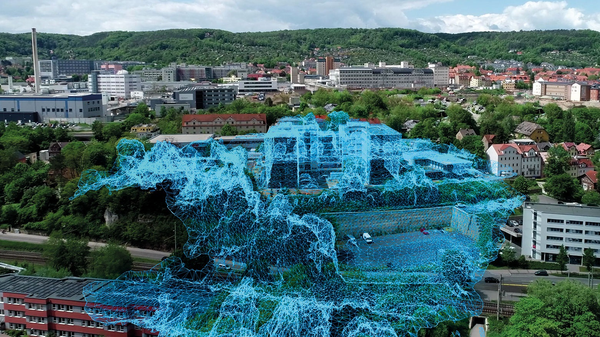
The forecast is validated using real-world data: for selected regions, the modelled number of charging sessions was compared with the observed utilisation of charging points in 2024 and calibrated accordingly. To this end, PFM utilises empirical data on existing charging points, their configurations and utilisation rates, and the revenue potential of additional charging points. The results are analysed interactively in a web application. As vehicles charge where they are parked, the PFM extracts parking spaces across the board from aerial imagery, including semi-public and private car parks. Potential sites are assessed using geodata such as pavement width, tree protection, listed building status, cycle paths or distance to the electricity grid, in order to automatically classify them as ‘suitable’, ‘with restrictions’ or ‘unsuitable’.
37 stakeholder discussions are paving the way for a market-ready tool
The development of PFM2M is based primarily on discussions with 37 stakeholders, during which requirements and the associated demand were identified. The market readiness called for in these discussions is to be developed systematically, whilst the demand from two stakeholders closely involved in the project will be met directly. The agreed success criteria include, amongst other things, that the technology is in demand from industry; that at least one industrial partner, in collaboration with DLR, launches a new product or service onto the market; and that a draft licensing agreement with at least one industrial partner has been finalised and is ready for signing.
Digital Building Industries is developing a platform and sales operations
Transfer takes place through the licensing of PFM to the commercial partner Digital Building Industries (DBI). DBI is developing back-end and front-end of a platform through which PFM is to be offered on the market, and is responsible for distributing the tool via licensing and sales to customers. A portion of the licence revenue is channelled back to DLR.
During the first half of the project, components will be further developed specifically for use by organisations that have already signed a letter of intent. These components will be licensed as a basic version and integrated into the licence holders’ digital platform. In parallel, the development of further requested functions will continue, with the aim of replacing the basic version with a full version by the end of the project, thereby attracting additional charging station operators and public sector stakeholders to use PFM and securing them as licence holders through contractual agreements. Target groups include operators of public and private charging infrastructure, property and land owners, network operators, electricity generators, as well as regulatory and political stakeholders.
The Institute of Remote Sensing Methodology, the Institute of Transport Research, the Institute of Vehicle Concepts and the Institute of Data Science are participating in the PFM2M project.
Participating institutes and organisations