Wind turbines are exposed unprotected to all weather events that occur. Today's turbines are unable to react adequately to events with rapid changes in wind speed and direction, often resulting in turbine throttling or even emergency stops.
In future, simulations will be used at DLR to forecast loads in the system and electricity production with the help of short-term weather forecasts. The aim is to improve the turbine behavior and to reduce structurally damaging loads and ensure a reliable energy supply. Measurement data from the research wind farm WiValdi is used to compare the simulation models with reality.
What impact do cold pool events have on wind turbines?
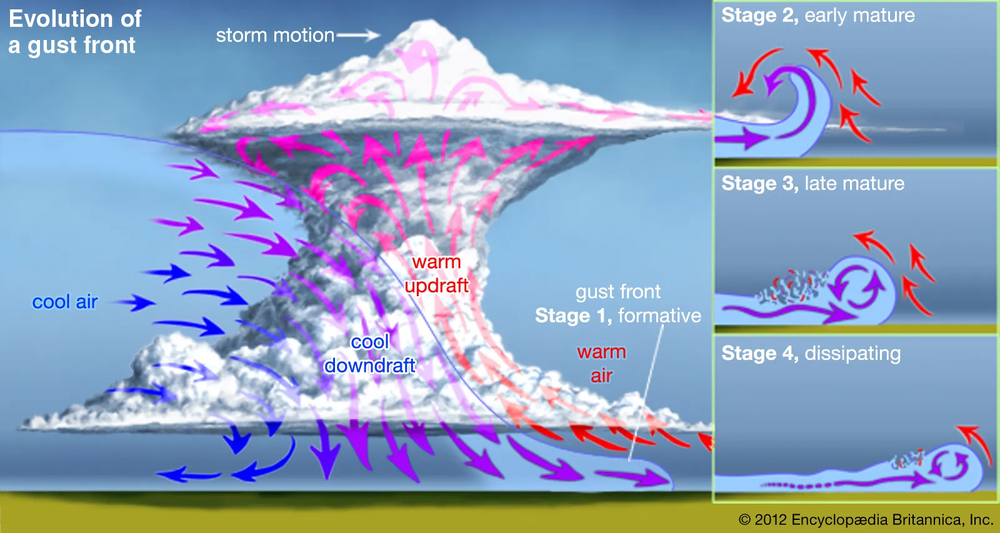
Cold pools, in the meteorological sense, are cold air masses that appear due to evaporative cooling and disseminate on the ground. When the cold pool front passes the observer, the temperature drops and the wind speed and direction change. The causal precipitation then begins. Such events occur many times a year in northern Germany, for example, and pose a challenge for a wind turbine.
The controller of a wind turbine has the task of adjusting the turbine’s settings based on the ambient conditions. The input for the controller includes the wind conditions, which are recorded by sensors. The controller steers the yaw angle, pitch angle and generator torque of the wind turbine.
The control of the turbine is an optimization problem. The loads on the turbine components determine the service life and should be as low as possible. Electricity production should be as high as possible; its value depends on the electricity price.
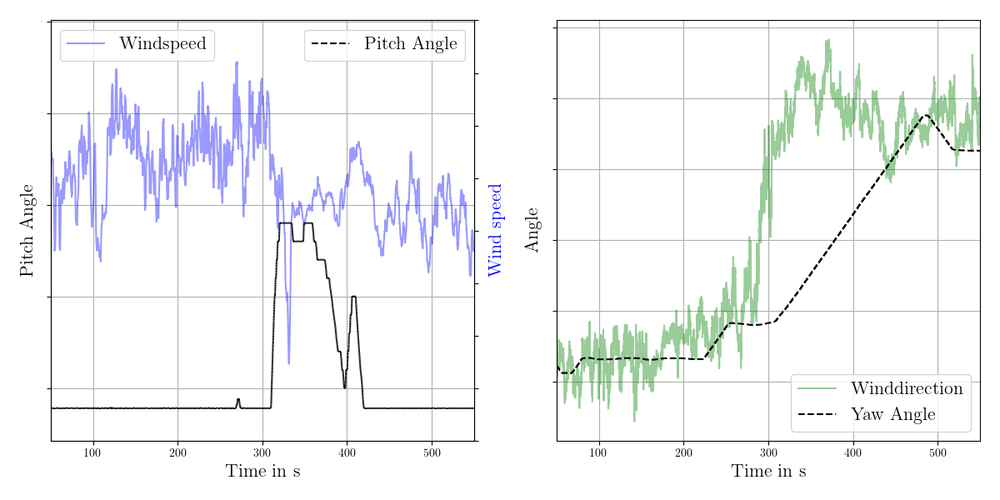
If a change in wind direction is measured, the yaw drive turns the turbine back into the wind. Rapid changes in wind direction, for example due to cold pool events, lead to a temporary misalignment of the turbine. To prevent increased loads, the turbine is throttled by pitching the rotor blades out of the wind. Emergency stops can also be observed. This reduces electricity production, but this behavior is not always optimal from a loads-perspective, either.
Cold pools in the turbine simulation
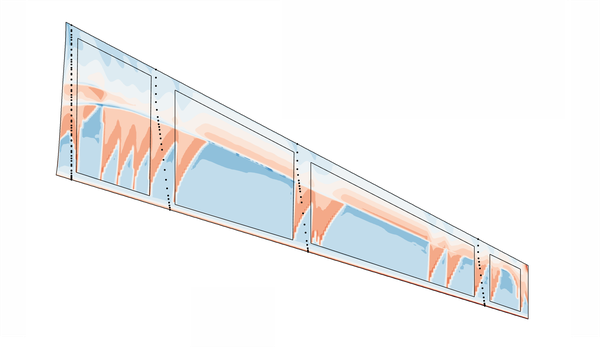
At the DLR Institute of Aeroelasticity, mathematical models of wind turbines and wind are used for simulations. In this case, the turbine is described by a multi-body model in SIMPACK. The aerodynamic forces are calculated using the blade element method in AeroDyn. By coupling these two simulations, the mutual influence of structural deformation and aerodynamics can be taken into account.
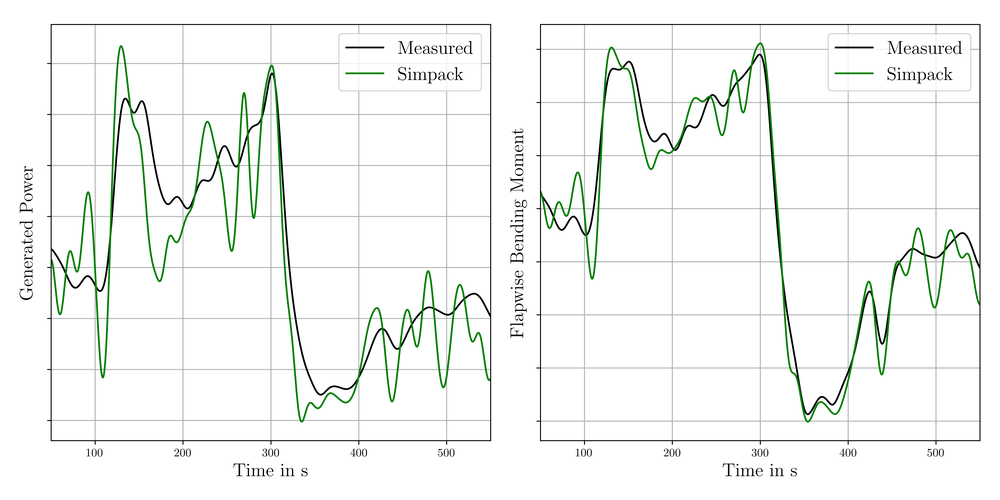
The results of the calculation include the loads in the system and the electricity production. In a first step, a cold pool event was simulated, which was observed in the WiValdi wind farm. The wind input is generated from the measured wind direction and speed, and the turbine model is controlled according to the real turbine movement. This enables a comparison between measurement and simulation. Deviations are to be expected as the detailed wind conditions are not known at every point in the rotor plane.
Comparison of simulation and measurement of a cold pool event
As the measurement and simulation agree well considering the simplifying assumptions, the model can be used for further investigations.
What are the benefits of weather forecasts?
The DLR Institute of Atmospheric Physics is developing methods for the short-term forecasting of certain weather events, known as nowcasting. The results include information about wind conditions in the near future.
Load and power-production forecasts can be achieved using these data to carry out turbine simulations. These can be of interest to grid operators in order to prepare for possible drops in power production.
Forecasts also make it possible to optimize the turbine behavior. If the controller or the system operator switches off the turbine, lower loads occur, but electricity production is also lower. Emergency stops can be avoided by prophylactic throttling. It would also be conceivable to yaw the turbine before the cold front arrives.