VIPER
Vibroacoustic Passenger Experience
VIPER
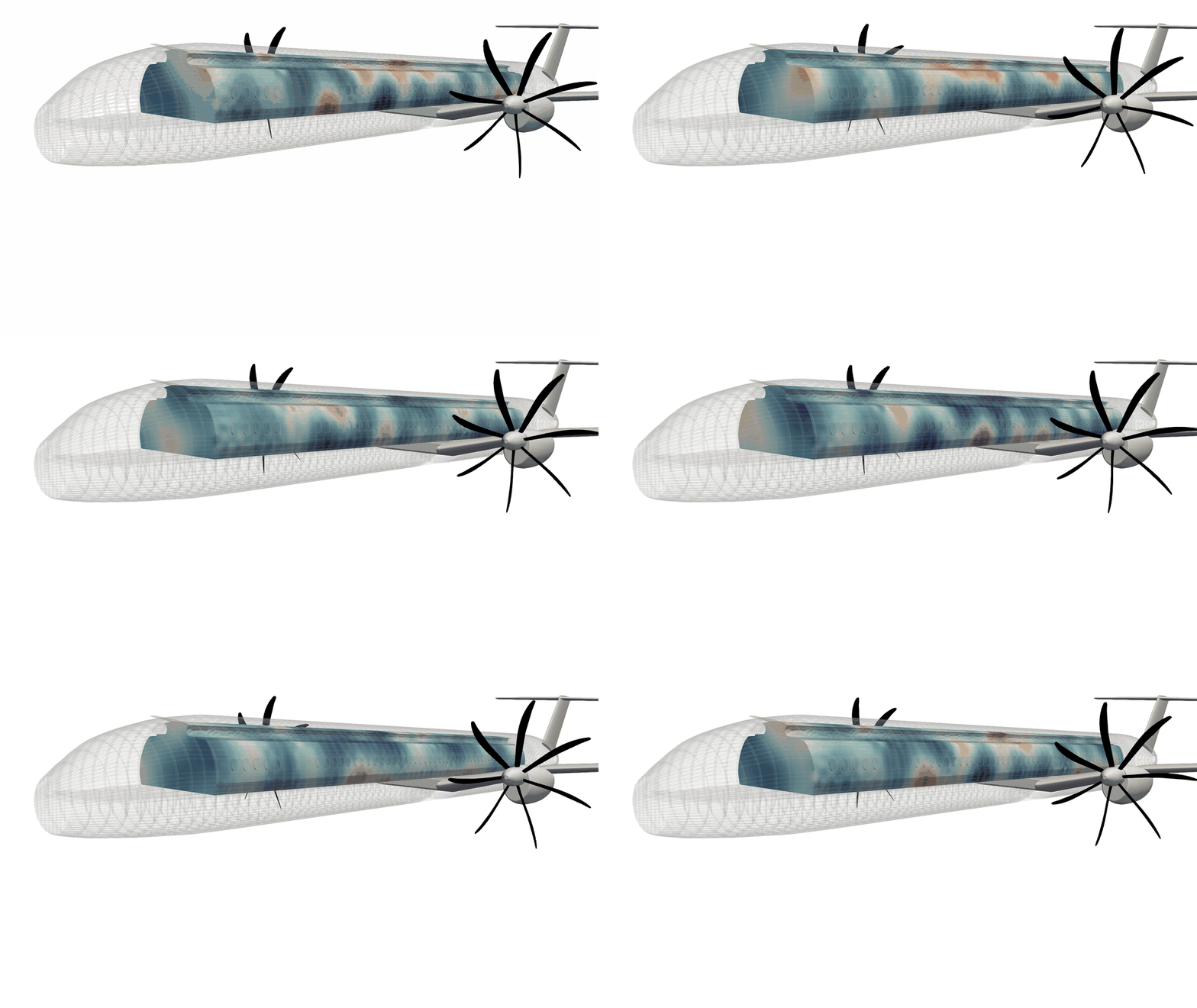
The project VIPER involves the development and validation of methods and measurement hardware for vibroacoustic analyses of future aircraft configurations. The objective is to enable the evaluation of cabin acoustics in the early phase of aircraft design.
Motivation and background
Due to the expected energy transformation of the aviation sector, new eco-efficient open-rotor propulsion systems and advancing lightweight design will play a decisive role in the design of future aircraft. In addition to the advantages of improved energy efficiency, however, increased noise emissions in the cabin and therefore reduced passenger comfort are to be expected. Consideration of cabin acoustics in the early design phase is therefore desirable in order to ensure social acceptance of future aircraft and to contribute to an eco-friendly aviation.
However, in order to incorporate cabin acoustics into the evaluation process of future aircraft configurations, a reliable quantification of cabin noise is required. This is exactly the objective of the project VIPER: The project aims to develop and validate novel and efficient methods and measurement hardware allowing the prediction and assessment of expected noise exposure in aircraft cabins, while also enabling the design of robust noise reduction measures.
Objectives
The DLR part of the project VIPER addresses the following objectives:
Development and validation of a MEMS sensor array for vibroacoustic measurements with high-resolution
The availability of a high-resolution measurement system for vibroacoustic measurements is highly relevant for understanding the sources of cabin noise. Due to their low cost, MEMS sensors appear to be particularly attractive for this task, as they enable the fast and cost-effective acquisition of acoustically relevant vibration.
Development of an actuator array
Pressure fluctuations on the outer skin of the aircraft are transmitted to the passengers and crew via complex structures and different materials in a wide frequency range. The realistic experimental investigation of this transmission requires suitable realistic excitation for corresponding tests in the laboratory. Successful tests with loudspeaker arrays have so far been limited by the dimensions of the loudspeakers and the costs per loudspeaker. Integrated circuits on PCBs combined with low-cost miniature loudspeakers, e.g. based on MEMS technology, makes it possible to overcome this limitation.
Development and validation of a methodology for the characterization of all blocked forces components
The characterization of blocked forces provides a detailed understanding of the vibroacoustic behavior of aircraft engines. The findings can be used for future virtual tests in order to design more efficient aircraft components with regard to cabin noise. In addition, knowledge of the blocked forces enables the definition of requirements for manufacturers of new propulsion systems.
Establishment of an automated model generation for cabin noise prediction
Automated methods for model generation enable the fast integration and analysis of cabin noise in the early phases of aircraft design. In this way, new aircraft designs can be analyzed directly with regard to their internal noise emission while also integrating this discipline into the holistic view of the multidisciplinary design.
Development of robust noise reduction measures
The effectiveness of active and passive noise reduction measures in aircraft cabin has already been confirmed in numerous projects, both numerically and experimentally. The control quality of such systems depends on the accuracy of the models used for the design. However, the real cabin which is approximated by such models, is subject to uncertainties such as temperature, seat occupancy, material behavior, etc. As a consequence, the uncertain parameters cause a reduction in control quality. One objective is therefore to increase the robustness of noise reduction measures by researching the influences of model uncertainties.
Project | VIPER - Vibroacoustic Passenger Experience |
|---|
Duration | 07/2025 - 09/2028 |
Partners | - Airbus Operation GmbH (Joint project management)
- Hamburg University of Applied Sciences
- TU Braunschweig
- DLR Institute of Aeroelasticity (DLR project management)
- DLR Institute of Aerodynamics and Flow Technology
- DLR Institute of Lightweight Systems
- DLR Institute of System Architectures in Aeronautics
|
Type of project | Research project in the VII-1 aviation research program |
Funding code | 20K2402B |
Funding agency | Federal Ministry for Economic Affairs and Energy (BMWE) |