Infection risk model for cabins and passenger compartments
Infection risk model for cabins and passenger compartments
Your consent to the storage of data ('cookies') is required for the playback of this video on Quickchannel.com. You can view and change your current data storage settings at any time under privacy.
Experimental acquisition of the spreading of exhaled aerosol particles in the Do728 research aircraft cabin at DLR Göttingen
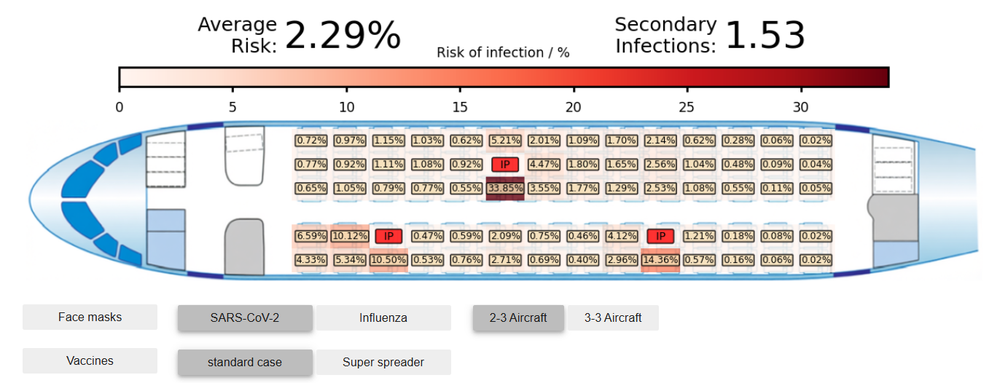
The interactive visualization tool quickly and easily generates “maps” of the infection risk for given ventilation setups and pathogen properties, as shown here for an aircraft cabin.
Aircraft cabins are a critical environment for the spread of airborne pathogens. If one or more infectious passengers are on board, there is an increased risk of secondary infections due to the proximity between passengers and the exposure times during long flights.
To identify effective countermeasures, it is crucial to know how this infection risk changes for different pathogens and ventilation configurations. The Virtual Infection Risk Framework can predict these risks. Using numerical simulations of cabin airflow and aerosol particle dispersion, the exposure of each passenger is determined and this dose is then converted into individual infection probabilities, taking into account the biological and medical characteristics of the pathogen.
Schematic visualization of the spreading of exhaled aerosol particles at mixing ventilation in the Do728 passenger cabin.
Simulation of an infection risk model
Your consent to the storage of data ('cookies') is required for the playback of this video on Quickchannel.com. You can view and change your current data storage settings at any time under privacy.
Simulation of an infection risk model
Schematic visualization of the spreading of exhaled aerosol particles at mixing ventilation in the Do728 passenger cabin.
In this way, we can determine the risks for a particular disease and ventilation configuration, analyse the dependence of the risk on variations in airflow and the biological properties of the pathogen, and evaluate and find effective and robust countermeasures.
The Virtual Infection Risk Framework generates a large amount of complex data, which is made accessible using an interactive visualisation tool. This allows us to quickly and easily recognise patterns, find correlations and effectively communicate our findings to stakeholders.