To make future aircraft more environmentally friendly and efficient, the design of several components of existing aircraft need to be reconsidered and adapted. This includes, for example, higher wing aspect ratios, extended functionality of control surfaces, and the integration of new propulsion technologies.
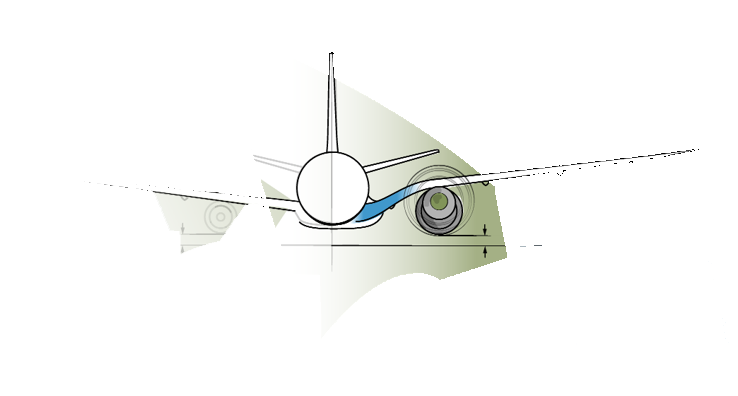
Within the BMWE-funded LuFo-project ENIGMA, we therefore work together with partners from research and industry on a so-called highly stretched gull-wing – a wing geometry required to integrate future large Ultra-High-Bypass-Ratio (UHBR) or open fan engines (USF, Unducted Single Stage Fan). For this purpose, the inner wing section is bent upwards to provide sufficient ground clearance for the engine before transitioning back to a more conventional geometry further outboard.
The resulting S-shaped curvature in the inner wing region poses new aerodynamic, structural, and kinematic challenges, particularly for the design of the high-lift systems, required for take-off and landing.
Within the ENIGMA project, our work focuses in particular on:
Integrated high-lift design: Aerodynamics, structures, kinematics, and systems are developed in a coordinated iterative process in order to realize a high-performance inner flap for the S-shaped gull-wing.
Continuous digital design chain: New design tools link aerodynamic design, structural design, and manufacturing processes.
Validation and manufacturing: System tests under load, including engine vibrations, are carried out at the DLR WISDOM test facility in Bremen. Flap and kinematics demonstrators made of composite materials are tested, supported by virtual simulations.
The starting point is a digital model of the highly stretched gull-wing. Based on this model, kinematic and structural designs for the inner landing flap are developed and iteratively coordinated between aerodynamics, structures, kinematics, and systems. The results feed into demonstrators and experimental tests.
For wing skin manufacturing, robotic fibre placement trials are conducted to determine material parameters and optimise manufacturing processes. The results form the basis for manufacturing demonstrations at the industrial partner ASA. Curvature-induced deviations in fibre placement are analysed to be considered in the wing design. This establishes a continuous digital process chain for both the high-lift system and the wing structure, linking design, simulation and manufacturing.
Project
ENIGMA - Integrierte "full-scale" Evaluierung von Wing & Moveables
Term
9/2025 - 11/2028
Project Participants
Airbus Operations GmbH (Project leadership and coordination)
Airbus Aerostructures GmbH
Broetje-Automation GmbH
Diehl Aerospace GmbH
Technische Universität Hamburg (TUHH) Institut für für Flugzeug-Systemtechnik
Technische Universität Braunschweig, Institut für Mechanik und Adaptronik (IMA)
FFT Produktionssysteme GmbH & Co. KG
Siemens
Fraunhofer-Gesellschaft zur Förderung der angewandten Forschung e.V. (IFAM)
DLR Institute of Aerodynamics and Flow Technology
DLR Institute of Aeroelasticity
DLR Institute of Flight Systems
DLR Institute of Lightweight Systems
Funding
Federal Ministry of Economic Affairs and Energy (BMWE), Aviation Research Programme (LuFo), ref. no. 20W2401F