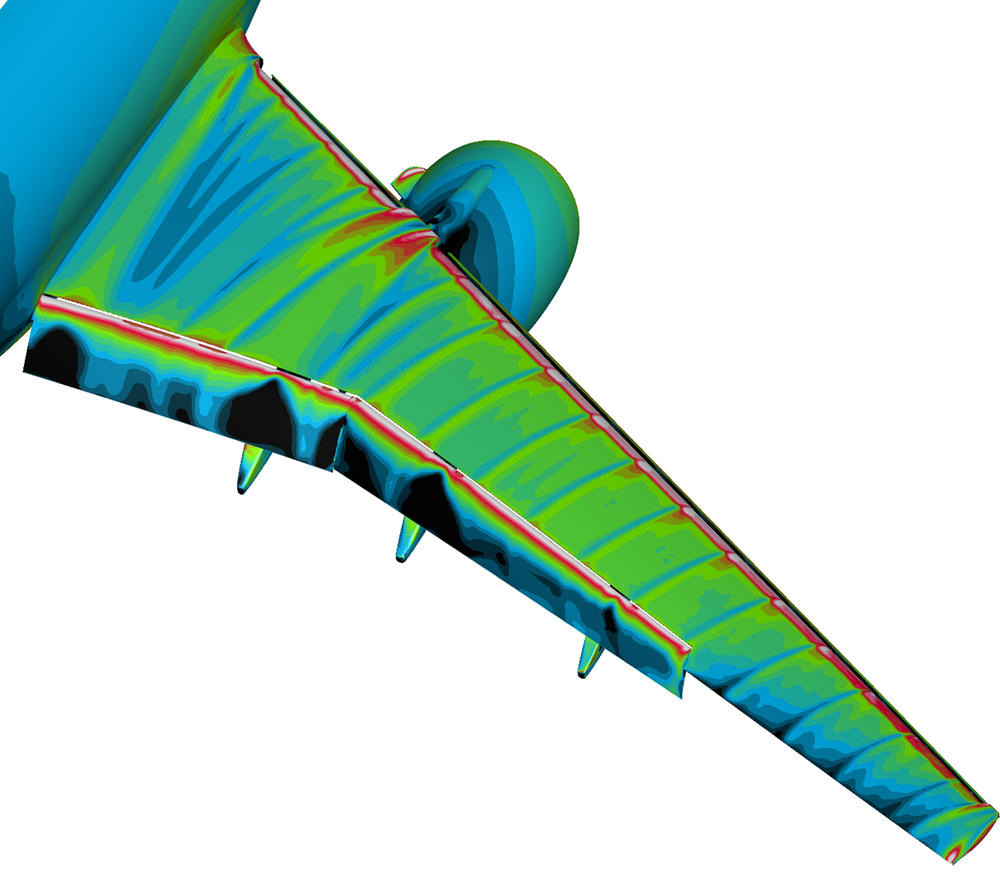
The reduction of aviation’s climate impact is one of the key challenges facing the aerospace industry. This requires highly accurate aerodynamic simulation methods that enable the reliable development and assessment of efficient, low-noise and low-emission aircraft concepts. While the DLR flow solver TAU currently represents an established European standard, the CFD software by ONERA, DLR and Airbus (CODA) pursues the vision of a new European simulation platform for aerospace applications.
In the future, CODA is intended to replace the TAU code as a production tool within the German and European aerospace industry and to be integrated into industrial development workflows. Its application areas range from commercial aircraft and helicopters to spacecraft. In addition, CODA is expected to gradually replace TAU as a research tool at more than 30 European universities and to be used in further fields such as shipbuilding, wind energy, and traffic meteorology - for example, for high-fidelity simulation of wake vortices and contrails behind commercial aircraft.
Within the technology transfer project TerriFic, CODA is being systematically advanced from a research tool to production-ready software. This includes the implementation of technical extensions and demonstrations on industrially relevant use cases. The activities of the Institute of Aerodynamics and Flow Technology focus in particular on:
Reduction of computational time while maintaining high simulation accuracy
Improvement of numerical robustness and memory efficiency
Optimisation of multi-equation turbulence models for industrial configurations near the edges of the flight envelope
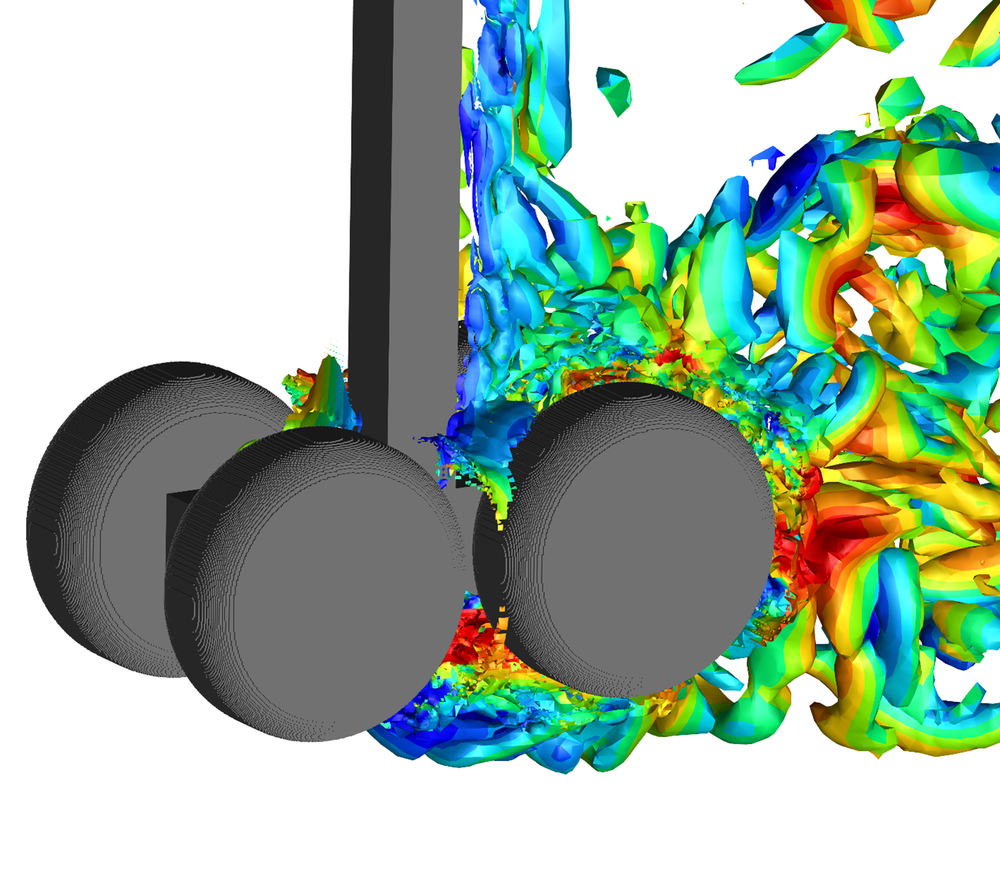
Rapid scale-resolving simulation around simplified landing gear
Further participating DLR institutes are advancing numerical methods for propeller and propulsion integration, increasing the maturity of boundary conditions for open-rotor systems, and adapting CODA to modern HPC and cloud architectures. In parallel, validation and verification processes are being systematically strengthened to demonstrate the software’s readiness for industrial use. CODA is being further developed to enable core DLR partners to integrate the software into their industrial workflows and to attract additional partners for testing and commercial application. In addition, CODA’s technological unique selling points are being specifically prepared for marketing and external communication.
A key feature of CODA is its modern software architecture, which includes:
Modular design and hybrid parallelization
Efficient use of modern hardware such as multi-core systems and GPUs
Seamless integration into multidisciplinary workflows within the HPC environment FlowSimulator
Automated quality management with continuous testing and code reviews
This results in a highly scalable European simulation platform that accelerates the development of new aerodynamic technologies and supports their transfer into industrial applications.
Project
TerriFic - Transfer von CODA in die industrielle Flugzeugentwicklung
Term
10/2024 - 2/2027
Project Participants
DLR Institute of Aerodynamics and Flow Technology (Lead)
DLR Institute of Aeroelasticity
DLR Institute of Propulsion Technology
DLR Institute of Software Methods for Product Virtualization