

Loading
Atmospheric Spectroscopy Department
The Atmospheric Spectroscopy department derives geophysical atmospheric composition parameters from remote sensing data. These data have been gathered primarily from satellite-borne instruments, but the approach is also applicable to data from other types of remote sensing instruments. The focus is on deriving trace gas concentrations and characterizing cloud and aerosol properties as well as wind parameters.
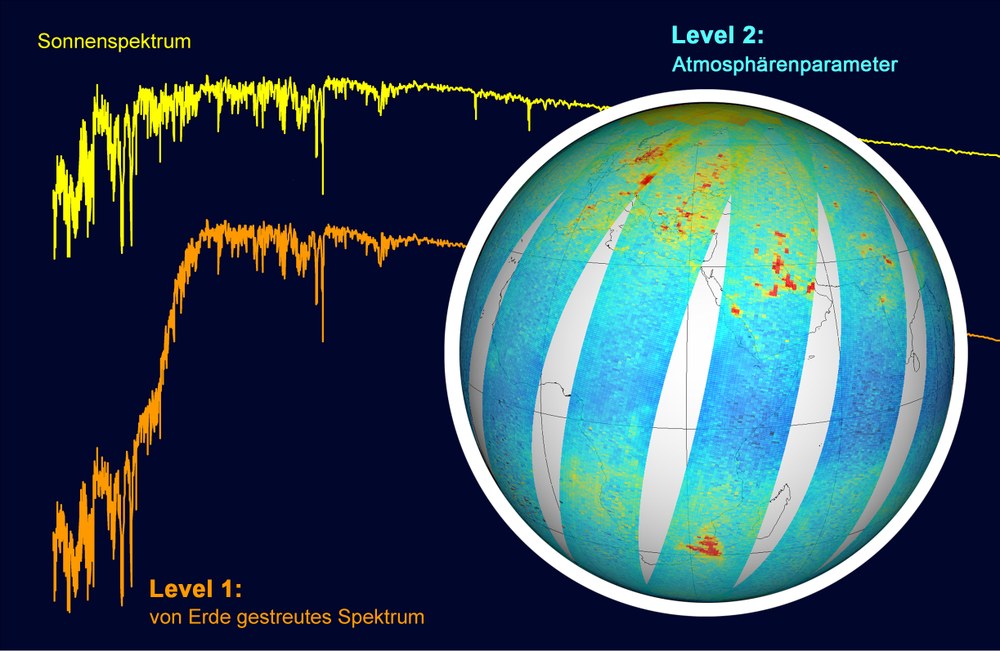
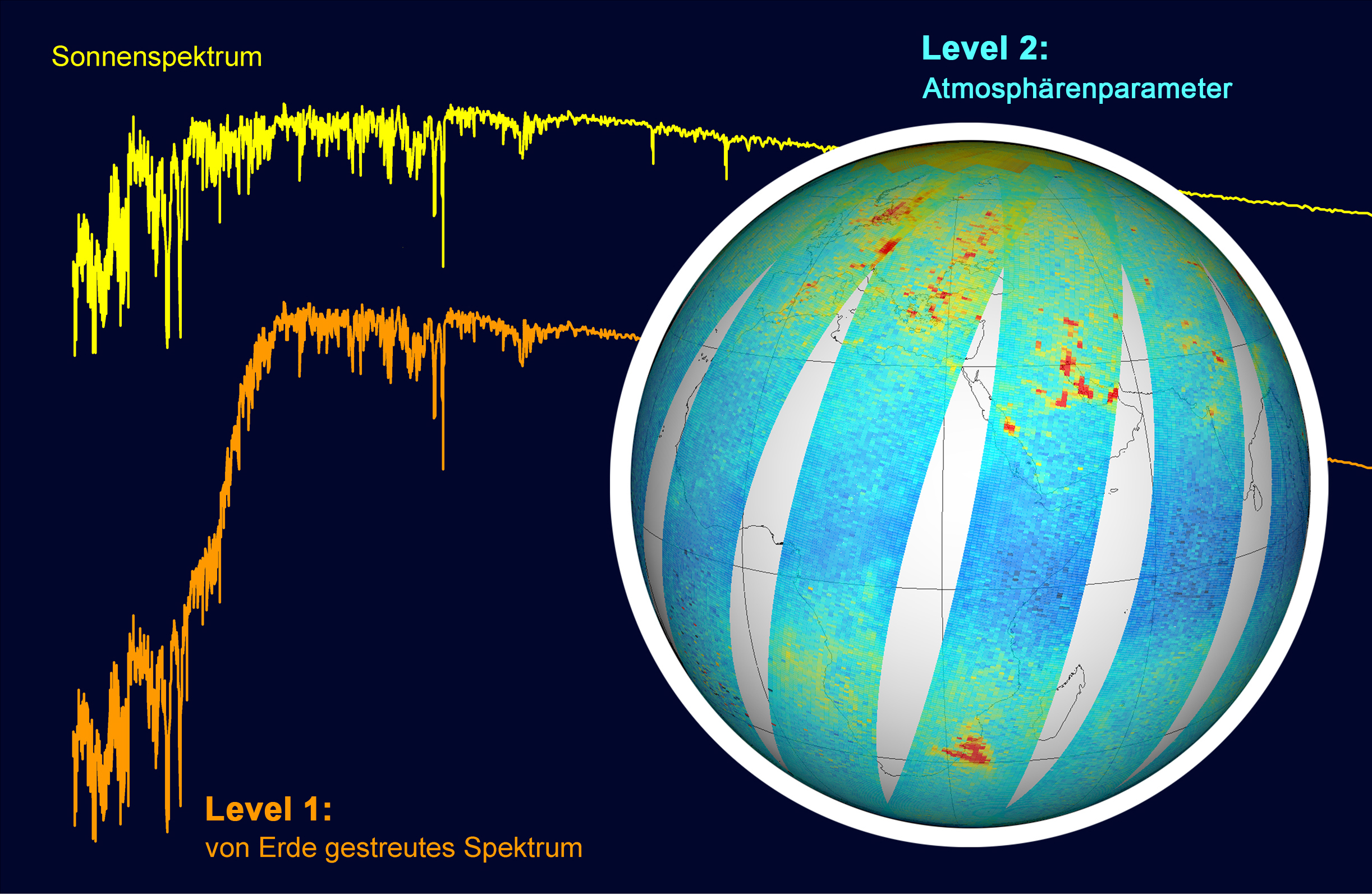
The department’s expertise in analyzing atmospheric remote sensing data covers the entire range from raw satellite data (Level 0) to their calibrated spectral data (Level 1), derived atmospheric parameters (Level 2), and climate data records (Level 3). Retrieval, or determining atmospheric characteristics, requires a deep understanding of radiative transfer, inversion and spectroscopy. To build this expertise, basic research is carried out aiming to develop procedures and methodologies for highly precise measurements and derivation of known atmospheric state variables as well as to extend their application to parameters previously inaccessible in remote sensing data. This work is relevant to both absorption and emission spectroscopy. The former concerns ultraviolet through visible to shortwave infrared wavelengths, while the latter covers the infrared range.
The quality of the derived parameters depends not only on the capabilities of the retrieval procedures but also on the quality of the input data, primarily the calibrated spectra. Therefore, rigorous attention is paid to calibrating the raw data to ensure that the required retrieval precision can be achieved. Similarly, creating climate data records by homogenizing measurements from different satellites spanning several decades requires detailed knowledge of the underlying instruments and retrieval algorithms.
In order to be able to continuously generate accurate atmospheric products from remote sensing data in the operational ground segment, the developed retrieval methodologies need to be implemented as algorithms and integrated into robust software systems called operational processors. Algorithm and processor development is therefore tailored to meet the requirements of specific missions and users, and the department is responsible for the scientific and technical content of the operational processors installed in the ground segment.
The Atmospheric Spectroscopy Department is actively engaged in collaborative research with leading national and international institutions at the forefront of atmospheric remote sensing and climate monitoring. Our scientists are integral members of numerous current and upcoming satellite missions, as well as major scientific initiatives. This strong international collaboration reflects our commitment to scientific excellence and global environmental stewardship.
Since 2010, our department has been actively contributing to the World Meteorological Organization (WMO) and United Nations Environment Programme (UNEP) scientific assessment report on the state of the Earth's ozone layer, published every four years. Since 2014, we are contributing to the annual "State of the Climate" report published in the Bulletin of the American Meteorological Society (BAMS). Furthermore, our data was used in the Sixth Assessment Report published in 2021 by the Intergovernmental Panel on Climate Change (IPCC).
Our research and satellite data are playing a key role in advancing global understanding of atmospheric composition, climate change, and environmental monitoring.
The department is divided into the following working groups:
Links
Contact
Dr. Diego Loyola
Head of Department
German Aerospace Center (DLR)
Remote Sensing Technology Institute (IMF)
Atmospheric Spectroscopy
Oberpfaffenhofen, 82234 Weßling