
Wildfires in Spain and France trigger air pollution emergency
Southwest Europe is enduring an unprecedented heatwave this July 2026, as devastating wildfires ravage large swaths of Spain and France. According to international reports from Deutsche Welle, extreme conditions have already forced over 300,000 people to evacuate their homes. The intense fires have triggered pyrocumulonimbus clouds in both France and Spain. These rare clouds push heavy ash, soot, and toxic gases high into the upper troposphere, creating widespread transport of pollution across regional borders. Millions of people in southwestern France and central Spain are experiencing severe haze, prompting health agencies to brace for a surge in hospital admissions for respiratory and cardiovascular issues.
Satellite data from Copernicus TROPOMI/Sentinel-5P is capturing the sheer scale of the disaster from space, tracking it through two critical atmospheric metrics: Aerosol Index (AI) and Formaldehyde (HCHO) concentrations. While the light-absorbing soot particles (measured by AI) are drifting thousands of kilometres across Western Europe and the Mediterranean, intense summer sunlight is fuelling a photochemically driven process inside the smoke that produce secondary HCHO far downwind from the actual flames. This toxic gas poses a major respiratory threat to millions in urban areas, even after the thickest visible smoke has drifted away.
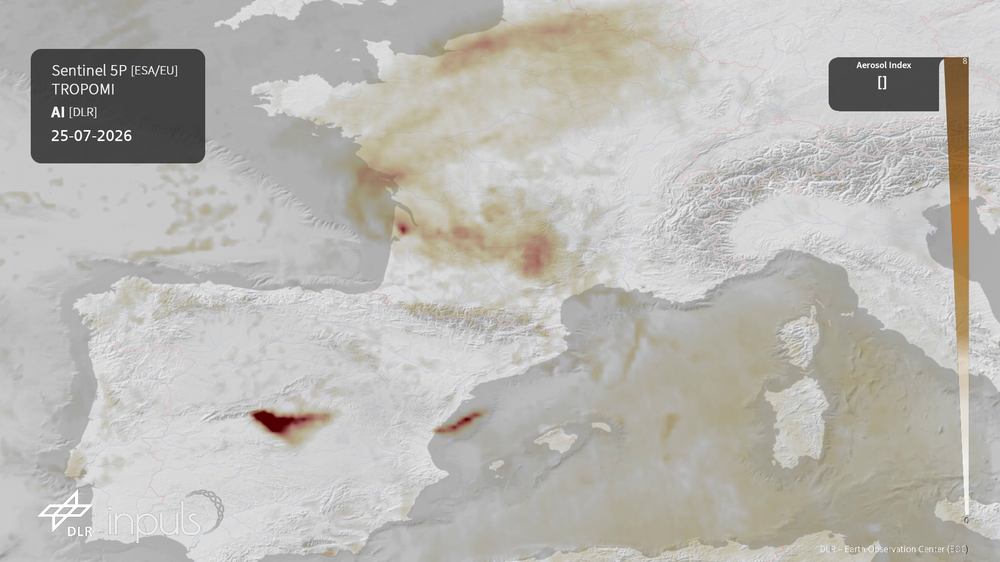
Wildfires in Spain and France – Aerosol Index (AI)
Your consent to the storage of data ('cookies') is required for the playback of this video on Quickchannel.com. You can view and change your current data storage settings at any time under privacy.
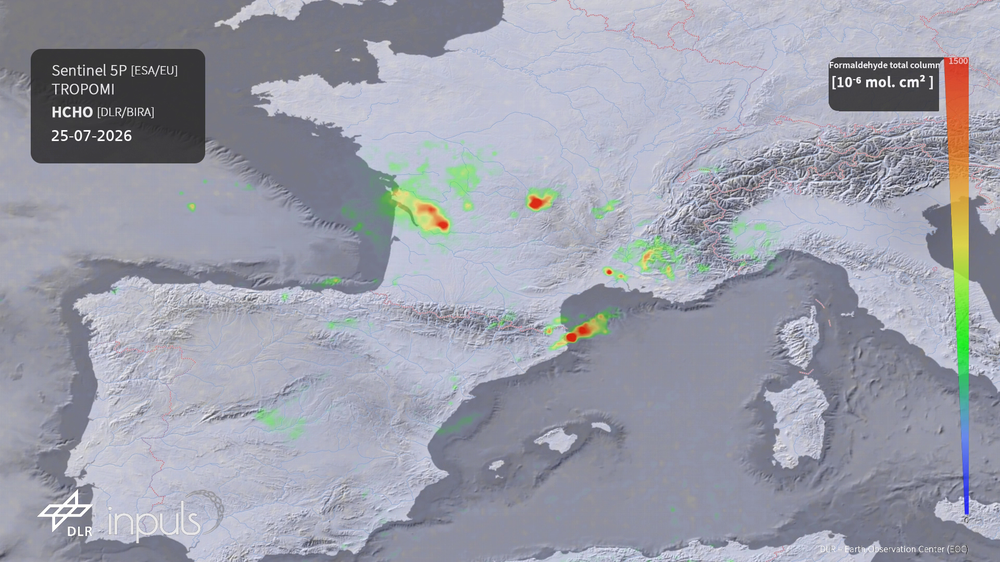
Wildfires in Spain and France – Formaldehyde (HCHO) concentrations
Your consent to the storage of data ('cookies') is required for the playback of this video on Quickchannel.com. You can view and change your current data storage settings at any time under privacy.
The TROPOMI animations show two main epicentres of extreme air pollution release:
Central Spain (Madrid Region): Copernicus data reveals that the massive Sierra Oeste fire west of the capital has consumed more than 27,000 hectares of land. The TROPOMI instrument aboard Sentinel-5P is registering extreme peaks in Aerosol Optical Depth and Aerosol Index (AI), as thick plumes laden with ash and black carbon darken skies across the Iberian Peninsula and drastically choking local air quality.
Southwest France (Gironde & Cozes) and North Spain (Girona & Empuriabrava): In the forests surrounding Bordeaux, emergency crews are battling historic blazes amid temperatures hitting 40°C. The combustion of vast pine forests is releasing immense amounts of volatile organic compounds (VOCs), driving major Formaldehyde (HCHO) vertical column anomalies in the upper atmosphere. In heavily impacted French towns like Le Porge in the Gironde department, mayors have warned of highly toxic fumes, forcing returning residents to wear protective masks. Winds pushing north across the estuary transport HCHO to towns like Cozes that face alternating periods of dense haze. Similar conditions led to a wildfire event in Spain, with strong winds spreading HCHO from fires from the Girona region to Empuriabrava and other towns in the northern area.
Links:
Contact
Dr. Diego Loyola