Aerosols are airborne solid and liquid particles with diameters between 0.001 and 100 micrometers. They remain in the troposphere for the relatively short time of a few days to a few weeks, so their global distribution varies considerably. Aerosols directly influence the earth’s radiation balance by reflecting some of the sunlight back into space. But aerosol particles with dark surfaces (like soot) can also absorb visible light and store it as heat in the lower atmosphere. Aerosols also have an indirect effect as condensation nuclei for droplet formation. Depending on particle properties, they can influence cloud formation and characteristics (brightness, lifetime). They can also affect the regional water cycle.
Understanding of global aerosol distribution, its composition and climate effects is still quite incomplete. Embedded in the ESA Climate Change Initiative (CCI) and the Copernicus Climate Change Service (C3S) of the European Union, new retrieval methods for remotely sensing aerosols and their characteristics from space are being developed at DFD, and the results are validated by comparison with ground measurements before they are processed for incorporation in atmosphere models. The retrievals exploit different sensors with complementary information content for monitoring Aerosol Optical Depth (AOD, a measure for the optical effect by the total amount of aerosols) and to characterize their composition from various types of particles (fine mode aerosols such as sulfate or soot, mineral dust and sea salt). Different algorithms are applied on single sensors or synergistic combinations of several instruments, including also stringent uncertainty propagation; additionally, machine learning methods and ensemble approaches are developed. With these, consistent Climate Data records of different aerosol components from 1995 can be derived.
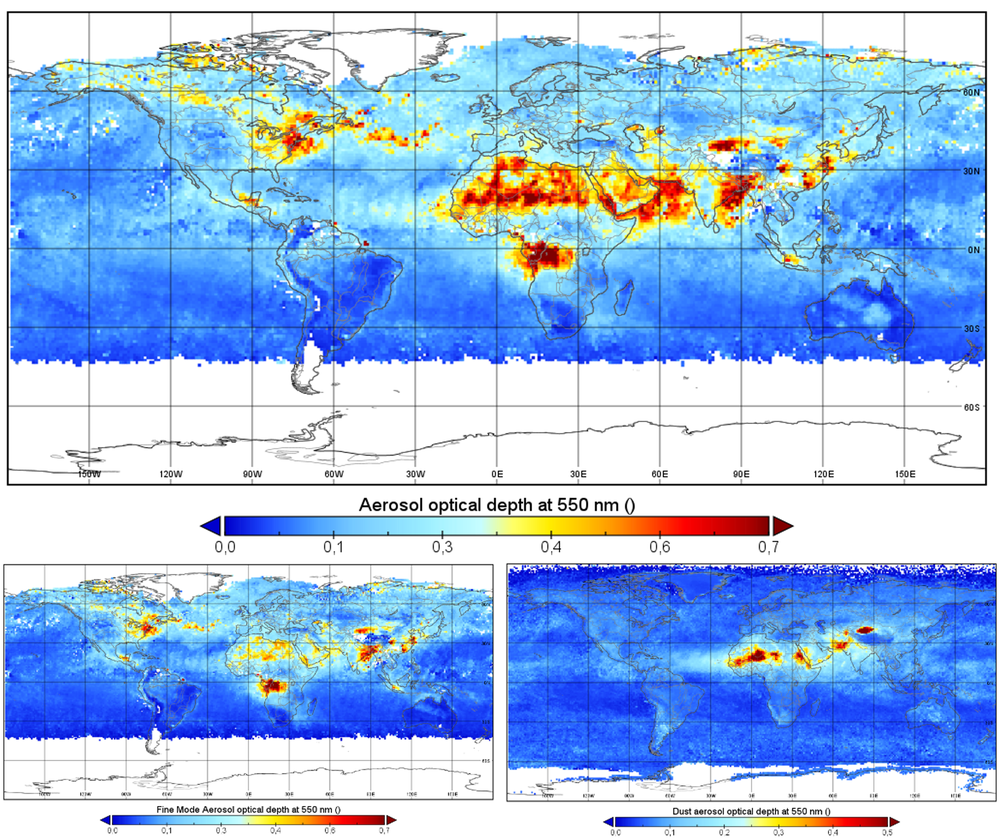
The image shows global maps of ensemble products for June 2003: total AOD (SLSTR), Fine Mode AOD (SLSTR, FMAOD), Dust AOD (IASI, DAOD).
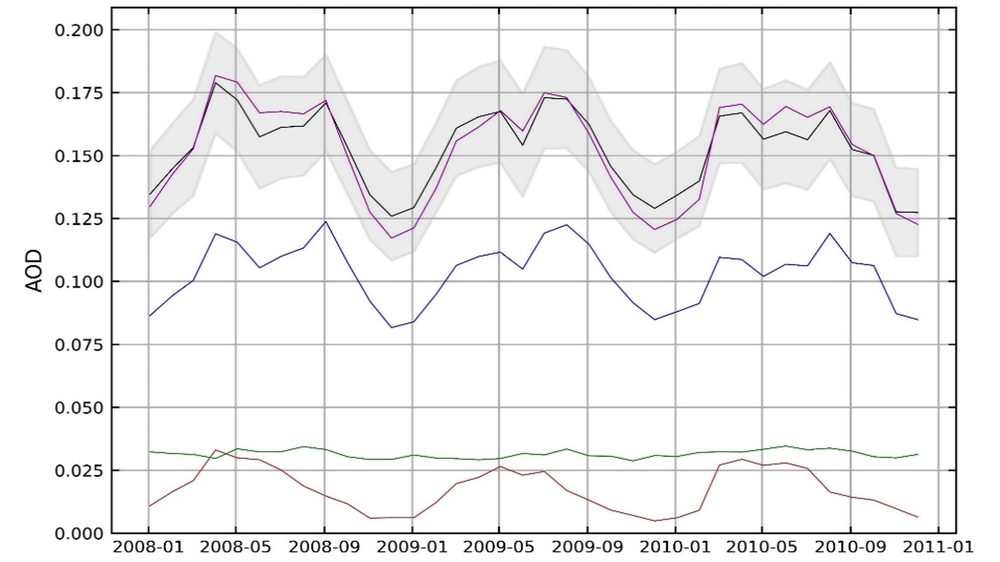
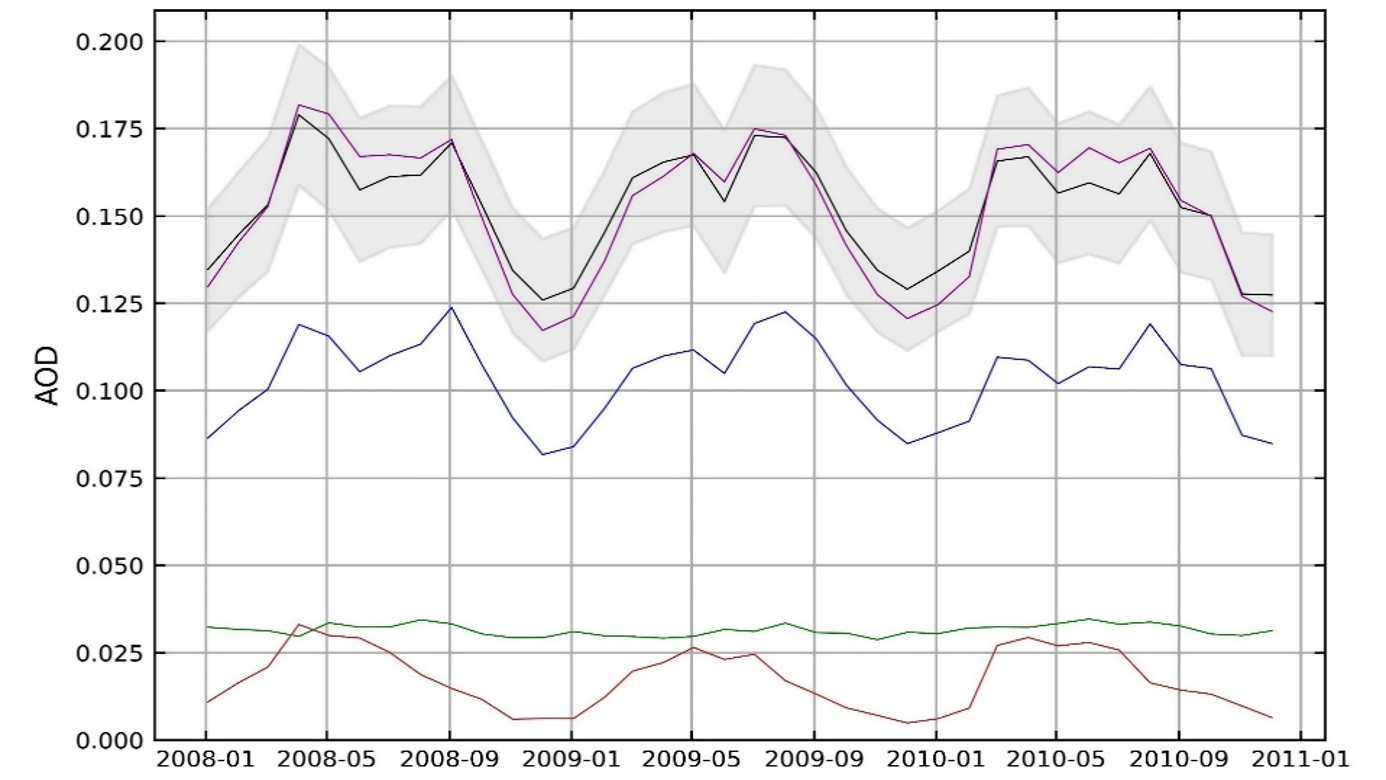
A multi-annual time series is shown here: total AOD (black), Fine Mode AOD (blue), Dust AOD (brown), together with sea salt AOD (SSAOD, from the CAMS model, green).
The different time series are consistent, which can be proven since the sum of the AOD components FMAOD+DAOD+SSAOD (purple) agrees with the independently derived total AOD within its uncertainty range of (grey shading).