
Air conditioning in rail vehicles - simulation of energy requirements
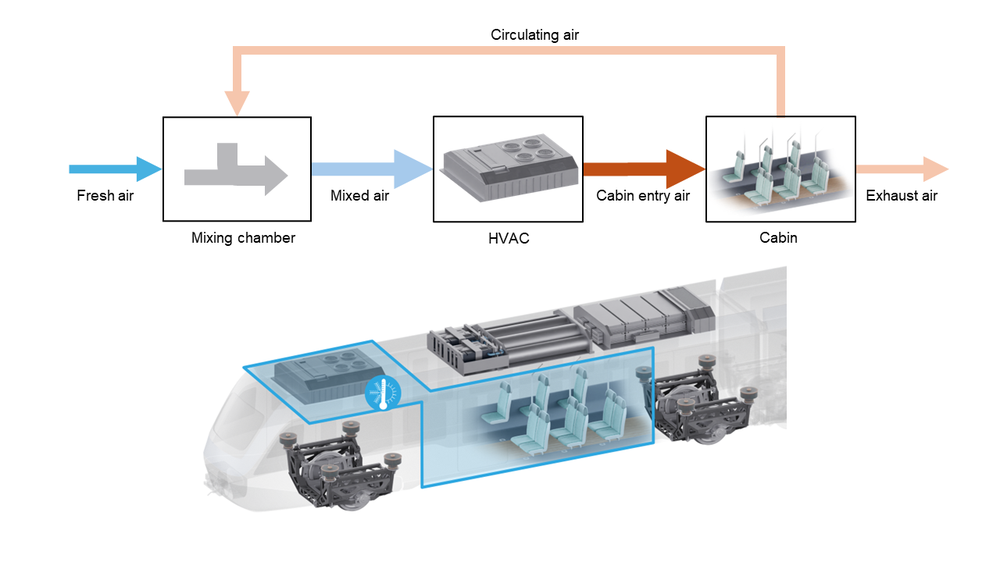
Air conditioning is indispensable in modern rail vehicles. In total, it accounts for up to 30 % of the annual energy consumption of a rail vehicle. This makes it the second largest energy consumer after traction and offers great potential for reducing energy consumption and operational costs.

Motivation
Especially in the case of battery-electric rail vehicles, which can be used on non-electrified routes as a possible alternative to diesel-powered rail vehicles, it is important to reduce the energy sonsumption in order to increase the range of the vehicles. Efficient air conditioning of the passenger compartment is therefore one way of providing the range required to operate the vehicles.
FK Research Portfolio
The Institute of Vehicle Concepts develops and validates thermal car body models (TCBM) for various rail vehicles to calculate the energy required for air conditioning. This allows the energy consumption for air conditioning to be determined under numerous operational and vehicle-related boundary conditions (vehicle specification, ambient conditions, occupancy rate, etc.) and the effectiveness of various concepts (CO2-controlled volume flow, heat pump, etc.) to be estimated.
Projects
- FINE 1 - FINE 1
- FINE 2 - FINE2
- MOSENAS - Modularer skalierbarer Energiespeicher für den SPNV
- FutuRe - eurail-fp6
- Pods4Rail - Homepage 01 - Pods4Rail
- Rail4Earth - eurail-fp4