
AMPTE
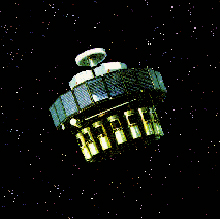

Tri-lateral project (USA, UK and Germany) for studying the solar wind and initiating the first artificial comet. The AMPTE program consisted of three spacecraft:
- the Ion Release Module (IRM), provided by Germany
- the United Kingdom Subsatellite (UKS) and
- the US/NASA Charge Composition Explorer (CCE).
All three spacecraft were launched by a Delta 3924 launch vehicle from the Kennedy Space Center on 16 August 1984 into a 28° inclined elliptical orbit with an apogee of 9.0 earth radii (RE) geocentric. The IRM and UKS stayed together and on the second orbit were boosted to an 18.7 RE apogee by the IRM kick motor. The CCE also contained a sizeable rocket motor, which was fired at apogee to reduce the CCE orbit inclination to near 0°. Thus the initial operational orbits were 28° elliptical with apogees in the solar wind for the IRM and UKS, and equatorial with a 9.0 RE apogee for the CCE. All data received at GSOC was processed, interpreted and archived. On request the appropriate data sets were transferred to the scientist-sites at MPI Garching, MPI Lindau, TU Braunschweig and RAL in Chilton. A global network for data reception during the ion-release phases had to be co-ordinated and controlled. A total of 8 releases (Barium and Lithium) could be measured successfully.