
TwinChain
The TwinChain project develops the methodological foundation for the use of digital twins to analyze complex transmission and impact chains. The goal is to represent real-world systems using simulation-based models in a way that enables the early identification and assessment of risks, interactions, and possible courses of action. The focus lies on the development of reliable, data-driven, and scalable modeling and simulation approaches that support decision-makers in the design and safeguarding of critical systems for civil security. While potential application areas are diverse, pandemics in particular require the protection of both critical infrastructure and the population.
Combining data, simulation, and artificial intelligence
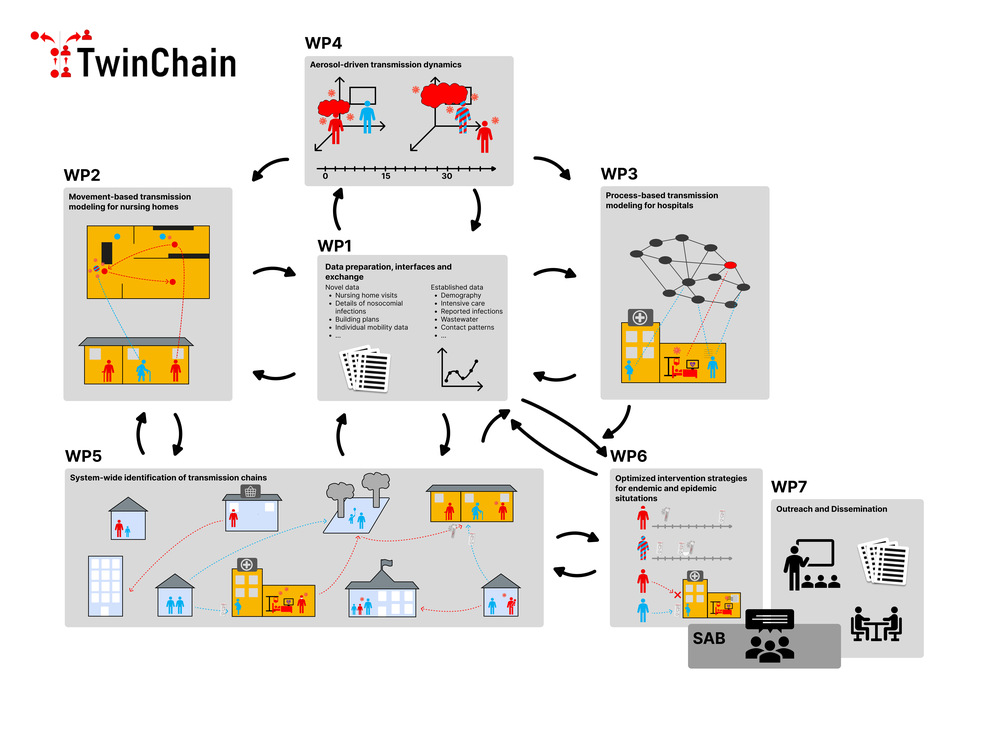
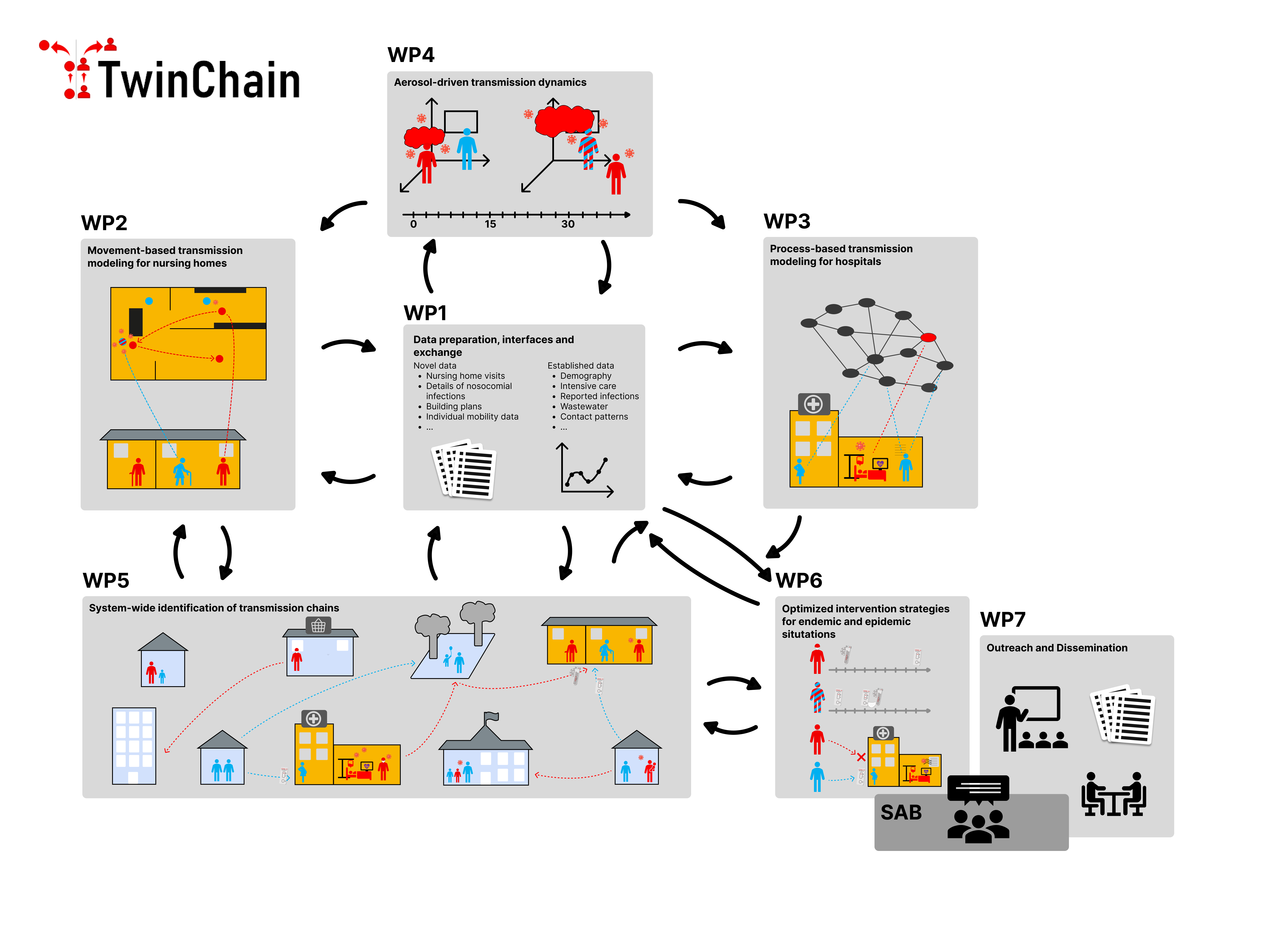
At the core of the methodology is a multi-stage modeling approach that combines high-resolution data, agent-based simulations, computational fluid dynamics, and methods from artificial intelligence. This integration enables the realistic representation of both direct interactions between actors and indirect transmission and propagation mechanisms. Digital twins thus allow for the systematic analysis of scenarios, the evaluation of measures, and the identification of robust strategies under uncertainty.

Model coupling and high-performance computing for realistic scenarios
A key aspect of the approach is the coupling of models across different scales: microscopic agent-based models are integrated into a large-scale simulation framework and linked with physics-based models and AI-based surrogate models. The use of high-performance computing enables the efficient operation of these digital twins and the analysis of complex scenarios with high temporal and spatial resolution. On this basis, optimized measures can be derived and their effects systematically compared.
Interdisciplinary collaboration and software-based implementation
The DLR Institute of Software Technology leads the TwinChain project and contributes its expertise in software architectures for digital twins, simulation-based analysis, AI methods, and high-performance computing across all project areas.
Within a strong research and data network, agent-based models from the University of Münster and Munich University of Applied Sciences are integrated into the MEmilio framework and coupled with computational fluid dynamics simulations and AI-based surrogate models developed by TU Berlin. Extensive real-world datasets are provided by Charité – Universitätsmedizin Berlin and the Public Health Department of the City of Cologne.
Transmission chains in critical infrastructures
One concrete application of this methodology is the simulation of infection and transmission chains, for example to analyze the spread of respiratory diseases. Digital twins can help to better understand transmission dynamics and to assess evidence-based measures for the protection of vulnerable groups, such as patients in hospitals and residents of care facilities. Beyond this application, the developed methodology is transferable to other fields of civil security, including mobility systems, energy supply, and other critical infrastructures in which complex interactions and propagation processes play a central role.
The project is funded by the Federal Ministry of Research, Technology and Space and is carried out within the framework of MONID – the Modeling Network for Severe Infectious Diseases.
Project runtime:
- 01/2026 - 12/2029
Scientific participants:
Further information:
- Softwareframework MEmilio:
Contact
Dr.-Ing. Achim Basermann