New large-scale research platform installed on the DLR’s Multifocus Tower in Jülich
Expansion enables testing of larger receivers and reactors on an industry-scale
With the new ‘SunBooster’ technology, a peak thermal output of up to 10 megawatts can be achieved
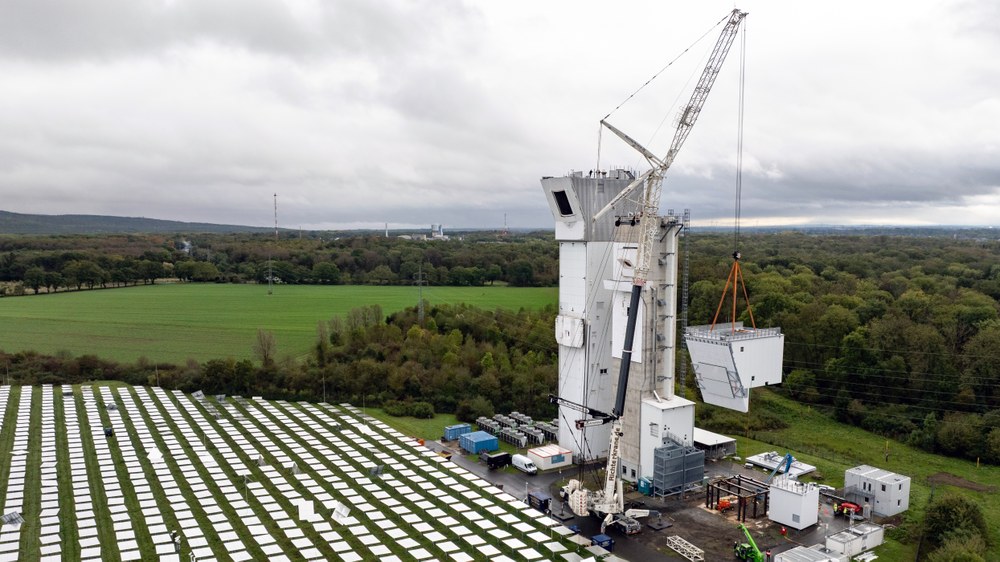
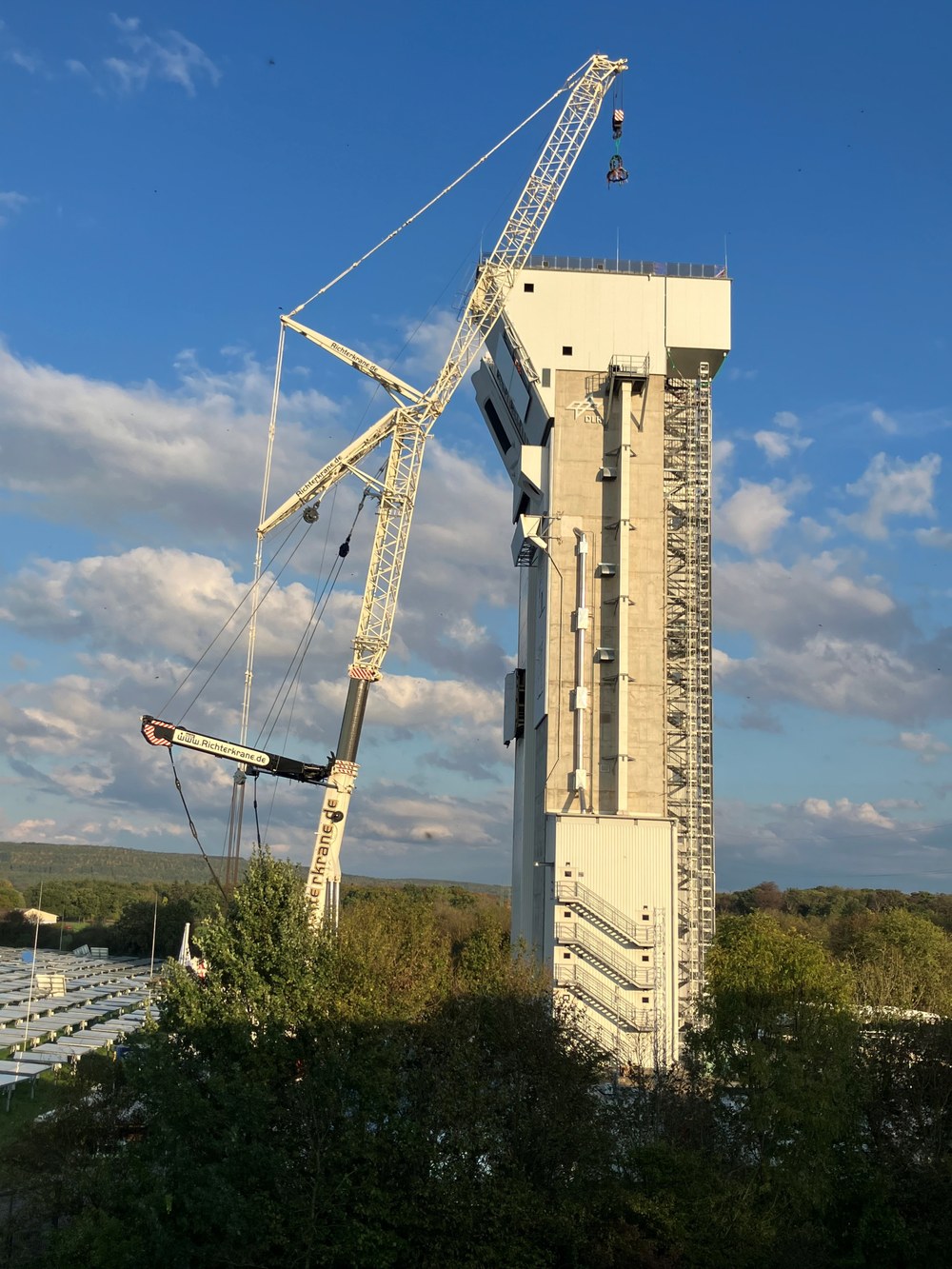
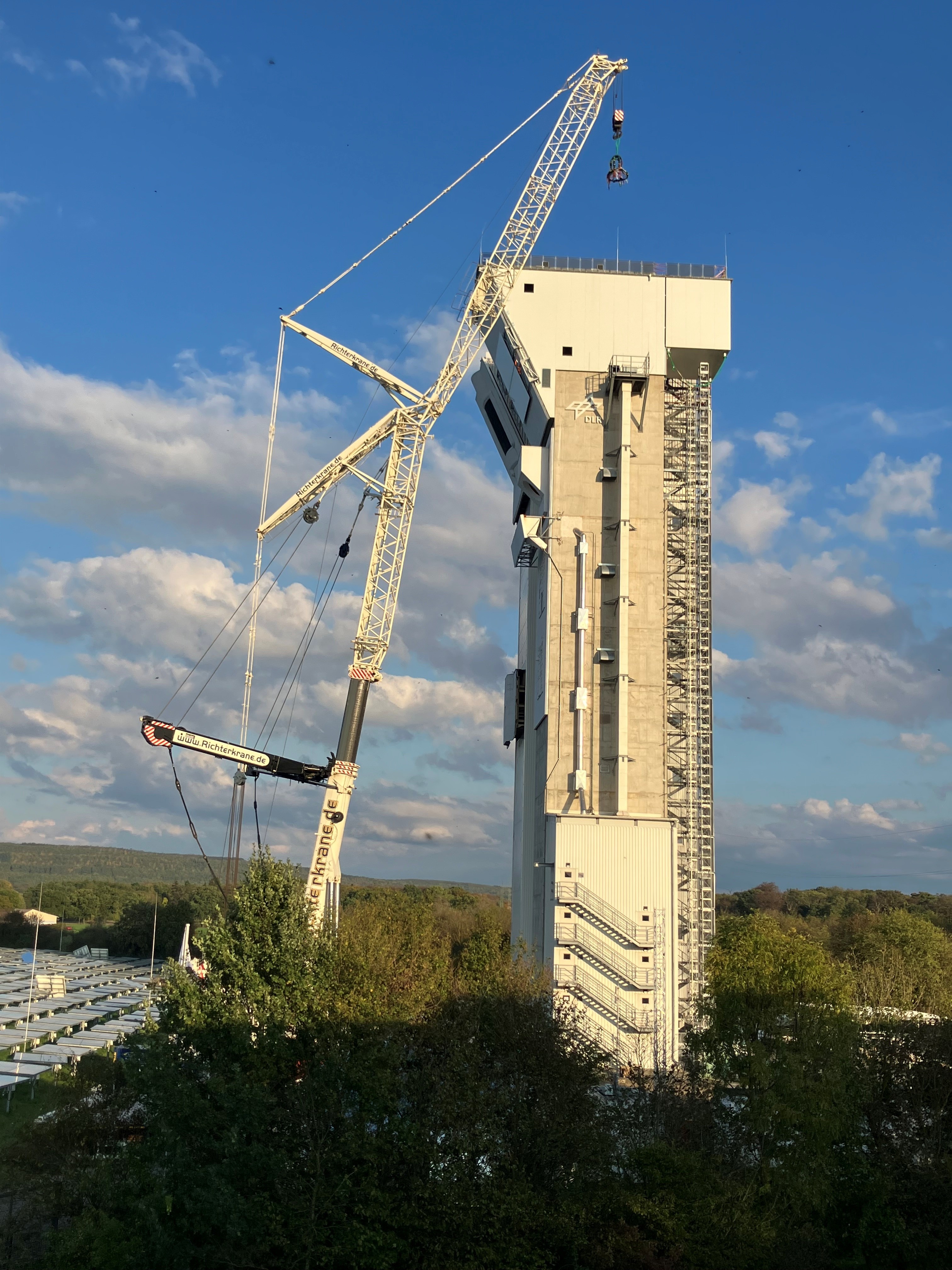
A crane hoisted the research platform, weighing a total of around 140 tonnes, onto the tower – which now stands 61 metres high – in several stages
The new large-scale research facility for high-temperature processes and solar fuels will offer even more opportunities for experimental research into concentrated solar power in future. During the week of 12 to 16 October, a new, globally unique large-scale research platform was installed on the roof of the Multifocus Tower at the German Aerospace Center (DLR) site in Jülich.
The expansion is an important step towards scaling up solar thermal technologies and opens up unique opportunities worldwide to investigate receivers, thermochemical reactors and process concepts for the production of sustainable fuels, as well as for the industrial supply of high-temperature heat – including for industrial applications.
A new level of large-scale research
The new level had to be positioned on top of the Multifocus Tower in Jülich with millimetre precision.
As the world’s largest test facility, it is intended to test and demonstrate solar technologies on as large a scale as possible, in line with industrial standards. There are two objectives: firstly, it should be possible to test receivers or reactors measuring 5.8 metres in diameter and eight metres in length at high power outputs.
‘SunBooster’ for research and industry
Furthermore, for the first time it is possible to utilise the entire thermal energy of the ten-hectare heliostat field in one go. This allows the concentrated solar radiation to be utilised as economically as possible, whilst at the same time achieving high process temperatures.
To this end, a new technology called ‘SunBooster’ will be installed at the plant at a later stage; this consists of a secondary concentrator three metres in diameter, in which the already concentrated radiation is compressed a second time, and an open volumetric receiver five metres in diameter surrounding it.
In the ‘SunBooster’ system, ten megawatts of radiant power is directed from the heliostat field to the central receiver. The receiver utilises at least five megawatts of this to achieve process temperatures of 1,200 to 1,500 degrees Celsius – hot enough for many thermochemical reactions. The surrounding ‘SunBooster’ also utilises the remaining power for applications at lower temperatures, thereby increasing the efficiency of the entire plant. This enables cost-effective use in industrial processes.
Assembly of the large-scale research platform in four steps
The installation was a prime example of successful collaboration and meticulous preparation: the assembly was carried out in four stages over a total of three days:
A new level of large-scale research
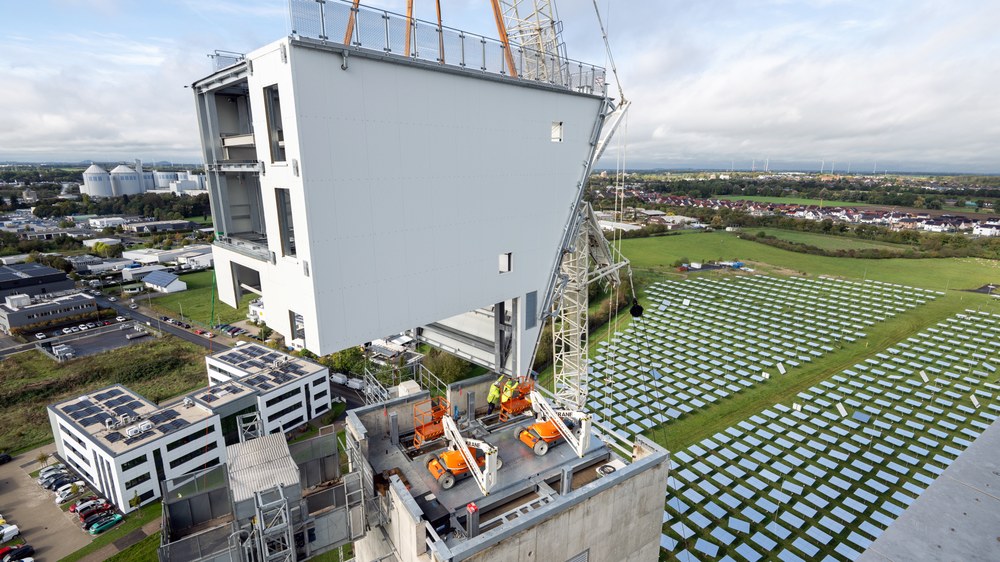
A second section of the platform was attached to the rear of the tower.
The first section comprises three storeys internally, weighs around 80 tonnes and was secured to the crane, hoisted into place, balanced, rotated into the correct position – a task made more difficult by the winches – gently set down and firmly bolted to the roof of the Multifocus Tower. The margin for manoeuvre was limited to just a few millimetres.
In the next step, a further section weighing around 20 tonnes was attached to the rear; the assembly had to be carried out whilst suspended, which required particular finesse.
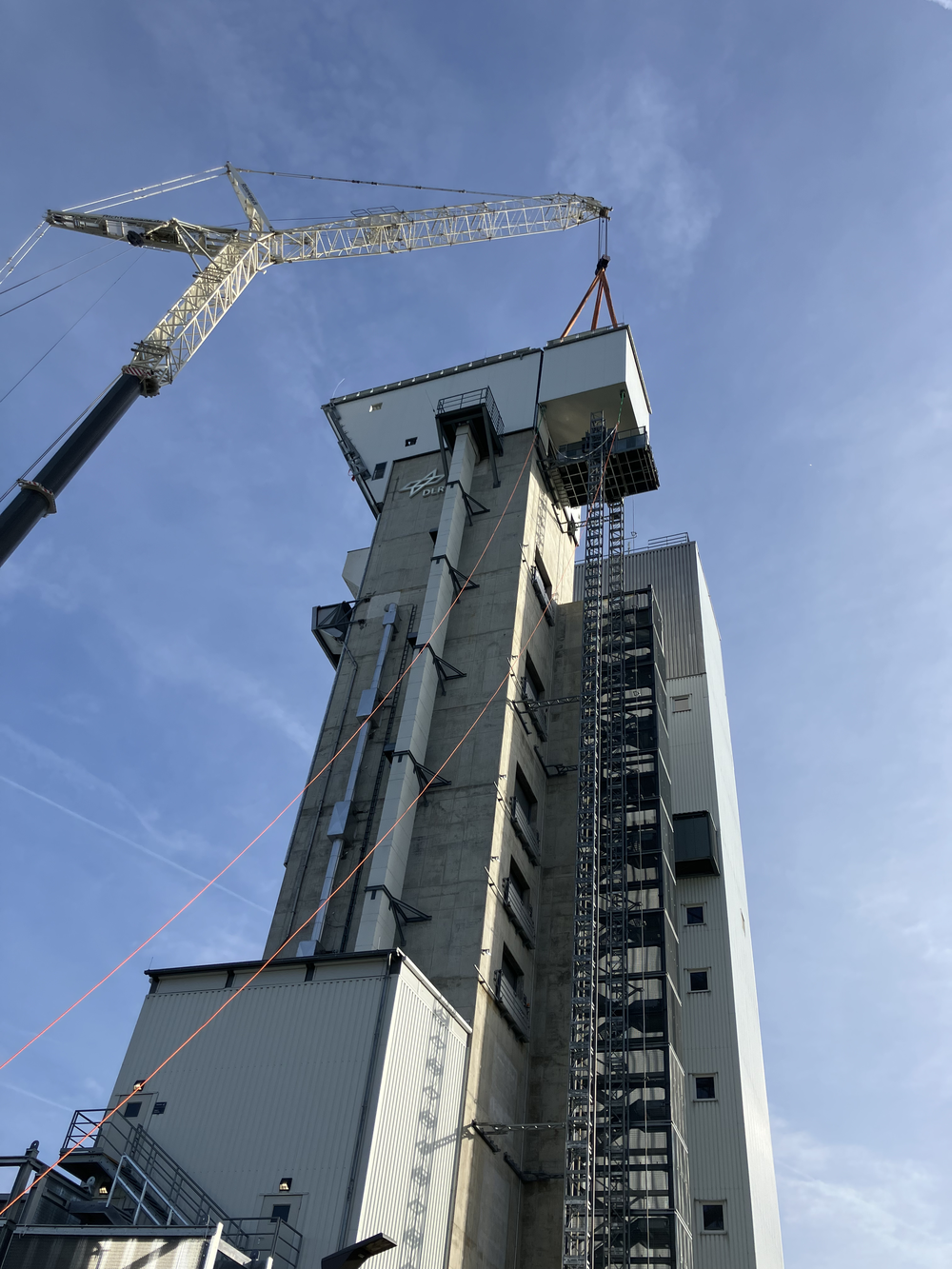
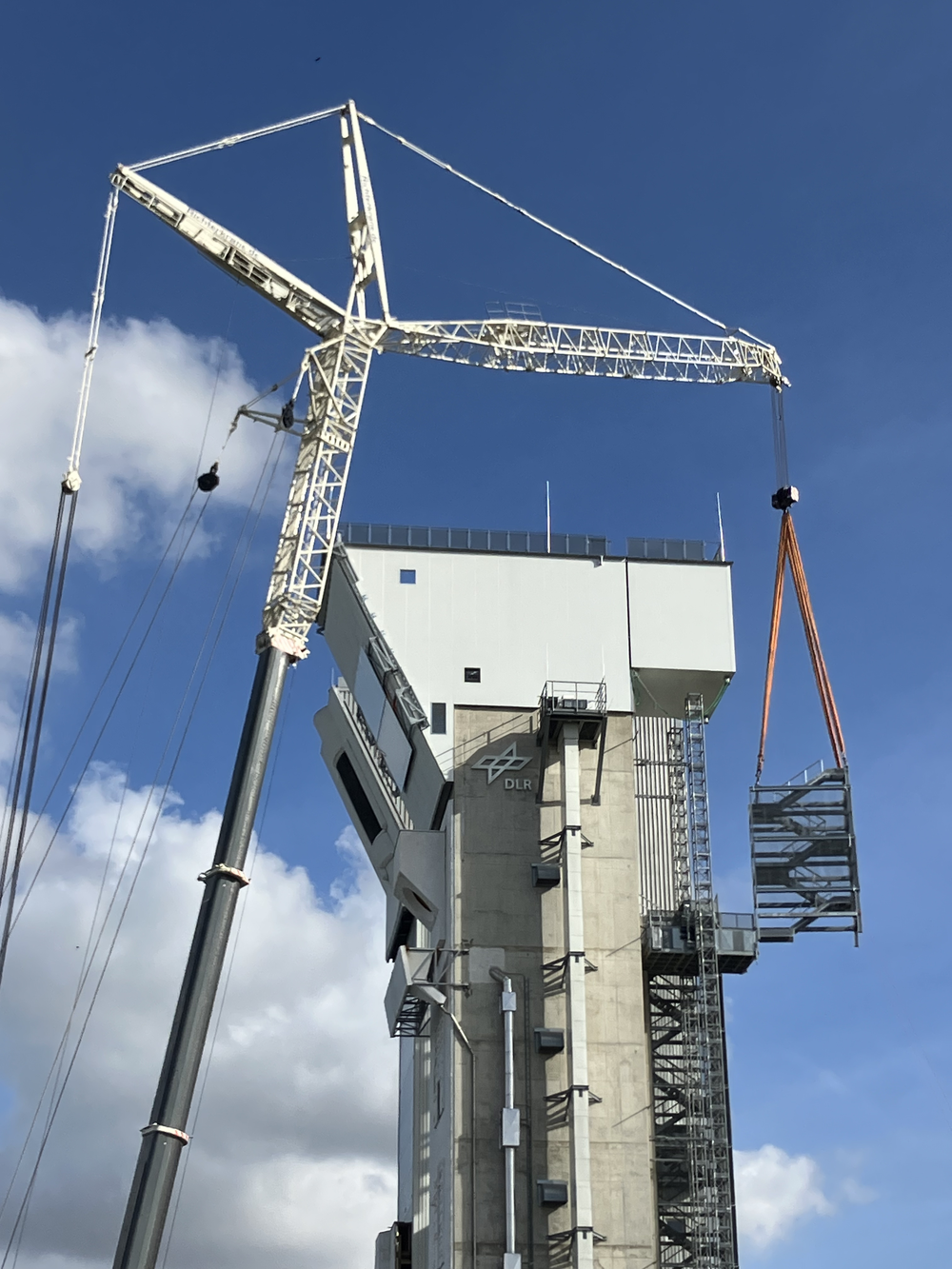
Furthermore, two stair towers, each weighing around 16 tonnes, were attached to the sides, and
finally, the roof was sealed with a seven-tonne cover.
This means that the research facility, which is unique in the world, has grown by around eleven metres to a height of approximately 61 metres and is now the same height as the Solar Tower, which houses a solar thermal power plant.
Over the coming months, the interior fit-out of the research floors will be carried out, with commissioning scheduled for 2027.
Key technical specifications:
Output: up to 10 megawatts of peak thermal output at a flux density of more than 2 megawatts per square metre for processes involving temperatures of up to 1,200 degrees Celsius and above.
Dimensions of the test specimens: up to 5.8 metres in diameter, 8 metres in length and weighing 20 tonnes, which can be fed in through a roof opening.
“SunBooster” technology: A combination of an air-cooled secondary concentrator with a surrounding open volumetric receiver and metallic absorber modules to make additional use of solar radiation.
Contact
Dr.-Ing. Kai Wieghardt
Head of Concentrating Solar Technologies Department