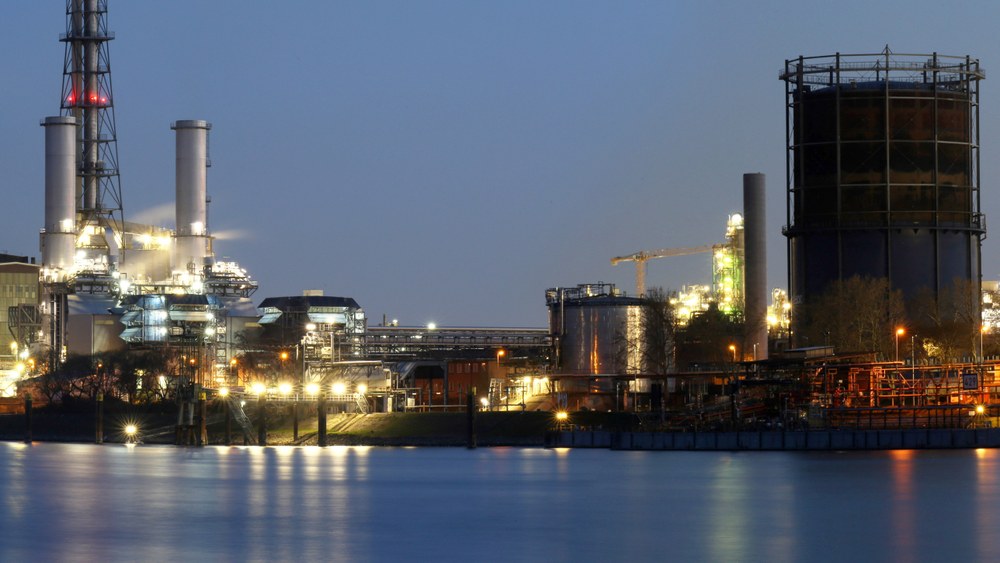
The chemical industry is one of the most energy-intensive sectors. As a leading chemical manufacturing hub, Germany faces the challenge of switching from fossil fuels to renewable energies while ensuring a secure and reliable energy supply. Numerous investments and initiatives are designed to support this transition and create a hotspot for forward-looking chemical technologies.
Solar energy as an environmentally friendly energy source
Solar energy is considered one of the cleanest and most environmentally friendly energy sources. If the chemical industry covers part of its high energy requirements with solar energy, it can significantly reduce its carbon footprint and make a significant contribution to global environmental protection.
The use of solar energy offers not only ecological but also economic advantages. Investments in solar technologies enable long-term cost reductions, create jobs and strengthen the competitiveness of German chemical companies on the global market. Germany is thus positioning itself as a pioneer for forward-looking technologies and attracting international investment.
Technological innovations and hybrid systems
The integration of solar energy requires innovative technologies that increase the efficiency of energy generation and utilisation. Research projects and development initiatives are aimed at optimally integrating solar energy into the production process of the chemical industry and at the same time optimising process sequences.
The integration of hybrid systems consisting of solar energy and other renewable energy sources in conjunction with storage systems is the basis for sustainable production. These systems enable flexible adaptation to the fluctuating availability of solar energy and guarantee a continuous energy supply in the long term, even without the use of fossil fuels.
DLR as an important player in the transformation of the chemical industry
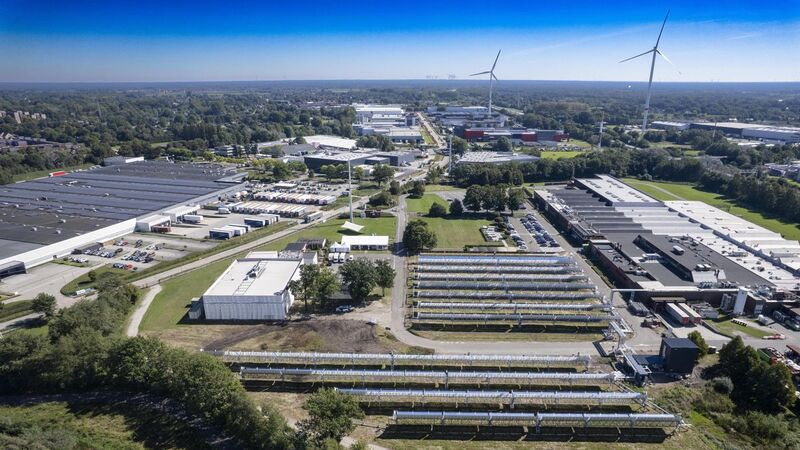
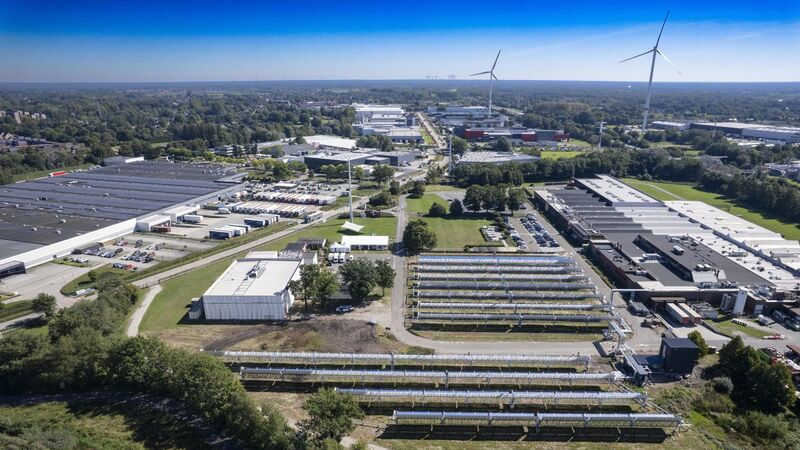
The German Aerospace Center (DLR) is strongly committed to the transformation of the chemical industry in Germany, particularly in North Rhine-Westphalia. An example from Belgium shows how concentrated solar heat can be used to generate process heat. Together with industrial companies, the Institute of Solar Research has developed a transfer station for connecting solar systems and heat storage units to a production facility of the company Avery Dennison. At the Institute of Solar Research, work on the transformation of the chemical industry has been bundled in the Sustainable Systems Process Engineering Department since 2024.
Avery Dennison plant in Turnhout/Belgium with parabolic trough system
Avery Dennison, a leading global supplier of self-adhesive materials and technologies, obtains part of its process heat for production in Turnhout, Belgium, from a parabolic trough solar field. The Institute of Solar Research was involved in the development of the power transfer station, which connects the solar field with the storage system and production.
Thanks to its close collaboration with experts from industry and its focus on sustainable technologies, the DLR is positioning itself as a key player in the transformation of the chemical industry. This not only contributes to the reduction of greenhouse gas emissions, but also strengthens Germany's competitiveness in the global context of green chemistry.
Contact
Dr.-Ing. Jana Stengler
Head of Sustainable Systems Process Engineering Department