5G solutions for efficient solar thermal power plants
Duration: 1.1.2022 - 30.6.2024
Solar tower power plants are extremely complex systems with thousands of movable mirrors, known as heliostats, which are distributed over several hectares of land. As these mirrors have to be controlled individually, many kilometres of cable are required for data communication and power supply. This is very complex and cost-intensive, which is why engineers have long been working on the development of wireless heliostat fields.
In addition to traditional mobile communications, the new 5G standard primarily addresses communication between machines in the industrial sector. With very high data rates, low latency and the capacity for enormous numbers of participants, the 5G standard is intended to enable the expansion of the Internet of Things (IoT).
The aim of this research and development (R&D) project was therefore to investigate whether the new 5G mobile communications standard is suitable for wireless communication with heliostats and thus whether a self-sufficient, wireless heliostat can be realised.
5G campus network
Together with project participants from industry and academia, the Institute of Solar Research established and operated a private 5G campus network at the DLR Solar Towers Jülich from 2023 until the end of 2024. The project team was able to acquire a locally exclusive mobile communications licence for the 3.7 to 3.8 gigahertz spectrum from the German Federal Network Agency. This is possible because Europe is among the global pioneers in authorising private 5G campus networks, with Germany taking a leading role within Europe.
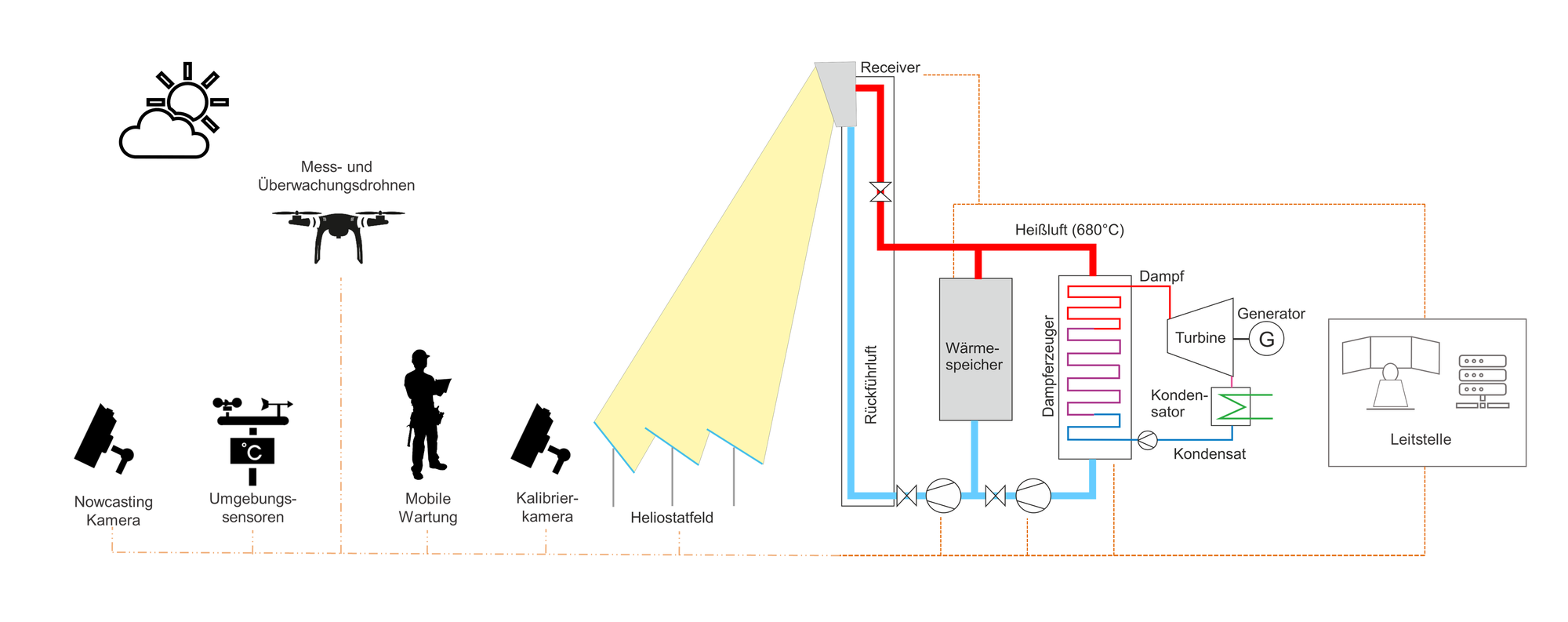
Graphical representation
Networking of all system components in a solar tower power plant.
To investigate the feasibility of this, the project team retrofitted eleven of the 2,000 heliostats in the Jülich solar field with 5G modems and connected them to the central control system via a mobile network. As further use cases, the team integrated an IP surveillance camera, a maintenance technician's tablet and the camera of a measurement drone into the mobile network.
In test operation in the year 2023, the project team was able to measure the signal strength, data rates, latency and reliability of 5G communication and compare it with the wired solution. In addition, TU Dortmund University has created a channel model for radio communication that describes the signal attenuation in the heliostat field as a function of location. Using this channel model, a team from TU Dortmund University can simulate wireless communication in an environment with heliostats made of glass and steel.
Scaling for commercial systems
Commercial tower power plants have heliostat fields with several thousand to more than 50,000 mirrors. Using complex simulations, TU Dortmund University was able to prove that 5G mobile radio can enable robust communication for heliostat arrays with over 60,000 mirrors.
Together with the project participants from industry, the institute estimated the costs of a wireless heliostat field with communication via 5G radio and energy supply from individual PV battery systems and compared them with those of a conventionally wired field. The project team was able to determine that the cost savings of the wireless solution – depending on the assumptions – is between 15 and 30 per cent. The "5hine" project was thus able to show that a significant reduction in the costs of solar tower systems can be achieved with radio-controlled wireless heliostats.