Innovative process chain for the production of printing rollers with sub-µm surface structuring for more efficient solar energy conversion and production of green hydrogen
Duration: 03.05.2024 - 30.04.2027
In order to be able to use renewable energies on a large scale in the future, the generation and use of solar energy must be further optimised. This includes both the production of individual components and their efficient operation.
This is where the Roll2Sol project comes in, focussing on two key areas of application for the technologies developed: increasing the efficiency of hydrogen production from ammonia through improved photocatalytic coatings and developing dirt-repellent films and self-cleaning coatings to maintain the long-term performance of solar collectors.
Anti-soiling structures on dirt-repellent films for solar collectors
The soiling of solar cells currently leads to considerable economic losses, estimated at around five to seven billion dollars per year. Anti-soiling structures prevent water, dust and dirt from adhering to the surface of solar collectors.
A special feature of the self-adhesive films investigated in the Roll2Sol project is their special surface structure, which consists of elements in the sub-micrometre range, i.e. they must be smaller than one micrometre (μm). The ultimate goal is 0.5 μm, which is around 100 times thinner than a human hair. The innovative aspect of the project lies in the proposal to use roll-to-roll printing roller technology to form such small structures on polymer films, which can then be transferred to solar collectors. This method significantly minimises the cost of producing structured films compared to alternative technologies.
Innovative process chain for the micro- and nanostructuring of printing rollers
The project consortium has set itself the goal of developing an innovative process chain for the micro- and nanostructuring of printing rollers. A technique is used that utilises a newly developed laser and subsequently etches the material with plasma. The aim is to produce smaller structural features of less than 0.5 µm, with a surface roughness (Ra) of less than 50 nanometres (nm) and steeper edge angles than with conventional laser processes. The printing rollers produced in this way can be used in the production of functional nanostructured continuous films.
In the consortium, research institutes and companies work closely together to drive forward the necessary research and development. The main objectives and approaches include
identify optimum process chains for mould structuring,
develop a new fs laser with a wavelength of 258 nm,
develop multi-beam optics,
integrate developed multi-beam optics into the cylinder structuring system,
develop new UV coatings,
develop nanoimprint collectors customised to the coating,
set up a NIL-R2R system,
develop the processes for film production and
validate the films produced in field trials and in the laboratory.
The Institute of Solar Research at the German Aerospace Center (DLR) is responsible for three areas in Roll2Sol. DLR is jointly responsible for the development of dirt-repellent films. It is concerned with the selection of film materials and the geometric shape of their surface structure in order to guarantee optimum anti-reflective and anti-soiling properties for the surfaces of photovoltaic collectors. The possibility of improving the antistatic properties of the films in order to reduce the attraction of dust particles is also being investigated.
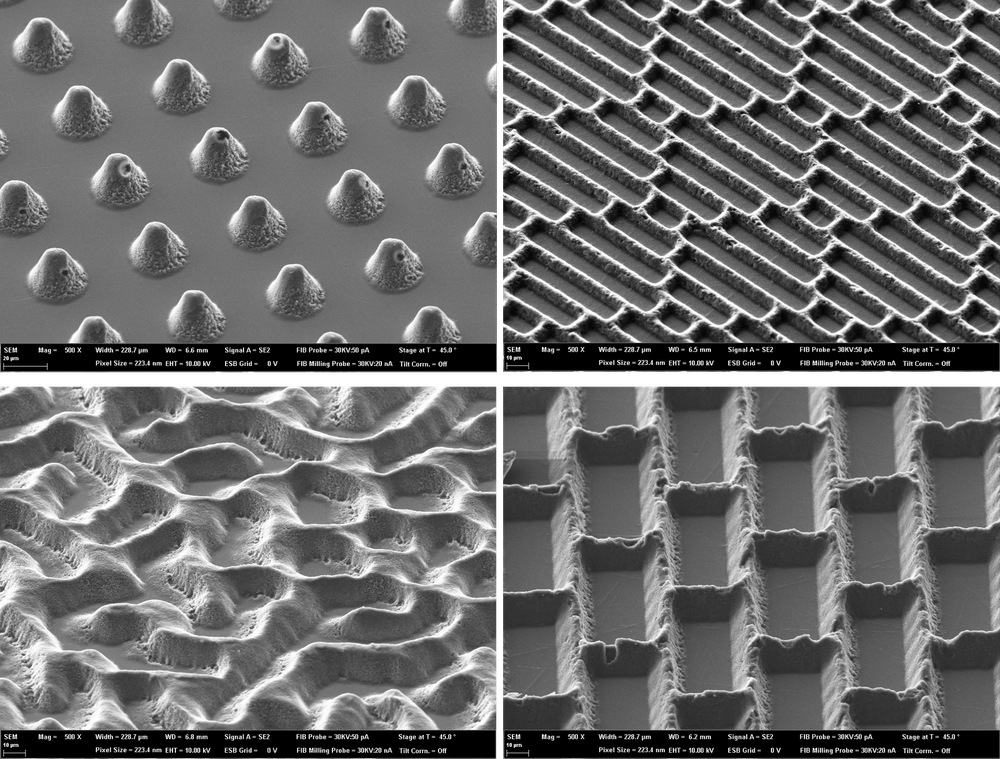
Examples of tested surface texturisations in the outdoor test stand
Light transmission and wetting of water droplets were also investigated. The samples were manufactured by the Roll2Sol project partners (https://roll2sol.de/).
The DLR is initially investigating how much radiation the anti-soiling structures produced allow to pass through and how much of the surface is wetted on contact with liquid droplets. The project team then carries out various ageing tests with the samples in climatic chambers and the specially developed sandstorm chamber, which correlates to field exposure in desert locations in Morocco. The ageing is determined by comparing the previously recorded values and the dirt adhesion in the accelerated dusting chamber.
Tests of anti-soiling films in Spain
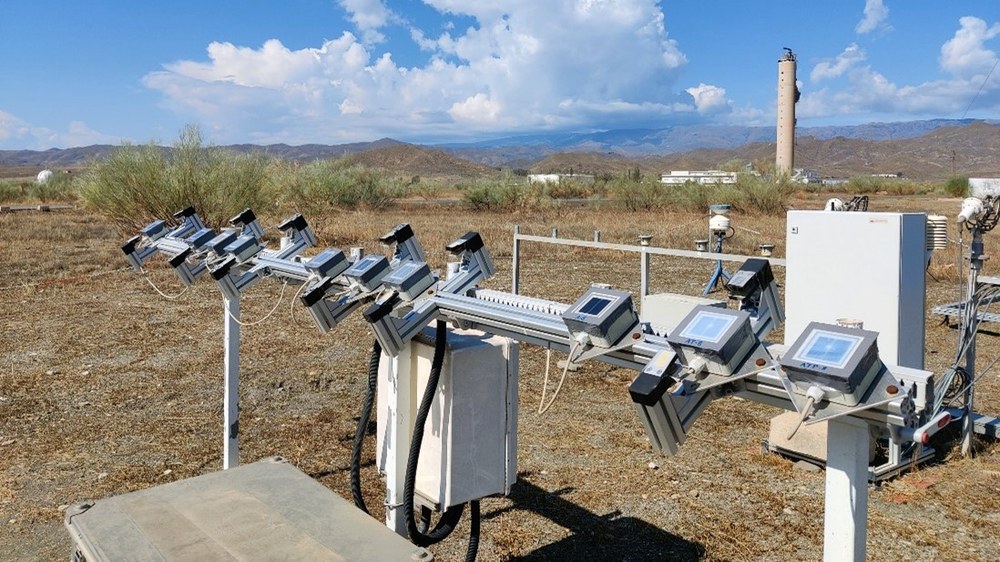
Parallel to the laboratory tests, the anti-soiling films are exposed at the Plataforma Solar de Almería (PSA), Spain (the owner of the PSA is the Spanish research centre CIEMAT). Dirt deposition will be measured there under relevant operating conditions in a desert environment. The company Phytonics will apply the anti-soiling layer to six sample glasses of typical PV module size. The exposed samples will be optically measured in the laboratory at two-week intervals and compared with uncoated reference samples in order to qualify the performance gain of the anti-soiling layer.
Roll2Sol and the various project participants from North Rhine-Westphalia have the overarching goal of establishing a complete value chain in the state. Under the industry funding programme, Schepers GmbH & Co. KG from Vreden, the Fraunhofer Institute for Laser Technology ILT from Aachen, EdgeWave GmbH from Würselen, Coatema Coating Machinery GmbH from Dormagen, Polyscale GmbH & Co. KG from Aachen, Gesellschaft für Angewandte Mikro- und Optoelektronik mbH (AMO GmbH) from Aachen and Phytonics GmbH from Karlsruhe (associated) with the German Aerospace Center in Jülich.
Credit:
Roll2Sol
Further information can be found on the project website: